Intermediary Bank Fees On Business Payments: OUR, SHA and BEN Explained
Intermediary bank fees occur when a payment passes through one or more correspondent banks before reaching the beneficiary. Understanding these charges alongside your selected charge instruction (OUR, SHA, or BEN) helps businesses ensure suppliers receive the correct payment amount.
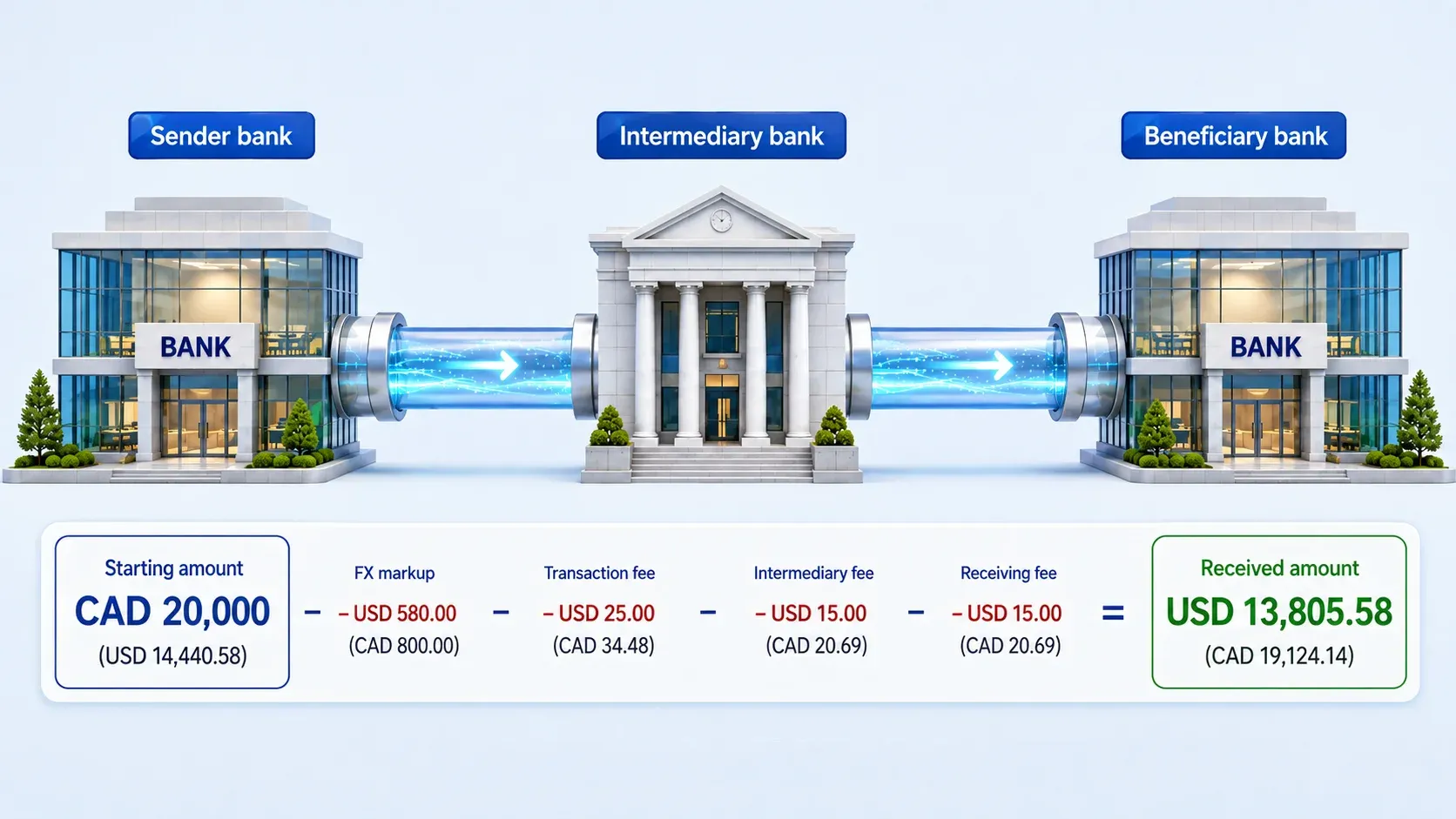
An intermediary bank fee is a charge applied by a bank that helps route an international payment between the sender’s bank and the recipient’s bank. Depending on the charge instruction, OUR, SHA or BEN, the sender, recipient or both may bear these charges. That is one reason an overseas supplier can receive less than the amount your business sent.
Overview:
- OUR, SHA and BEN allocate bank charges. They do not explain the exchange-rate markup.
- The advertised transfer fee is only one part of the cost. The amount debited and the amount credited both matter.
- An estimate should use a range. The actual route and every participating bank’s charge may not be known in advance.
This guide is for Canadian business owners, CFOs and accounts payable teams managing international invoices. It explains where deductions can occur, how OUR, SHA and BEN work, what to check when a payment arrives short, and how to estimate the payment’s total cost before approving the next transfer.
What is an intermediary bank fee?
An intermediary bank fee is a charge from a bank that handles an international payment on its way to the beneficiary bank. An intermediary may be needed when the sending and receiving banks do not have a direct settlement relationship or when the payment currency requires another bank in the chain.
Some payments travel directly between the sending and beneficiary banks. Others pass through one or more intermediary banks. Each participating institution may process the payment under its own agreement, applicable scheme rules and the selected charge instruction. Although the terms are often used interchangeably, there is a subtle distinction:
Correspondent bank: Typically refers to a bank that has an ongoing relationship with another financial institution, helping it provide services across different markets.
Intermediary bank: Usually refers to a bank involved in routing a specific payment between the sender’s and recipient’s banks.
SWIFT’s overview of correspondent banking provides further context on how banks connect across markets.
It is also worth separating the payment network from the fee. SWIFT provides standardized financial messaging; the banks or payment providers involved in the transaction apply the charges. An international wire may pass through the sending institution, one or more intermediary banks and the beneficiary bank, making accurate payment instructions and banking details essential at every stage.
Why did the recipient receive less than the business sent?
A recipient can receive less because an intermediary bank or beneficiary bank deducted a charge, or because currency conversion changed the amount credited. The sending bank’s fee may instead be added separately to the amount debited from the business account.
The first step is to separate the possible costs rather than treating the entire difference as one “wire fee.”
Consider a Canadian importer paying a USD 40,000 invoice. The business may see a CAD debit that includes the converted principal and a visible sending fee. The supplier may then see only USD 39,965 because a bank in the route deducted USD 25 and the beneficiary bank charged USD 10. The invoice remains USD 35 short even though the sender released the correct principal.
That small difference creates more work than its value suggests. Accounts payable must investigate it, the supplier may ask for a top-up, and the second payment can create another fee. Repeated shortfalls can also affect landed cost, margins, cash-flow forecasting and the supplier relationship.
Intermediary deductions are only one part of the full cost of a cross-border payment. Exchange-rate pricing, visible transfer fees and timing costs should be assessed separately so the same expense is not counted twice.
| Field | Value |
|---|---|
Amount Payable (USD) 30,000 | |
Bank Exchange Rate 1.4495 / 0.6899 | |
Total cost 43,484.44CAD |
| Field | Value |
|---|---|
Amount Payable (USD) 30,000 | |
MTFX Exchange Rate 1.4246 / 0.7019 | |
Total cost 42,738.38CAD |
You Save
CAD 746.06
with MTFX
13 October 2026
We use mid-market rates. This is for informational purposes only. Log in to view send rates.
What is the difference between OUR, SHA and BEN charges?
OUR, SHA and BEN tell participating institutions how transaction charges are intended to be allocated. They do not reveal the exchange rate, identify the complete bank route or guarantee the final amount credited.
Businesses may still see OUR, SHA and BEN in bank portals and payment documents. In bank-to-bank messages, the corresponding charge-bearer values are DEBT, SHAR and CRED. SWIFT’s application profile reference shows these mappings.
This distinction matters because cross-border payment instructions now use ISO 20022 as the global standard. SWIFT reports that the coexistence period with the older MT format ended on 22 November 2025, although businesses may continue to encounter familiar legacy labels in portals and supporting documents. The SWIFT ISO 20022 overview explains the transition and its role in carrying richer payment data.
You may also see SLEV, which means the charges follow the selected payment service or scheme rules. In that situation, the rail’s rules can determine the treatment instead of giving the sender a free choice among OUR, SHA and BEN.
Which charge instruction should a business use?
There is no universal winner. The right instruction depends on the invoice terms, payment route, currency, provider and the amount the supplier is expected to receive.
- Consider OUR when the supplier must receive the invoiced amount. Confirm that the option is supported for the currency and corridor, and ask how the provider handles fees that arise later in the route.
- Use SHA when the commercial agreement intentionally shares costs. The sender generally pays its own fee, while other charges may affect the amount received.
- Use BEN only when the beneficiary has agreed to absorb the charges. Otherwise, the recipient may reasonably treat the payment as incomplete.
- Follow the applicable service-level rule when it overrides the choice. Some domestic or regional payment schemes prescribe how charges are handled.
The fee instruction should match the contract or invoice. SWIFT’s market practice guidance on international payment charges also notes that local practices and bilateral agreements can affect how charging codes are applied. That is why OUR should be treated as an instruction, not an unconditional promise.
How do intermediary fees change a supplier payment?
The easiest way to understand the difference is to apply all three instructions to the same payment. The following example uses a USD balance so currency conversion does not distract from the bank-fee flow.
Example assumptions
- Supplier invoice: USD 25,000
- Sending-bank or provider fee: USD 25
- Estimated intermediary fee: USD 15–35
- Beneficiary-bank fee: USD 10
- All values are illustrative and stated in USD
These numbers are not a prediction of what a particular bank will charge. They simply show how the same assumed fees move between the sender and recipient under different instructions.
For a finance team, the practical question is not just, “What did it cost us to send?” It is also, “What did the supplier receive, and will the invoice close without a second payment?”
Can an OUR payment still arrive short?
Yes. OUR indicates that the sender is intended to bear the transaction charges, but it does not guarantee that the recipient will receive an exact amount in every corridor or circumstance.
The payment can still arrive short when:
- The provider or route does not support OUR as expected.
- A local payment scheme applies its own service-level rule.
- The beneficiary bank charges a separate account or local processing fee.
- The recipient’s bank converts the funds into another currency.
- Incomplete or incorrect instructions trigger an exception or repair charge.
- A bank in the chain applies local practice differently from the originating instruction.
That does not make the instruction meaningless. It means the sender should confirm how OUR is implemented for the specific payment instead of assuming that one three-letter code settles every possible charge.
Timing and investigation can also depend on cut-off times, time zones, compliance checks and the banks involved. Cut-off times, time zones, compliance checks and intermediary processing can all affect how long an international SWIFT transfer takes.
What should a finance team do when an international payment arrives short?
Start with the payment records, not an assumption about which bank caused the difference. A structured investigation makes it easier to separate FX conversion from bank fees and gives both parties a common set of numbers.
- Compare the instructed and credited amounts in the payment currency.
Confirm the amount your business instructed and the amount the supplier’s bank credited. If the records show different currencies, convert them on a consistent basis before calculating the shortfall. - Separate FX conversion from bank deductions.
Check the agreed rate, payment currency and beneficiary account currency. A conversion difference is not automatically an intermediary fee. - Review the charge-bearer instruction.
Look for OUR, SHA or BEN, or the equivalent DEBT, SHAR or CRED value, on the payment confirmation or provider record. - Ask the sending provider to trace the payment.
Request the route and deduction information available from the institutions involved. Some businesses may still hear the legacy term MT103 or Field 71A, but payment confirmation, charge-bearer information and a trace are more current and complete requests. - Ask the supplier for the credit advice.
The beneficiary bank’s record can identify an incoming fee or local currency conversion that is not visible on the sender’s receipt. - Reconcile the invoice and agree on the remedy.
Record the deduction correctly and determine whether the contract requires a top-up. If another payment is necessary, agree on the fee treatment first so the second transfer does not arrive short as well. - Set the next payment’s net-receipt expectation in advance.
Confirm the invoice currency, amount that must arrive, charge instruction and party responsible for any residual difference.
If your business is the recipient rather than the sender, local receiving details or a multi-currency collection arrangement may help reduce reliance on cross-border wires for some customer payments. For businesses receiving money from overseas customers, global collections with local account details and multiple currencies can offer an alternative to relying on a traditional cross-border wire for every payment.
How can businesses reduce unexpected intermediary-bank deductions?
The realistic goal is not to promise that every intermediary fee can be avoided. It is to make the amount, currency, route and fee responsibility clear before the payment leaves the account.
Put the net amount in writing
State whether the invoice amount is gross or must arrive net of bank charges. If the supplier expects USD 50,000 in its account, “USD 50,000 payment” may not be specific enough. The agreement should identify who bears sending, intermediary and receiving fees.
Invoice terms, the supplier’s preferred currency and the selected payment method all influence how a business pays overseas suppliers.
Confirm the route and available charge options
Ask the provider which fee instructions are supported for the destination, currency and payment method. If the payment follows a scheme-specific rule, find out whether the sender can choose a different option.
Validate the beneficiary instructions
Confirm the account name, bank identifier, account number or IBAN, account currency and payment purpose. Clean instructions support straight-through processing and reduce the chance of a manual repair.
Compare the sender debit and recipient outcome
A low sending fee can be misleading if the recipient later requests a top-up. Compare the rate, visible fee, estimated deductions and expected recipient amount as one decision.
Consider suitable local payment routes
Where a provider offers an appropriate local route or local-currency delivery option, it may produce a simpler and more predictable payment path. Availability and economics vary, so compare the actual route rather than assuming local delivery is always cheaper.
Standardize recurring payment controls
For regular suppliers, store approved payment details, document the agreed fee instruction and review deductions by beneficiary and corridor. Patterns become much easier to spot when the data is consistent.
Plan the FX side separately
Intermediary fees and exchange-rate costs are different, but both affect the economics of an international invoice.
- Check current market levels using MTFX live exchange rates and estimate the currency amount with the currency converter.
- Review recent movements on the currency charts or use historical exchange rates when reconciling a past payment.
- For near-term planning, follow the daily USD/CAD outlook or the weekly Canadian dollar forecast. Forecast ranges are planning inputs, not guaranteed market levels.
- Monitor scheduled data and central-bank decisions with the economic calendar, then set a currency rate alert if your payment has a target conversion level.
Compare FX rates and save on fees for business payments.
For material or recurring exposures, the payment schedule may also warrant a documented business FX risk management approach rather than relying on a single spot-rate decision.
How should a business compare the total cost of an international payment?
Compare the amount debited from the business, the amount expected to reach the recipient, the exchange rate and every known or estimated fee. An advertised transfer fee alone does not reveal the full economic cost.
Use the same payment amount, currency pair, and quote time when comparing a bank with an online international payment provider.
Suppose Bank A quotes no transfer fee but converts CAD 100,000 at a rate that produces USD 70,200. Provider B charges CAD 25 but its rate produces USD 70,850. If both estimate the same downstream deductions, Provider B leaves the recipient with USD 650 more before its CAD 25 fee is considered. The visible fee alone would have pointed to the wrong conclusion.
That example is intentionally simple. A real comparison should use live quotes captured at nearly the same time. A meaningful cost comparison starts with the destination-currency amount produced by a current exchange rate comparison. It should also account for bank exchange rate markups, which can outweigh a visible flat transfer fee.
If a short payment forces the business to send a top-up, include the additional fee and administrative work in the review. Do not add the original deduction twice: once as a bank fee and again as a shortfall. The point is to compare the complete outcome, not inflate it.
How MTFX helps businesses compare the full payment outcome
A successful international payment should settle the commercial obligation at a cost the business understands. That means considering the full payment journey, not just the outbound transfer fee.
Review the Total Payment Cost
Finance teams should consider the exchange rate, total sender debit, possible intermediary deductions, expected recipient amount and whether a follow-up payment may be needed to close the invoice.
Confirm the Payment Setup
MTFX brings currency conversion and payment execution into one business workflow. Before releasing funds, teams can review the payment currency, validate beneficiary details and confirm the available payment setup against the supplier’s invoice terms.
Compare the Exchange Rate
When conversion is required, the live currency converter provides a current mid-market reference point. Teams can compare it with the customer rate, then factor in the transfer fee and known or estimated bank deductions to assess the likely economic cost.
Plan for Recipient-Side Charges
If a specific net amount must arrive, an MTFX currency specialist can clarify the available options for the currency and destination. When intermediary or receiving-bank charges cannot be confirmed in advance, the business can budget for a reasonable range rather than rely on a falsely precise recipient amount.


Make the amount received part of the payment decision
Intermediary bank fees are easy to overlook because the sender may not see the deduction on its own receipt. The problem appears later, when the supplier reports that the invoice was paid short.
OUR, SHA and BEN help define who is intended to bear transaction charges, but the instruction is only one part of a sound payment decision. Finance teams should also confirm the currency, expected recipient amount, exchange rate, provider fee and process for tracing deductions.
When those details are agreed before release, reconciliation is easier, and supplier conversations are clearer. Use a range-based estimate, document the net-receipt requirement and compare the total payment cost before the next international invoice is due. Register with MTFX and get better exchange rates compared to tradational banks.
FAQs
1. What is an intermediary bank in an international wire transfer?
An intermediary bank is a bank that helps route or settle a payment when the sender’s and recipient’s banks do not exchange the funds directly. It may process the payment between those institutions and can apply a charge according to the route, fee instruction and relevant banking agreements.
2. Does every international payment use an intermediary bank?
No. Whether an intermediary is needed depends on the banks, currencies, payment rail and available settlement relationships. A direct or local payment route may not require one, while another payment to the same country could use one or more intermediaries because it involves a different currency or beneficiary bank.
3. How much do intermediary banks charge?
There is no universal intermediary-bank fee. The amount can vary by bank, currency, corridor, payment route, account arrangement and fee instruction. Because the route may not be known in advance, businesses should use a clearly labelled range and confirm any available estimate with the payment provider.
4. Who pays intermediary bank fees?
The intended payer depends on the charge instruction. Under OUR, the sender is intended to bear the transaction charges. Under SHA, charges are shared under the applicable arrangement. Under BEN, the beneficiary bears the charges. Local scheme rules, provider terms and banking agreements can still affect the actual treatment.
5. Which option should a business use when a supplier must receive the full invoice amount?
OUR may be appropriate when the supplier must receive the instructed invoice amount, provided the option is supported for that payment. The business should confirm the provider’s terms, route and treatment of beneficiary or local charges rather than assuming OUR guarantees the final credit in every circumstance.
6. Can a recipient still receive less with OUR charges?
Yes. OUR is a charge-allocation instruction, not an unconditional guarantee. An unsupported route, local scheme rule, beneficiary-bank charge, currency conversion or payment exception can still affect the amount credited. Confirm the expected recipient amount and available fee treatment before releasing a time-sensitive or exact-value payment.
7. Is a correspondent bank the same as an intermediary bank?
The terms overlap and are often used interchangeably. “Correspondent bank” commonly refers to an ongoing relationship or account arrangement between financial institutions, while “intermediary bank” often describes a bank used in a particular payment path. The precise wording can vary among banks and payment providers.
8. Do I need to provide intermediary bank details?
Not always. The sending bank or provider may select the route based on the currency and beneficiary bank. However, some beneficiary instructions specify a correspondent or intermediary bank. Follow the recipient bank’s complete instructions and confirm any uncertainty before sending, because incorrect routing information can cause delays or repairs.
9. How can I find out which bank deducted a fee?
Compare the payment confirmation with the recipient’s credit advice, then ask the sending provider for the charge-bearer information and a payment trace. Those records may show the institutions involved and available deduction details. Avoid relying only on the sender’s account debit, which may not show charges taken later in the route.
10. Are intermediary fees the same as an exchange-rate markup?
No. An intermediary fee is a bank charge associated with the payment path. An exchange-rate markup is part of the price used to convert one currency into another. Both affect the payment’s economics, but they should be calculated and displayed separately to avoid double counting or misdiagnosing a shortfall.