CAD to USD Business Payments: How to Reduce FX Risk and Lower Costs
Canadian businesses making CAD to USD payments need more than a good exchange rate. This guide explains how provider fees, payment timing, exchange-rate movement, and FX tools such as rate alerts and forward contracts can affect USD supplier payments, cash flow, and margins.
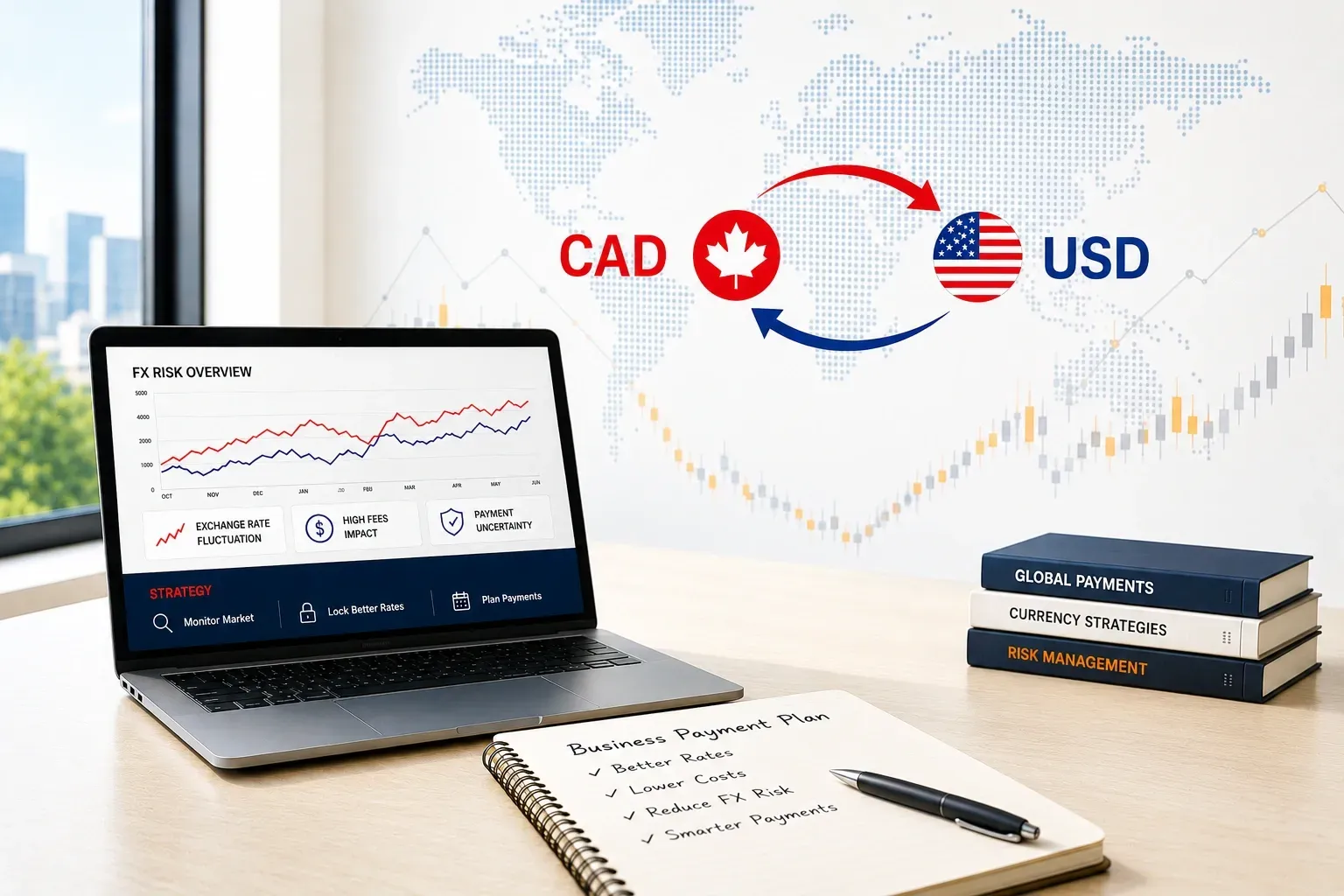
Canadian businesses that regularly convert CAD to USD should look beyond the exchange rate they see online. The real cost of a USD payment depends on the rate your provider gives you, transfer fees, bank markups, payment timing, and how well your business manages currency risk.
This matters most when your company earns in Canadian dollars but pays US suppliers, vendors, contractors, software providers, freight partners, or overseas teams in USD. Even a small move in the CAD to USD exchange rate can change the final cost of a large invoice.
Quick overview: Canadian businesses can reduce CAD to USD payment costs by comparing the full CAD cost of each transfer, avoiding hidden exchange-rate markups, planning payments before invoice deadlines, and using FX tools where appropriate. For known future USD payments, forward contracts and rate alerts can help reduce uncertainty and protect business budgets.
For businesses making one-off or recurring USD payments, the goal is not just to “find a better rate.” It is to protect cash flow, reduce unnecessary fees, and make payment costs easier to forecast. That is where a clear currency risk management strategy can help.
Why do CAD to USD payments create FX risk for Canadian businesses?
CAD to USD payments create FX risk when a Canadian business has costs in USD but earns, budgets, or reports in CAD. If the Canadian dollar weakens before a payment is made, the same USD invoice becomes more expensive in Canadian-dollar terms.
This is common for Canadian companies that:
- Buy inventory from US suppliers
- Pay logistics, freight, or customs-related partners in USD
- Use US-based software or subscription platforms
- Pay contractors, consultants, or agencies in the US
- Import equipment, raw materials, or finished goods
- Maintain recurring USD obligations while earning revenue in CAD
The US remains a major market for Canadian businesses. The Trade Commissioner Service notes that Canada exported $699.4 billion in goods and services to the US, which explains why CAD to USD planning is such a regular issue for Canadian companies doing cross-border business.
Here is a simple example.
A move from 1.35 to 1.42 may not look dramatic on a chart, but on a US$50,000 supplier invoice, it can add about C$3,500 to the cost. For businesses with thin margins or frequent USD payments, that can quickly affect profitability.
What affects the CAD to USD exchange rate?
The CAD to USD exchange rate moves because of interest rates, inflation data, oil prices, trade headlines, US dollar strength, and broader market sentiment. Businesses do not need to predict every move, but they should understand why the rate can change between invoice approval and payment date.
Key drivers include:
- Bank of Canada and Federal Reserve policy: Interest-rate expectations can shift demand for CAD and USD.
- Inflation and jobs data: Strong or weak economic reports can move currency markets quickly.
- Oil and commodity prices: Canada’s dollar often reacts to commodity market trends.
- Canada-US trade news: Tariffs, supply-chain issues, and trade-policy changes can affect confidence.
- US dollar strength: When global investors favour the US dollar, CAD can come under pressure.
- Risk sentiment: During uncertain periods, markets often move toward safe-haven currencies.
For day-to-day planning, businesses can monitor live exchange rates, review currency charts, and follow the latest Canadian dollar forecast to understand how CAD is moving against major currencies.
The Bank of Canada also provides a daily exchange rate lookup tool, but it notes that its exchange rates are indicative rates based on averages of aggregated price quotes from financial institutions. That makes them useful for reference, but not necessarily the exact rate a business will receive when making a payment.
| Field | Value |
|---|---|
Amount Payable (USD) 20,000 | |
Bank Exchange Rate 0.6918 / 1.4456 | |
Total cost 28,911.29CAD |
| Field | Value |
|---|---|
Amount Payable (USD) 20,000 | |
MTFX Exchange Rate 0.7038 / 1.4208 | |
Total cost 28,415.26CAD |
You Save
CAD 496.03
with MTFX
16 October 2026
We use mid-market rates. This is for informational purposes only. Log in to view send rates.
Is timing CAD to USD payments enough to reduce risk?
Timing can help, but it is not a complete FX risk strategy. If your business has flexibility, waiting for a better rate or using a target-rate tool may reduce costs. If the invoice is fixed and due soon, waiting too long can create more uncertainty.
For example, suppose your business has a US$75,000 supplier invoice due in 45 days. If CAD weakens by just three cents before the payment is made, the final CAD cost could rise by more than C$2,000.
That is why payment timing should be treated as part of a broader plan, not a guessing game.
Businesses can use historical currency trends to understand recent CAD/USD movement, but past rates do not guarantee future direction. The practical goal is to make better-informed decisions before payment pressure builds.
Protect your profit margins with a clear hedging strategy.
How do banks and online FX providers compare for CAD to USD business payments?
Banks are convenient, but they may not always offer the most cost-effective or flexible option for CAD to USD business payments. Business-focused FX providers can often provide more transparent exchange rates, lower transfer friction, and tools designed for recurring or larger international payments.
The main difference is not only the transfer fee. It is the total amount your business pays in CAD to deliver the required USD amount.
For Canadian businesses, the better question is not “Which provider has the lowest fee?” It is “Which provider gives us the best total CAD cost, the right payment speed, and enough visibility to manage USD exposure properly?”
MTFX supports international business payments for companies that need to pay suppliers, vendors, contractors, and business partners across borders without relying only on traditional bank wires.
What fees affect CAD to USD business payments?
The main costs are the exchange-rate spread, transfer fee, wire fee, intermediary bank charges, and any receiving-bank fees. The exchange-rate spread is often the biggest cost because it is built into the rate rather than shown as a separate line item.
A business should compare the final CAD cost, not just the visible transfer fee.
For example:
Provider B may appear inexpensive if the transfer fee is low, but the exchange-rate difference can still cost the business C$1,500 more on a US$100,000 invoice.
Common CAD to USD payment costs include:
- Exchange-rate markup: The difference between the market rate and the customer rate.
- Transfer fee: A fixed or variable fee for sending the payment.
- Wire fee: A bank charge for processing wire transfers.
- Intermediary bank fee: A fee from banks involved between sender and recipient.
- Receiving fee: A fee charged by the recipient’s bank.
- Timing cost: The extra CAD cost created if the rate moves before payment.
For larger invoices, even a small exchange-rate difference can matter more than the visible fee.
How can businesses reduce CAD to USD payment costs?
Businesses can reduce CAD to USD payment costs by comparing customer rates, avoiding hidden markups, planning payment timing, using rate alerts, and choosing payment methods that match the size and urgency of the transfer.
Here are practical ways to control costs:
- Compare the final CAD cost. Do not judge a provider only by the transfer fee.
- Avoid last-minute conversions. Urgent payments reduce your flexibility.
- Use rate alerts. Set target levels so your team knows when the market moves in your favour.
- Review recurring USD invoices. Group predictable payments where possible.
- Check historical trends. Use historical exchange rates to understand recent movement.
- Consider forward contracts. Locking a rate may help when the USD amount and date are known.
- Keep payment records clean. This helps finance teams reconcile costs and review FX impact.
A simple habit can make a big difference: before approving a USD payment, ask, “What is the full CAD cost today, and what happens if the rate moves before we pay?”
Can forward contracts help with CAD to USD business payments?
Yes. A forward contract can help a Canadian business lock in a CAD to USD exchange rate for a future payment. This can make supplier invoices, project costs, and cash-flow forecasts easier to manage.
A forward exchange contract is an agreement to exchange a specific amount of currency at a predetermined rate on a future date. Investopedia describes it as a tool often used to hedge against currency risk in international transactions.
For businesses, the value of a forward contract is certainty. It does not guarantee the best possible future rate. It helps protect the budget from an unfavourable move.
Here is an easy example.
A Canadian importer knows it must pay a US$120,000 supplier invoice in 90 days. The company has quoted its customer in CAD and has limited room to absorb extra costs. If CAD weakens before the invoice date, the company’s margin could shrink.
By using a forward contract, the business can lock in a rate today for that future USD payment. That gives the finance team a clearer CAD cost before the payment deadline arrives.
Forward contracts can be especially useful when the amount, currency, and payment date are already known.
When should a Canadian business consider hedging CAD to USD exposure?
A Canadian business should consider hedging CAD to USD exposure when exchange-rate movement could materially affect margins, pricing, supplier costs, or cash flow.
Hedging does not need to be complicated. It starts with understanding which USD payments are predictable and which ones are flexible.
EDC also highlights the importance of managing FX risk before it affects profits, especially for businesses exposed to international sales or purchases. The same thinking applies to Canadian companies with regular CAD to USD payment needs.
A good starting point is to separate your USD exposure into three groups:
Known payments
These are confirmed invoices or contracts with clear amounts and due dates. They are often the best candidates for forward contracts.
Expected payments
These are likely expenses, such as recurring supplier orders or quarterly software renewals. They may be managed with alerts, staged payments, or partial hedging.
Flexible payments
These are payments that can be moved forward or delayed without affecting operations. Timing tools may be enough for these.
How should businesses plan recurring CAD to USD payments?
Businesses with recurring USD payments should review their exposure, invoice dates, payment amounts, and budget rate before converting CAD to USD.
A simple process can help finance teams stay organized.
1. List your USD obligations
Start by listing supplier invoices, contractor payments, software subscriptions, logistics costs, inventory purchases, and other USD commitments.
This gives your team a clear view of how much USD the business needs each month or quarter.
2. Separate fixed and flexible payments
Some payments have strict due dates. Others can be paid early, delayed slightly, or grouped with other transfers.
Fixed payments may need more certainty. Flexible payments give your business more room to monitor the market.
3. Set a budget exchange rate
Choose a CAD/USD rate that protects your expected margin. This helps your team decide when a rate is acceptable and when action may be needed.
For example, if your product pricing assumes a CAD/USD rate of 1.36 but the market moves to 1.42, your profit margin may be lower than expected.
4. Monitor the market before payment dates
Use live exchange rates, charts, and forecasts to track movement before large payment dates. Businesses that monitor rates early usually have more choices than those that wait until the invoice is due.
The US dollar forecast can also help finance teams understand broader USD themes before planning upcoming payments.
5. Choose the right payment method
Use spot payments for immediate needs. Use rate alerts when timing is flexible. Consider forward contracts when the amount and payment date are known.
The right method depends on payment size, timing, and how much uncertainty your business can tolerate.
6. Review the strategy regularly
FX exposure changes when order volumes, supplier terms, revenue mix, or exchange rates change. A quarterly review can help keep your payment plan aligned with your business needs.
What is the best way to make CAD to USD business payments from Canada?
The best way to make CAD to USD business payments depends on the payment size, frequency, urgency, and level of FX risk. For large or recurring USD payments, a business-focused FX provider can offer more value than simply using a bank out of habit.
A good payment method should help your business answer these questions:
- What is the final CAD cost?
- What exchange rate are we receiving?
- Are there transfer, wire, or receiving fees?
- How quickly will the supplier receive the funds?
- Can we track the payment?
- Can we lock in a rate for a future invoice?
- Can we manage recurring payments efficiently?
- Can we speak with someone who understands business FX needs?
For smaller one-off payments, a bank may be convenient. For recurring supplier payments, high-value invoices, or known future USD obligations, a specialist provider can help reduce friction and improve cost visibility.
Quick decision guide: Use a spot payment when the USD payment is due now. Use a rate alert when payment timing is flexible. Use a market order when your business has a target exchange rate. Consider a forward contract when the USD amount and future payment date are known.
Businesses can also use the currency converter to estimate payment values before sending funds, then compare that with the actual customer rate available when booking a transfer.
How can MTFX help Canadian businesses manage CAD to USD payments?
MTFX helps Canadian businesses send CAD to USD payments, compare exchange rates, reduce payment friction, and manage currency exposure with business-focused FX tools and support.
For companies that regularly pay US suppliers, vendors, contractors, or partners, MTFX can support:
- Competitive CAD to USD exchange rates
- International business payments in 50+ currencies
- Payments to more than 190 countries
- Rate alerts for preferred exchange-rate levels
- Currency charts and historical rate tools
- Forward contracts for future payment planning
- Dedicated account support for business clients
- Secure, FINTRAC-regulated payment services
MTFX is Canadian-based, established since 1996, and built for businesses that need more than a basic wire transfer. Whether your company is paying a single large invoice or managing monthly USD supplier payments, the right FX setup can make costs easier to control.
If your business is reviewing upcoming US payments, MTFX can help you compare CAD to USD rates, plan payment timing, and explore tools that support better FX risk management.


From exchange rate guessing to payment control
CAD to USD business payments are not only about getting a better rate on the day you send money. They are about protecting cash flow, reducing unnecessary fees, and making sure exchange-rate movement does not quietly erode your margins.
A business that pays US invoices without a plan is often reacting to the market. A business that monitors exposure, compares provider costs, sets target rates, and uses tools such as forward contracts when appropriate is in a much stronger position.
Set up your MTFX business account today and manage CAD to USD payments with competitive exchange rates, business-focused support, and FX tools designed for cross-border payment decisions.
FAQs
1. What is CAD to USD FX risk for Canadian businesses?
CAD to USD FX risk is the risk that exchange-rate movement changes the Canadian-dollar cost of a USD payment. If CAD weakens before your business pays a US invoice, the payment becomes more expensive in CAD.
2. How can Canadian businesses reduce CAD to USD payment costs?
Canadian businesses can reduce CAD to USD payment costs by comparing exchange rates, avoiding hidden bank markups, using rate alerts, planning payments early, and choosing a provider that supports business FX needs.
3. Should businesses wait for a better CAD to USD exchange rate?
Businesses can monitor the market when payment timing is flexible, but waiting is not always the right approach. If a supplier invoice has a fixed due date, tools such as rate alerts, staged payments, or forward contracts may provide more control than simply hoping for a better rate.
4. Can businesses lock in a CAD to USD exchange rate?
Yes. Businesses can use a forward contract to lock in a CAD to USD exchange rate for a future payment when the amount and date are known. This can help protect budgets and reduce uncertainty.
5. Are forward contracts useful for US supplier payments?
Forward contracts can be useful for US supplier payments when a Canadian business knows it must pay a specific USD amount at a future date. They help the business confirm the CAD cost in advance instead of waiting for the market rate on payment day.
6. What is the difference between FX fees and FX risk?
FX fees are the provider costs involved in converting and sending money, such as transfer fees or exchange-rate markups. FX risk is the possibility that exchange-rate movement changes the final CAD cost of a USD payment.
7. Is an online FX provider better than a bank for CAD to USD business payments?
An online FX provider may be better for businesses that need competitive rates, clearer pricing, faster support, payment tracking, and FX tools. Banks may still be convenient for simple payments, but businesses should compare the full CAD cost before deciding.
8. How often should businesses review CAD to USD exposure?
Businesses with recurring USD payments should review CAD to USD exposure at least monthly or quarterly. They should also review exposure before signing large supplier contracts, approving major invoices, or setting prices that depend on USD costs.
9. What is the best way to pay US suppliers from Canada?
The best way to pay US suppliers from Canada is to compare the total CAD cost, exchange rate, fees, delivery time, and payment support before sending funds. For large or recurring payments, a business-focused FX provider such as MTFX can help improve transparency and payment planning.
10. Why does the CAD to USD rate matter for business margins?
The CAD to USD rate matters because it affects how much a USD invoice costs in Canadian dollars. If your business prices products in CAD but pays suppliers in USD, a weaker Canadian dollar can reduce margins unless the cost is managed or built into pricing.
Disclaimer: The information in this article is provided for general business and educational purposes only and does not constitute financial, investment, legal, tax, or foreign exchange advice. Exchange rates, fees, payment timelines, and hedging options can vary based on market conditions, provider terms, transaction size, and business requirements.