How to Automate Recurring International Vendor Payments
You can automate recurring international vendor payments by saving supplier details, setting payment schedules, approving invoices in advance, and using a business payment provider that supports foreign currency transfers. This helps Canadian businesses pay overseas suppliers on time, reduce manual work, avoid errors, and manage monthly international invoices with better control.
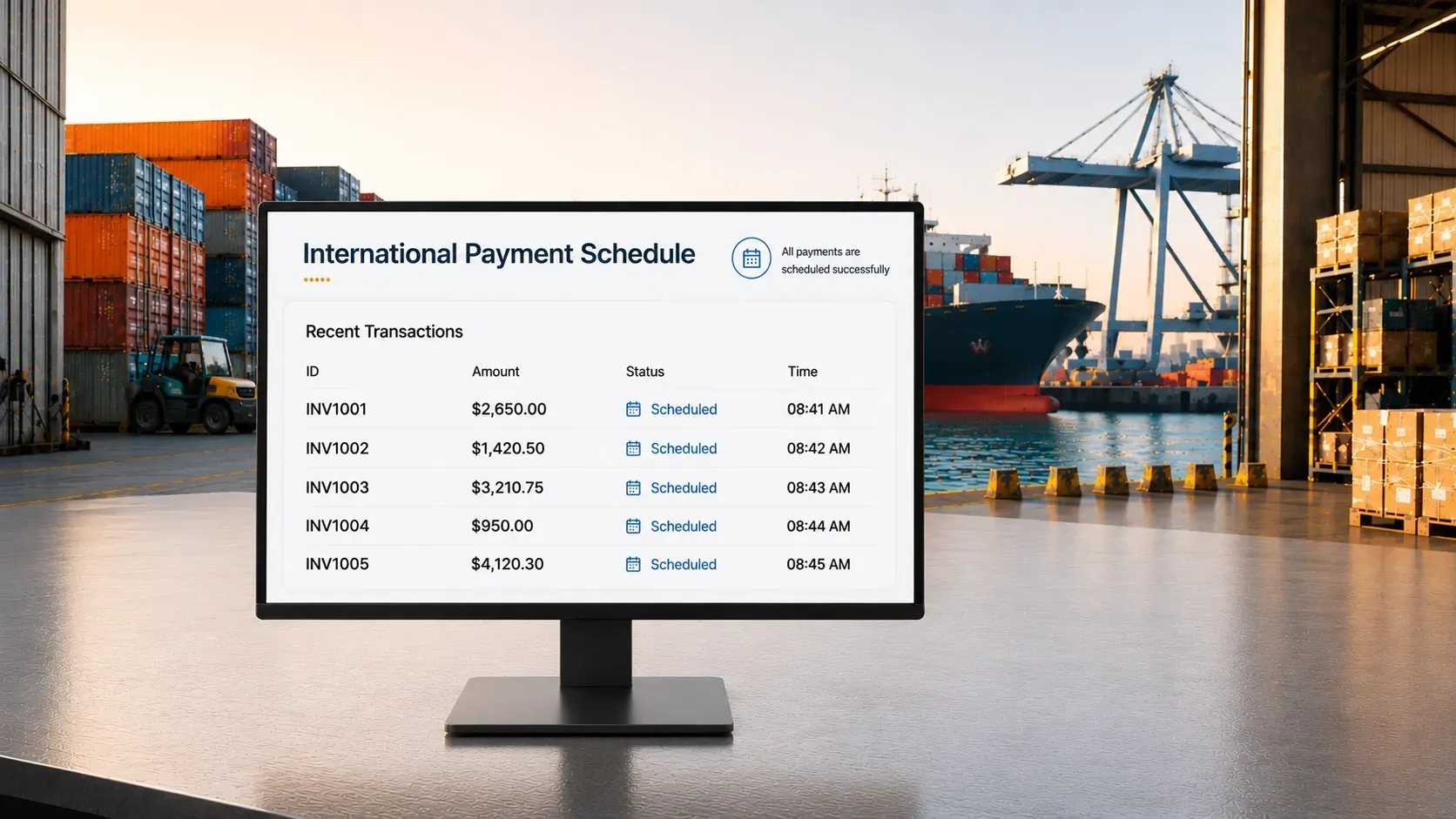
Recurring international vendor payments can be automated by saving supplier details, setting schedules, and approving invoices in advance. This helps Canadian businesses reduce manual work, avoid late payments, and manage monthly international invoices with more control.
Finance teams can use a repeatable workflow to pay overseas suppliers faster and with fewer errors. It also makes payment tracking, cash flow planning, and currency conversion easier.
MTFX helps Canadian businesses simplify recurring international payments with competitive exchange rates, secure global payments, and dedicated FX support. As a Canadian-based, FINTRAC-regulated provider trusted since 1996, MTFX gives businesses a reliable way to pay overseas vendors with confidence.
Quick answer: Recurring international vendor payments can be automated by saving verified supplier details, setting approval rules, scheduling payments before invoice due dates, and using a payment provider that supports foreign currency transfers. This helps Canadian businesses reduce manual work, avoid late payments, and manage FX costs more consistently.
What are recurring international vendor payments?
Recurring international vendor payments are repeat payments made to overseas suppliers, contractors, manufacturers, or service providers on a fixed schedule. They often happen monthly, quarterly, or annually and may involve foreign currency conversion.
These payments are common for businesses that work with:
- Overseas manufacturers
- International contractors
- Global software providers
- Logistics companies
- Raw material suppliers
- Recurring service providers
Unlike one-time transfers, recurring supplier payments usually involve the same vendor, similar payment details, repeated invoice cycles, and ongoing foreign exchange exposure.
For example, a Canadian importer paying a European supplier every month may need to convert CAD to EUR each time an invoice is due. If this is done manually, the finance team must check rates, approve the invoice, enter supplier details, send the transfer, and track confirmation every month.
With an automated supplier payment process, much of this repetitive work can be streamlined using international business payment solutions.
Why Canadian businesses should automate monthly international invoices
Canadian businesses should automate monthly international invoices to reduce manual work, avoid late payments, improve cash flow planning, and manage foreign exchange costs more effectively.
Automation helps finance teams create a repeatable payment process instead of rebuilding the same international vendor payment every month.
Reduce manual payment processing
Automation reduces manual payment processing by helping businesses save vendor details, reuse payment information, and schedule recurring supplier payments.
This means finance teams spend less time entering:
- Beneficiary names
- Bank account details
- SWIFT or BIC codes
- IBANs
- Invoice numbers
- Payment references
- Payment amounts
By using saved vendor profiles and a structured workflow, businesses can make international invoice payments more consistent and less error-prone.
Avoid late payment risk
Automated payment scheduling helps businesses avoid late payment risk by planning international vendor payments before the invoice due date.
Cross-border payments can be delayed by:
- Bank cut-off times
- Intermediary banks
- Public holidays
- Compliance checks
- Incorrect payment details
- Destination-country processing times
Scheduling recurring international payments in advance gives finance teams more time to approve invoices, manage exchange rates, and pay overseas suppliers on time.
Improve cash flow planning
Recurring payment automation improves cash flow planning by showing when international payments are due and how much foreign currency may be needed.
This is especially useful for businesses with monthly vendor payments in:
- USD
- EUR
- GBP
- MXN
- INR
- PHP
- Other supplier currencies
When payment timing is predictable, finance teams can plan outgoing cash more accurately and avoid last-minute funding decisions.
| Field | Value |
|---|---|
Amount Payable (USD) 20,000 | |
Bank Exchange Rate 1.4486 / 0.6903 | |
Total cost 28,971.47CAD |
| Field | Value |
|---|---|
Amount Payable (USD) 20,000 | |
MTFX Exchange Rate 1.4237 / 0.7024 | |
Total cost 28,474.41CAD |
You Save
CAD 497.06
with MTFX
14 October 2026
We use mid-market rates. This is for informational purposes only. Log in to view send rates.
Reduce foreign exchange uncertainty
Businesses can reduce foreign exchange uncertainty by planning recurring international payments in advance and reviewing exchange rates before invoices are due.
A foreign currency invoice can cost more or less in Canadian dollars depending on when the payment is made. For example, a USD 25,000 or EUR 15,000 invoice may have a different CAD cost from one month to the next.
Finance teams can use MTFX live exchange rate tools to monitor currency movements and review market rates before making recurring international invoice payments. For official benchmark exchange rate data, businesses can also refer to the Bank of Canada exchange rates.
Monitor FX Rates for Recurring Vendor Payments
| Currency | Rates | High | Low | Daily |
|---|---|---|---|---|
 USD | 1.4202 | 1.4221 | 1.4197 | -0.10% |
 EUR | 1.5913 | 1.5925 | 1.5905 | -0.06% |
 INR | 66.81 | 67.02 | 66.77 | -0.01% |
 GBP | 1.8844 | 1.8849 | 1.8822 | 0.06% |
 CNY | 4.7114 | 4.7144 | 4.7088 | 0.13% |
 JPY | 111.47 | 111.57 | 111.26 | 0.15% |
 MXN | 12.95 | 12.95 | 12.92 | 0.29% |
How do recurring international payments work?
Recurring international payments use saved vendor details, approved invoice information, payment scheduling, and currency conversion to send repeat payments to overseas suppliers. Once the vendor profile is set up, finance teams do not need to re-enter the same banking details every month.
The process is simple:
- Confirm the invoice amount
- Choose the payment currency
- Approve the transfer
- Schedule the payment before the due date
- Track confirmation once the funds are sent
This creates a more reliable workflow for monthly vendor payments. It helps reduce errors, avoid delays, improve tracking, and make international invoice payments easier to manage.
Finance teams should still keep internal controls in place. That means checking invoice details, reviewing exchange rates, approving payments, and saving records for reconciliation.
What details do you need to set up international vendor payments?
To set up international vendor payments, businesses need accurate supplier details, bank account information, payment currency, invoice references, and internal approval confirmation.
Collecting this information upfront helps prevent delays, returned payments, and reconciliation problems.
For businesses making cross-border supplier payments every month, a standard vendor onboarding checklist can reduce back-and-forth before payment deadlines.
If your supplier provides an IBAN or SWIFT/BIC code, make sure the details are copied exactly from the invoice or supplier bank document. For reference, SWIFT explains the role of IBAN standards, and MTFX also provides useful tools for checking IBAN codes and SWIFT/BIC codes.
How exchange rates affect foreign currency invoice payments
Exchange rates affect foreign currency invoice payments by changing how much a supplier invoice costs in Canadian dollars. If the Canadian dollar moves against USD, EUR, GBP, or another currency, the final cost of the same invoice can increase or decrease.
For recurring international payments, even small exchange rate differences can add up over time.
Example: If a Canadian business pays a USD 20,000 supplier invoice every month, even a small difference in the CAD/USD exchange rate can affect the total annual cost. A difference of 1% on USD 20,000 is about USD 200 per payment before other fees. Across 12 monthly payments, that difference can become meaningful, which is why finance teams should compare the full CAD cost before sending recurring vendor payments.
Finance teams can use a MTFX rate calculator to estimate the CAD value of upcoming invoices before sending payment.
Common FX costs to watch
Businesses should look at the full cost of an international invoice payment, not just the visible transfer fee.
For many businesses, the exchange rate markup can matter more than the transfer fee. A low transfer fee does not always mean the payment is cheaper if the exchange rate is less competitive.
Banks vs business FX payment providers for recurring supplier payments
A business FX payment provider is often better suited than a bank for recurring supplier payments because it may offer more payment-focused support, competitive exchange rates, saved vendor workflows, and better visibility over cross-border business payments.
Banks are familiar, but they may not always be the most cost-effective option for recurring international vendor payments.
Before sending repeat payments, businesses can compare exchange rates to understand how rate differences and markups may affect the final amount received by the supplier.
How to automate vendor payments step by step
To automate vendor payments, businesses need to identify recurring vendors, organize payments by currency and due date, save verified vendor profiles, set approval rules, schedule payments early, and track confirmations.
This creates a repeatable accounts payable workflow for international invoice payments without removing financial control.
Step 1: Identify recurring international vendors
Start by identifying overseas suppliers that are paid regularly. These vendors are the best candidates for recurring international payment automation.
Look for vendors paid:
- Monthly
- Quarterly
- On fixed invoice dates
- In the same currency
- With similar payment details
These may include manufacturers, contractors, logistics providers, software companies, raw material suppliers, and international agencies.
Step 2: Group payments by currency and due date
Group recurring payments by currency and due date so your finance team can plan funding needs and payment timing more effectively.
For example, your business may have:
- Several USD vendor payments due at month-end
- Multiple EUR invoices due quarterly
- Regular GBP payments for services
- Repeated supplier payments in local currency
Grouping payments can make cash flow planning and currency management easier.
Step 3: Create saved vendor profiles
Create saved vendor profiles to reduce repeated data entry and lower the risk of payment errors.
A vendor profile should include:
- Verified supplier name
- Bank account details
- SWIFT/BIC or IBAN
- Preferred payment currency
- Payment reference format
- Usual invoice schedule
Saved profiles help finance teams process recurring supplier payments faster and more accurately.
Step 4: Set internal approval rules
Set internal approval rules before scheduling recurring international payments. This ensures automation supports control instead of bypassing it.
Businesses should define:
- Who reviews invoices
- Who approves payments
- Who authorizes transfers
- What payment limits apply
- When extra approval is needed
Clear approval rules help maintain oversight while still reducing manual work.
Step 5: Schedule payments before the due date
Schedule payments before the due date to reduce the risk of late supplier payments.
International payments may take time because of:
- Destination country
- Payment currency
- Banking route
- Payment method
- Compliance checks
Scheduling payments early gives finance teams more time to manage exchange rates and avoid rushed approvals. You can use rate alert tool to get the best rates so that you can schedule your payments. Also, make sure to check the monthly forecast to ensure you are making an informed decision.
Step 6: Track payment status and save confirmations
Track payment status and save confirmations so your finance team can reconcile invoices and respond to supplier questions quickly.
Clear records help with:
- Month-end reporting
- Invoice reconciliation
- Audit trails
- Supplier communication
- Internal payment reviews
Every international vendor payment should have a payment confirmation and invoice reference.
How Canadian businesses can reduce costs on monthly vendor payments
Canadian businesses can reduce costs on monthly vendor payments by comparing exchange rates, paying suppliers in local currency, planning payments ahead of due dates, and using a business FX specialist.
Because these payments happen repeatedly, small improvements can create meaningful savings over time.
Compare exchange rates, not just transfer fees
Businesses should compare exchange rates, not just transfer fees, because the exchange rate can have a bigger impact on the total cost of an international payment.
The better question is:
- Not just: “What is the transfer fee?”
- But: “How much CAD will it cost to deliver the exact invoice amount to the supplier?”
For recurring international vendor payments, this comparison matters even more because rate differences repeat across multiple payment cycles.
Pay suppliers in local currency
Paying suppliers in local currency can improve transparency and help vendors receive the amount they expect.
It can also reduce confusion around:
- Who handles the currency conversion
- What amount will arrive
- Whether the supplier needs to absorb conversion costs
- How the invoice should be reconciled
This is especially useful for overseas supplier payments that happen every month.
Plan payments around invoice cycles
Planning payments around invoice cycles gives finance teams more time to review exchange rates, approve invoices, and schedule transfers.
This helps businesses avoid:
- Last-minute wire transfers
- Rushed payment approvals
- Missed payment cut-off times
- Poor exchange rate decisions
- Supplier follow-ups
If your business pays global vendors every month, recurring payment planning can make accounts payable more predictable.
Use a business FX specialist
A business FX specialist can help companies understand currency exposure, compare payment options, and manage recurring foreign currency invoice payments more effectively.
This support can be useful for businesses that:
- Pay overseas vendors regularly
- Send payments in multiple currencies
- Handle large supplier invoices
- Need better exchange rate visibility
- Want support beyond general bank wire services
Canadian businesses can explore MTFX business foreign exchange solutions to manage recurring supplier payments with dedicated FX support.
Common mistakes to avoid with international invoice payments
The most common mistakes with international invoice payments include waiting until the due date, re-entering vendor details manually, ignoring exchange rate markups, failing to track confirmations, and using the same process for every vendor.
Avoiding these mistakes can save time, reduce costs, and prevent supplier frustration.
Waiting until the due date
Waiting until the invoice due date can cause late international payments because cross-border transfers may not arrive instantly.
Businesses should schedule recurring international vendor payments before the due date to allow time for processing and delivery.
Re-entering vendor details manually
Re-entering vendor details manually increases the risk of payment errors.
Common mistakes include:
- Wrong account number
- Not checking IBAN
- Incorrect SWIFT code
- Incomplete payment reference
- Outdated supplier banking details
Saving verified vendor details can make recurring supplier payments more efficient.
Ignoring exchange rate markups
Ignoring exchange rate markups can make international invoice payments more expensive than expected.
Many businesses focus only on transfer fees and overlook the rate used to convert Canadian dollars into foreign currency. For foreign currency invoice payments, the exchange rate can have a major impact on the final cost.
Not tracking payment confirmations
Not tracking payment confirmations can create reconciliation problems and supplier communication issues.
Finance teams should save:
- Payment confirmation
- Invoice number
- Payment reference
- Date sent
- Currency and amount
- Supplier name
This makes it easier to confirm which invoice was paid and when.
Using the same process for every vendor
Using the same payment process for every vendor can create problems because suppliers may have different requirements.
Vendors may differ by:
- Preferred currency
- Banking details
- Payment reference format
- Delivery expectations
- Local banking rules
A strong vendor payment process should allow for these differences while keeping the overall workflow consistent.


How MTFX helps with recurring international vendor payments
MTFX helps Canadian businesses manage recurring international vendor payments by supporting global payments, foreign exchange, overseas supplier payments, and cross-border business payment workflows.
For companies that pay international invoices every month, MTFX provides business-focused payment solutions designed to improve efficiency and cost control.
MTFX can support businesses that need to:
- Pay international invoices in foreign currencies
- Send recurring supplier payments to overseas vendors
- Manage cross-border business payments
- Reduce reliance on manual bank wire processes
- Improve payment tracking and transparency
- Plan foreign currency invoice payments more effectively
- Support accounts payable teams with international payment workflows
- Access competitive exchange rates
- Work with dedicated FX specialists
MTFX is registered as a money services business with FINTRAC. Businesses can verify registration details through FINTRAC’s official Money Services Business Registry.
Ready to simplify recurring international payments?
MTFX can help Canadian businesses simplify recurring international payments by making it easier to send global payments, manage foreign exchange, and pay overseas suppliers in multiple currencies.
With MTFX, businesses can:
- Send international business payments
- Pay overseas vendors in multiple currencies
- Access competitive exchange rates
- Use a currency converter before sending payments
- Work with dedicated FX specialists
- Improve recurring supplier payment workflows
Open a free MTFX business account to streamline monthly vendor payments, reduce manual payment processing, and manage international invoices with greater confidence.
FAQs
1. What are recurring international vendor payments?
Recurring international vendor payments are repeat payments made to overseas suppliers, contractors, or service providers. They usually happen monthly, quarterly, or on another fixed schedule.
2. Can businesses automate recurring international payments?
Yes, businesses can automate recurring international payments by saving vendor details, setting schedules, using approvals, and tracking confirmations. This helps reduce manual work and payment errors.
3. What is the best way to pay monthly international invoices?
The best way is to use a structured process with verified vendor details, scheduled payments, competitive exchange rates, and clear approvals. This helps businesses pay overseas suppliers on time and with better control.
4. How do exchange rates affect international invoice payments?
Exchange rates affect how much a foreign currency invoice costs in Canadian dollars. If rates move unfavourably, the same supplier invoice can become more expensive.
5. Are recurring supplier payments cheaper than one-time wire transfers?
Recurring supplier payments are not always cheaper, but they give businesses more time to plan, compare exchange rates, and reduce manual errors. This can help lower costs over time.
6. What details are needed to pay an international vendor?
Businesses usually need the vendor’s legal name, address, bank details, account number or IBAN, SWIFT/BIC code, payment currency, invoice number, and payment reference.
7. Can Canadian businesses pay overseas suppliers in local currency?
Yes, Canadian businesses can pay overseas suppliers in local currency when the payment provider supports it. This helps vendors receive the expected amount and makes reconciliation easier.
8. Why should businesses avoid manual international payment processing?
Manual processing can increase the risk of errors, duplicate payments, late payments, and missing records. Automation helps make recurring international vendor payments faster and more reliable.
9. How can MTFX help with cross-border business payments?
MTFX helps Canadian businesses send international payments, manage foreign exchange, and pay overseas vendors in multiple currencies. It supports recurring invoice workflows with business-focused FX and payment solutions.