How to Minimize Currency Exchange Risk When Paying Overseas Suppliers
Canadian businesses can minimize currency exchange risk when paying overseas suppliers by mapping foreign currency exposure, monitoring live exchange rates, setting rate alerts, using forward contracts for known future invoices, using market orders for target rates, and reviewing payment results after each cycle.
Canadian businesses can reduce currency exchange risk on overseas supplier payments by mapping foreign currency exposure, checking live rates, planning payment timing, setting rate alerts, using forward contracts for known future invoices, using market orders for target exchange rates, and working with an FX specialist for larger or recurring payments.
Currency risk matters because your supplier’s invoice may stay the same in USD, EUR, GBP, CNY, or another currency, while the Canadian dollar cost can change before the payment is made. Even a small exchange rate movement can affect margins, cash flow, landed cost, and pricing decisions.
MTFX helps Canadian businesses manage global payments for business, pay overseas suppliers, monitor exchange rates, and use FX risk management tools such as forward contracts, market orders, rate alerts, and multi-currency solutions. MTFX is FINTRAC regulated, trusted since 1996, and supports business payments to more than 190 countries in 50+ currencies.
Currency exchange risk and supplier costs
Currency exchange risk in supplier payments is the risk that exchange rates move unfavourably between the time a supplier invoice is issued and the time your business sends or settles the payment.
This is common for Canadian businesses that import goods, pay manufacturers, buy inventory, outsource services, or work with international vendors. A supplier may invoice your business in USD, EUR, GBP, JPY, CNY, or another currency. If the Canadian dollar weakens before payment, your business may need more CAD to settle the same invoice.
The Bank of Canada explains that the foreign exchange market determines the value of the Canadian dollar and that the Canadian dollar floats based on buying and selling in currency markets. That means businesses exposed to foreign-currency invoices should expect exchange rates to move over time.
For example, a Canadian importer may approve a USD 75,000 supplier invoice today but pay it in 30 days. If the CAD to USD exchange rate moves against the business during that period, the same USD invoice becomes more expensive in Canadian dollars.
| Field | Value |
|---|---|
Amount Payable (USD) 20,000 | |
Bank Exchange Rate 1.4469 / 0.6911 | |
Total cost 28,937.4CAD |
| Field | Value |
|---|---|
Amount Payable (USD) 20,000 | |
MTFX Exchange Rate 1.4220 / 0.7032 | |
Total cost 28,440.93CAD |
You Save
CAD 496.48
with MTFX
16 October 2026
We use mid-market rates. This is for informational purposes only. Log in to view send rates.
Exchange rates, margins and cash flow
Exchange rate fluctuations affect supplier payments because most overseas invoices are fixed in the supplier’s currency, not in Canadian dollars. Your business may know the foreign invoice amount, but not the final CAD cost until the exchange rate is booked.
This can create several problems:
- Higher landed cost on imported goods
- Reduced gross margin
- Budget variance between purchase order and payment date
- Cash flow pressure before invoice deadlines
- Difficulty quoting customers or setting product prices
- Supplier relationship issues if payments are delayed
The larger the payment, the more important currency planning becomes. On a high-value supplier transfer, a small change in the exchange rate can create a meaningful cost difference. Businesses making frequent B2B global payments should review exchange rates, transfer fees, payment timing, and currency exposure before approving supplier invoices.
Main FX risks for supplier payments
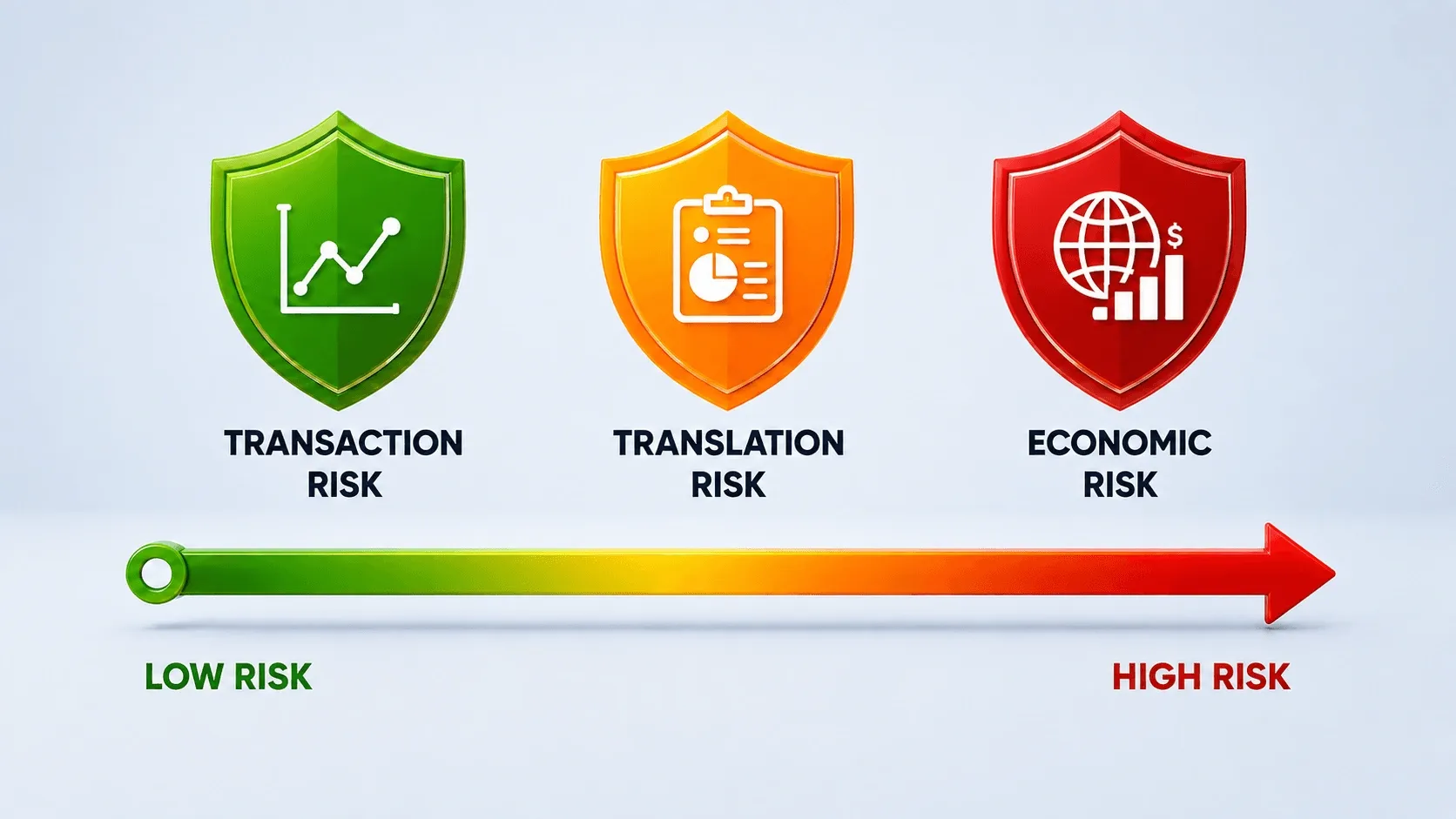
Businesses paying overseas suppliers usually face three types of foreign exchange risk: transaction risk, translation risk, and economic risk. For supplier payments, transaction risk is usually the most immediate concern.
1. Transaction risk
Transaction risk happens when exchange rates move between the date a transaction is agreed and the date it is settled. Investopedia describes transaction risk as the risk of loss from FX fluctuations between agreement and settlement, which fits overseas supplier invoices and payment terms.
For example, your business may agree to pay a supplier in USD on 60-day terms. During those 60 days, the CAD/USD rate may move. If the rate moves against you, the payment costs more in Canadian dollars.
2. Translation risk
Translation risk matters when a business holds foreign-currency assets, liabilities, or balances that need to be reported in Canadian dollars. This can affect accounting, balance sheets, and financial reporting.
A Canadian company with foreign subsidiaries, foreign receivables, or overseas bank balances may need to consider translation exposure as part of a wider FX risk management strategy.
3. Economic risk
Economic risk is the long-term effect of currency movements on your business model. It can influence supplier pricing, product margins, customer pricing, and competitiveness.
For example, if your business depends heavily on USD suppliers and the Canadian dollar stays weaker for a long period, your product costs may rise. That may affect pricing, profitability, and supply chain decisions.
How to reduce currency risk?
The practical way to reduce currency risk is to build a supplier payment process instead of waiting until the invoice due date. Businesses should understand what they owe, when they owe it, which currencies are involved, and how much exchange rate movement they can tolerate.
Export Development Canada recommends that businesses identify foreign exchange exposure and build a policy or process to manage how currency movement may affect cash flow, profitability, and competitiveness.
Step 1: map your foreign currency exposure
Start by reviewing all supplier payments that involve foreign currency.
Include:
- Supplier name
- Invoice currency
- Invoice amount
- Payment deadline
- Payment frequency
- Average invoice size
- Country or region
- Payment approval process
- Expected future orders
This gives your finance team a clear view of total exposure. It also helps decide whether you need basic rate monitoring or a more structured currency risk management strategy.
Step 2: compare live exchange rates before booking payments
Businesses should check live exchange rates before confirming supplier payments. Live rates help you understand where the market is moving and whether the current rate fits your budget.
MTFX’s live exchange rate tool lets users monitor global currency pairs and access live exchange rates for personal transfers and business payments.
Step 3: pay suppliers in the invoice currency
Paying suppliers in the invoice currency can reduce confusion and make reconciliation easier. If a supplier invoices in USD, paying in USD may help avoid disputes about conversion rates, short payments, or receiving-bank deductions.
Before sending funds, confirm:
- Exact invoice currency
- Beneficiary name
- Supplier bank details
- SWIFT/BIC code or IBAN where applicable
- Payment reference or invoice number
- Any intermediary or receiving bank fees
- Expected settlement timeline
This is especially important for larger payments, recurring payments, and first-time supplier transfers. You can also review this global payment checklist before sending international supplier payments.
Step 4: set rate alerts for target exchange rates
Rate alerts help businesses monitor exchange rates without manually watching the market all day. You can choose a target exchange rate and receive a notification when the market reaches that level.
MTFX’s currency rate alerts let users select a currency pair, review the current rate, set a target rate, and create an alert.
This is useful when your supplier payment is due in a few days or weeks, and you have some flexibility around when to book the exchange.
Step 5: use forward contracts for future invoices
Forward contracts can help businesses lock in an exchange rate for a future supplier payment. This can make budgeting easier when you know the invoice amount and payment date.
MTFX describes forward contracts as a tool that locks in today’s exchange rate for future payments, helping businesses keep costs predictable and protect against sudden rate fluctuations.
A forward contract may be useful when:
- You have a large upcoming supplier invoice
- You know the currency and amount in advance
- You need budget certainty
- Your margins are sensitive to FX movements
- You import goods regularly
- You want to protect a future payment deadline
MTFX also explains that forward contracts can help Canadian importers and exporters stabilize costs by locking in today’s exchange rate for future transactions.
Step 6: use market orders for target rates
Market orders can help when your business has a preferred exchange rate and does not need to book the payment immediately. You set a target exchange rate, and the order can execute when the market reaches that level.
MTFX explains that market orders allow businesses to set a target rate and have the payment executed automatically once the market hits that level.
This is useful for supplier payments where timing is flexible, but the target rate is important for margin or budget reasons.
Step 7: review FX results after each cycle
After supplier payments are completed, review the results. Compare the expected CAD cost against the actual CAD cost, then identify where exchange rate movement, fees, or payment timing affected the outcome.
Track:
- Exchange rate booked
- Transfer fee
- Payment date
- Settlement date
- Supplier amount received
- Any intermediary fee deduction
- Difference between budgeted and actual CAD cost
This helps improve your next payment cycle and supports better supplier payment forecasting. Businesses with frequent supplier payments can also explore treasury solutions to manage cash flow, currencies, and recurring payments more efficiently.
FX tools for supplier payments
The right tools depend on your payment amount, deadline, currency, and risk tolerance. Businesses with recurring or high-value supplier payments often need more than a simple spot transfer.
MTFX offers FX risk management solutions including forward contracts, market orders, and multi-currency accounts to help companies manage margins, costs, and cross-border operations.
Minimize currency risk, improve cash flow, & simplify international supplier payments.
Example: monthly USD supplier payment
A Canadian business pays a manufacturer USD 40,000 every month. The supplier invoice is always in USD, but the Canadian dollar cost changes with the CAD/USD exchange rate.
Without a plan, the business converts CAD to USD on the invoice due date each month. This creates uncertainty because the final CAD cost depends on the rate available that day.
A stronger payment process could look like this:
- Forecast the next three to six months of USD supplier invoices.
- Use the live exchange rates page to monitor CAD/USD.
- Use the currency converter to estimate CAD cost.
- Set currency rate alerts for target levels.
- Use a forward contract for confirmed future invoices.
- Use market orders for flexible payments with target rates.
- Review payment outcomes monthly to improve budgeting.
This does not remove all currency risk, but it creates more control over timing, visibility, and supplier payment costs.
Forward contracts vs market orders
Forward contracts and market orders are both useful, but they are not the same. A forward contract is mainly about certainty. A market order is mainly about timing.
A forward contract may work better when you know the exact invoice amount and due date. A market order may work better when you have a target exchange rate and enough time before the invoice deadline.
Multi-currency accounts
Multi-currency accounts can help businesses that regularly pay and receive funds in different currencies. Instead of converting every payment immediately, a business may be able to hold and manage currencies more strategically.
This can be useful when a company:
- Pays suppliers in USD, EUR, GBP, or other currencies
- Receives foreign-currency revenue through global collections
- Has recurring monthly supplier invoices
- Wants to reduce repeated conversions
- Needs more control over timing
- Manages international vendors or contractors
MTFX notes that multi-currency accounts and treasury solutions can help businesses hold and manage funds in different currencies, reduce frequent conversions, and support smoother cross-border operations.
Common supplier payment mistakes
Many businesses lose control of FX costs because they treat supplier payments as a last-minute admin task. Currency risk management works better when it is built into procurement, finance, and payment approval workflows.
Avoid these common mistakes:
- Waiting until the invoice due date to convert currency
- Comparing only transfer fees instead of the full exchange rate
- Ignoring FX markup, intermediary fees, and receiving bank charges
- Not confirming supplier banking details before sending funds
- Paying manually without a repeatable approval process
- Failing to track recurring supplier exposure
- Not using rate alerts for target currency levels
- Not reviewing forward contracts for known future payments
- Using the same process for small invoices and large transfers
- Forgetting to include FX movement in landed cost calculations
A better approach is to compare the full cost of the supplier payment, including the exchange rate, transfer fee, payment speed, currency route, and amount the supplier receives. Businesses should also review what to look for when choosing a global payments provider, especially if they regularly pay international suppliers, contractors, or vendors.
How MTFX helps businesses manage supplier payments
MTFX can help Canadian businesses manage overseas supplier payments by combining international payment capabilities with FX risk management tools.
Through cross-border payments for business, businesses can pay overseas suppliers, vendors, contractors, and global partners in more than 190 countries and 50+ currencies.
They support businesses with:
- Competitive exchange rates for international supplier payments
- Fast and secure B2B money transfers
- Currency risk management tools
- Live exchange rates
- Forward contracts for known future invoices
- Market orders for target rates
- Multi-currency payment support
For businesses that want more market visibility, MTFX also provides FX tools such as currency charts, daily exchange rate lookup, historical exchange rates, and an economic calendar to help track currency market context.


When to hedge FX risk?
A business should consider hedging supplier payment risk when currency movement could affect margins, cash flow, or pricing.
Hedging may be useful when:
- Supplier invoices are large
- Payments are recurring
- Margins are tight
- Payment terms are 30, 60, or 90 days
- Inventory is priced in foreign currency
- You import from the same region regularly
- Exchange rates are volatile
- You need cost certainty for budgeting
- You are quoting customers before supplier payment is due
Currency hedging does not mean every payment needs a complex strategy. Some payments may only need live rate checks and alerts. Larger or repeated payments may justify forward contracts, market orders, or specialist FX support.
Foreign exchange tools such as forward contracts and market orders may not be suitable for every business. Review your payment timeline, cash flow needs, and risk tolerance before choosing an FX strategy.
MTFX’s currency hedging strategies guide explains that businesses paying overseas supplier invoices can use hedging strategies to assess exposure, choose suitable tools, and protect cash flow from exchange rate swings.
Plan payments before rates move with MTFX
Currency exchange risk is not something businesses should manage at the last minute. If your company pays overseas suppliers, exchange rate movement can affect margins, budgets, cash flow, and supplier relationships.
The best approach is to build a clear process. Map your exposure, compare live rates, confirm supplier details, set rate alerts, use forward contracts where certainty matters, use market orders where timing is flexible, and review your payment results regularly.
Ready to simplify overseas supplier payments? Sign up with MTFX to streamline international bulk payments for your business with competitive exchange rates, secure cross-border transfers, multi-currency payment solutions, and specialist support for paying suppliers, contractors, vendors, and global teams.
FAQs
1. What is currency exchange risk in supplier payments?
Currency exchange risk in supplier payments is the risk that exchange rates move unfavourably between the invoice date and payment settlement date, increasing the final cost in Canadian dollars.
2. How can businesses minimize currency risk when paying overseas suppliers?
Businesses can minimize currency risk by planning payment timing, monitoring live rates, setting rate alerts, using forward contracts, using market orders, and working with an FX specialist for recurring or high-value payments.
3. What tools help mitigate currency conversion risks in global payments?
Useful tools include live exchange rates, currency converters, rate alerts, forward contracts, market orders, multi-currency accounts, currency charts, and specialist FX guidance.
4. How do forward contracts help with supplier payments?
Forward contracts help businesses lock in an exchange rate for a future supplier payment. This can make future invoice costs more predictable and support better budgeting.
5. Are market orders useful for overseas supplier payments?
Yes. Market orders are useful when your business has a target exchange rate and flexible payment timing. The transaction can execute when the market reaches your chosen level.
6. Can exchange rates affect supplier payment costs?
Yes. If a supplier invoice is in a foreign currency, the CAD cost can rise or fall before payment depending on exchange rate movement.
7. Should businesses pay overseas suppliers in local currency?
In many cases, paying suppliers in the invoice currency can simplify reconciliation and reduce confusion. Always confirm the supplier’s preferred payment currency and bank details before sending funds.
8. When should a business hedge foreign exchange risk?
A business should consider hedging FX risk when payments are large, recurring, margin-sensitive, or due in the future. Hedging can help reduce uncertainty, but the right tool depends on the payment timeline and risk tolerance.
9. What is the difference between transaction risk and translation risk?
Transaction risk affects payments before settlement, such as unpaid supplier invoices. Translation risk affects accounting when foreign-currency assets or liabilities are reported in the home currency.
10. How can MTFX help with overseas supplier payments?
MTFX helps Canadian businesses send supplier payments globally, compare exchange rates, set rate alerts, use FX risk management tools, and access specialist support for recurring or high-value international payments.
11. What is the best way to reduce currency risk on supplier payments?
The best way is to create a repeatable payment process: identify foreign-currency exposure, monitor exchange rates, set target rates, use forward contracts for known invoices, and review payment outcomes regularly.