Today's Currency Headlines
- USD: Euro trades cautiously as the US dollar recovers from its post-CPI softness ahead of PPI.
- CAD: Euro remains directionless as the Canadian dollar trades within its weekly range.
- GBP: Euro loses some ground as sterling remains near weekly highs following upbeat UK GDP.
- JPY: Euro strengthens as the yen stays pressured by the US dollar’s post-CPI recovery.
- AUD: Euro trades steadily as the Australian dollar drifts lower amid cautious market conditions.
- EUR: Resilient industrial data provides support, but EUR/CAD remains confined to a narrow range.
Where's the EUR/CAD Trading Today?
The EUR/CAD today, August 13, 2026, is trading around 1.6080 CAD, which means $1 CAD is equal to 0.6219 EUR.
- Daily Range: The currency pair fluctuated between a low of 1.6051 and a high of 1.6088.
- Recent Trend: The Canadian dollar is trading broadly steady against the euro, keeping EUR/CAD directionless as the pair moves choppily within a narrow range despite resilient euro-area industrial data.
- Short-Term Outlook: The Canadian dollar could strengthen if US PPI or jobless claims weaken the US dollar and improve broader risk sentiment, while renewed euro demand or softer CAD momentum may lift EUR/CAD.
EUR/CAD Daily Trading Range
Today, August 13, 2026, EUR/CAD is trading between 1.6051 and 1.6088. The current rate of 1.6080 is 0.0029 above the day’s low and 0.0008 below the day’s high. It is currently positioned 78% of the way through today’s range, with a midpoint of 1.6070.
Current Rate
Change Today
0.14%Today's EUR/CAD Headlines - Euro remains directionless despite firm industrial data
EUR/CAD continues to trade within a narrow range as neither currency establishes a clear advantage. The euro rate today is receiving some support from stronger industrial data, although cautious market sentiment is preventing the pair from building sustained upward momentum. Meanwhile, the Canadian dollar rate today is modestly pressured but remains within its weekly range as traders assess softer oil prices and recent domestic strength. Attention now turns to the US Producer Price Index and initial jobless claims, which could reshape Federal Reserve expectations and influence wider risk flows. A meaningful surprise in either release may provide the catalyst EUR/CAD currently lacks.
EUR/CAD Daily Performance
As of August 13, 2026, EUR/CAD is trading at 1.6080, representing a 0.14% shift in the last 24 hours. The pair is likely to trade within the 1.6051-1.6088 range.
CURRENT RATE
1.6079
DAILY CHANGE %
+0.14%
DAY'S LOW
1.6051
DAY'S HIGH
1.6087
EUR/CAD Performance Year to Date
We use mid-market rates. This is for informational purposes only.
Global FX Rates Against Euro
| Currency | Rates | High | Low | Daily |
|---|---|---|---|---|
| Check Out EUR Exchange Rates | ||||
Daily Outlook for USD, GBP, and JPY Against the Canadian Dollar
Quick view of today’s rates, daily movement, and trading range for other major currency pairs.
Get a live exchange rate for your international payment and see how much you could save versus your bank.
Useful EUR/CAD Tools and Forecasts
FAQs
As of August 13, 2026, the EUR/CAD exchange rate is 1.6080, meaning one euro buys approximately 1.6080 Canadian dollars. The pair opened at 1.6058, compared with its previous close of 1.6058, and has moved 0.14% today.
The displayed rate is a market reference rate. The rate available for an international transfer may include an exchange rate margin or fees.
As of August 13, 2026, EUR/CAD is up today, having moved 0.14%, or 0.0022, from its previous close of 1.6058.
A rise in EUR/CAD means the euro is strengthening against the Canadian dollar, while a decline means the Canadian dollar is gaining against the euro.
As of August 13, 2026, EUR/CAD is up by 0.14%, trading near 1.6080 after opening at 1.6058. The pair has remained within today’s range of 1.6051-1.6088, with the current rate positioned 78% of the way through the day’s range.
The move may reflect changes in European Central Bank expectations, Bank of Canada policy pricing, Canadian oil prices, economic data or broader market sentiment.
As of August 13, 2026, the short-term EUR/CAD outlook is bullish, with a bullish bias. The pair is currently trading at 1.6080, compared with its 50-day moving average of 1.6142 and its 200-day moving average of 1.6106.
The current rate is below the 50-day moving average and below the 200-day moving average. This outlook reflects current momentum and market conditions but does not guarantee the pair’s next move.
EUR/CAD is particularly sensitive to interest-rate decisions and policy guidance from the European Central Bank and the Bank of Canada. Eurozone inflation, economic growth, employment and business-activity data can affect the euro, while Canadian inflation, employment, retail sales and GDP figures can influence the Canadian dollar.
Oil-price movements may also affect EUR/CAD because Canada is a major energy exporter. Stronger oil prices can support CAD, while weaker oil prices may reduce demand for the Canadian dollar.
EUR/CAD can rise when markets expect the European Central Bank to maintain higher interest rates than the Bank of Canada, because relatively higher European yields may support the euro.
The pair can fall when the Bank of Canada is expected to keep rates higher for longer or adopt a more restrictive position than the ECB. Markets often react not only to the rate decision itself but also to central-bank statements, economic projections and comments about future policy.
The current EUR/CAD rate of 1.6080 is below, its 50-day moving average of 1.6142, and below, its 200-day moving average of 1.6106.
Trading above a moving average can indicate stronger upward momentum, while trading below it can suggest weaker momentum. Moving averages are trend indicators and should be considered alongside current economic data, central bank policy, and market news.
As of August 13, 2026, EUR/CAD is trading at 1.6080, within a yearly range of 1.5609 to 1.6466. The pair has changed -0.15% year to date and -0.12% over the past 12 months.
Comparing the current rate with its yearly high and low provides useful historical context, but it does not indicate whether the pair will continue moving in the same direction.
A higher EUR/CAD rate means one euro buys more Canadian dollars. This generally benefits someone converting euros into Canadian dollars but makes euros more expensive for someone converting Canadian dollars into euros.
A lower EUR/CAD rate means the Canadian dollar has strengthened against the euro. This generally benefits Canadians buying euros for travel, property, tuition, supplier payments or other expenses in Europe.
As of August 13, 2026, EUR/CAD is trading at 1.6080, after changing -0.18% over the past month and -0.15% year to date. The rate is currently below its 50-day moving average and below its 200-day moving average.
Whether the rate is favourable depends on the direction of your transfer, your payment deadline and your tolerance for further currency movement. A lower EUR/CAD rate generally benefits someone converting CAD to EUR, while a higher rate generally benefits someone converting EUR to CAD.
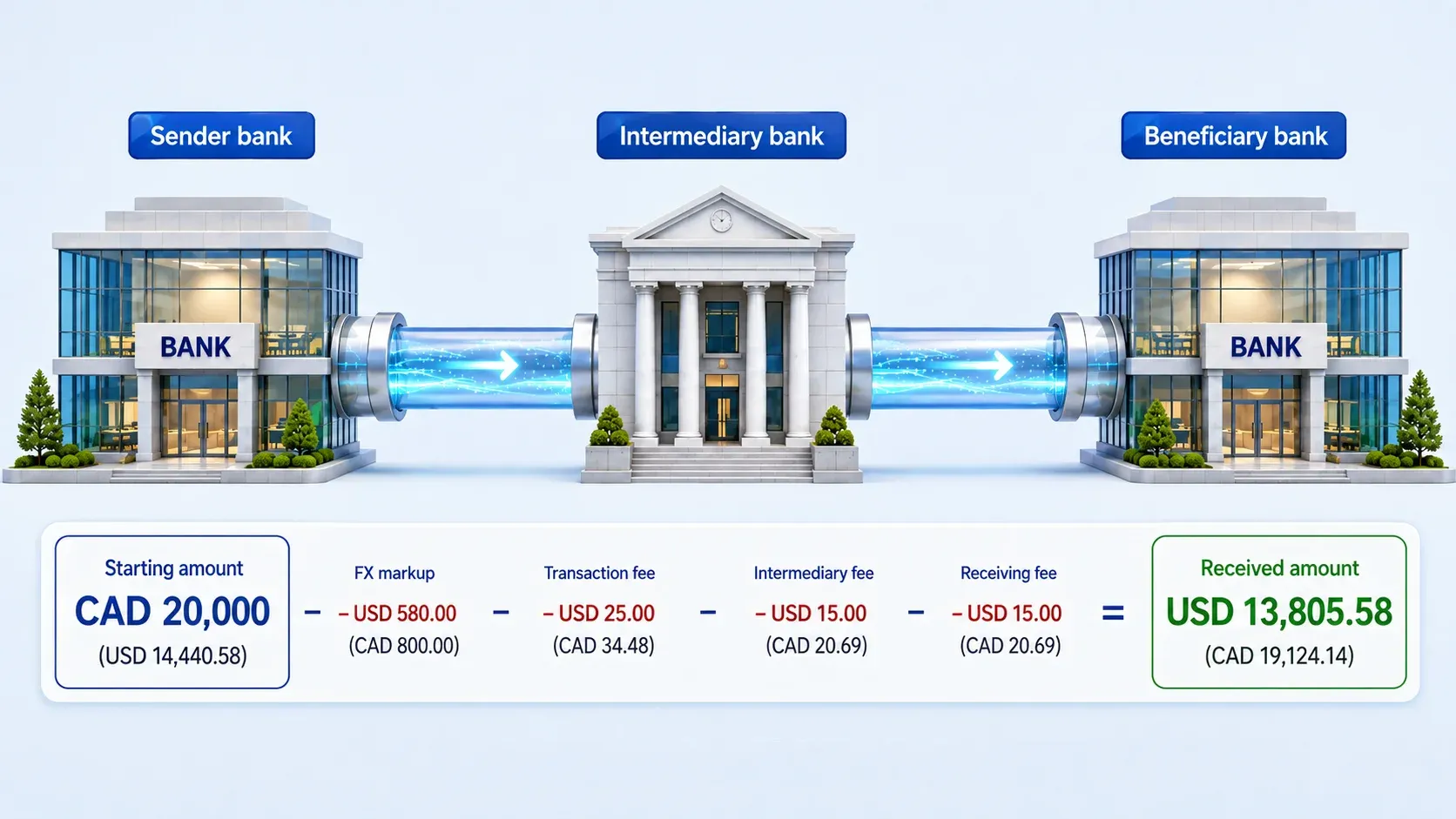
The EUR/CAD market rate is a reference price used in global currency markets. The rate offered for an actual transfer may differ because banks and currency providers can include an exchange-rate margin, transaction fee or both.
When comparing options, review the total amount the recipient will receive rather than looking only at the advertised exchange rate.
The final amount depends on the exchange rate offered, the size of the transfer, any transaction fees and possible receiving-bank charges. The EUR/CAD rate may also change between requesting a quote and confirming the transaction.
For a more accurate comparison, check the complete transfer cost and the exact amount scheduled to reach the recipient’s account.
Compare the provider’s exchange rate margin and fees rather than relying only on the headline market rate. For larger transfers, asking for a personalized quote may produce a more competitive rate than a standard online or bank rate.
You can also use a currency rate alert to monitor a preferred EUR/CAD level or convert in stages when your payment timeline allows.
Yes. You can fund an international transfer in Canadian dollars and have the funds converted into euros before they are deposited into the recipient’s European bank account.
You will generally need the recipient’s full name, IBAN, bank details and, in some cases, the bank’s SWIFT or BIC code. The required information may vary depending on the destination country and the type of payment.