International Wire Transfer Not Received? A Recovery Guide for Canadian Businesses
Waiting for an international business payment to arrive? This guide helps Canadian finance teams trace delayed wires, understand payment statuses and resolve returned or missing supplier payments.
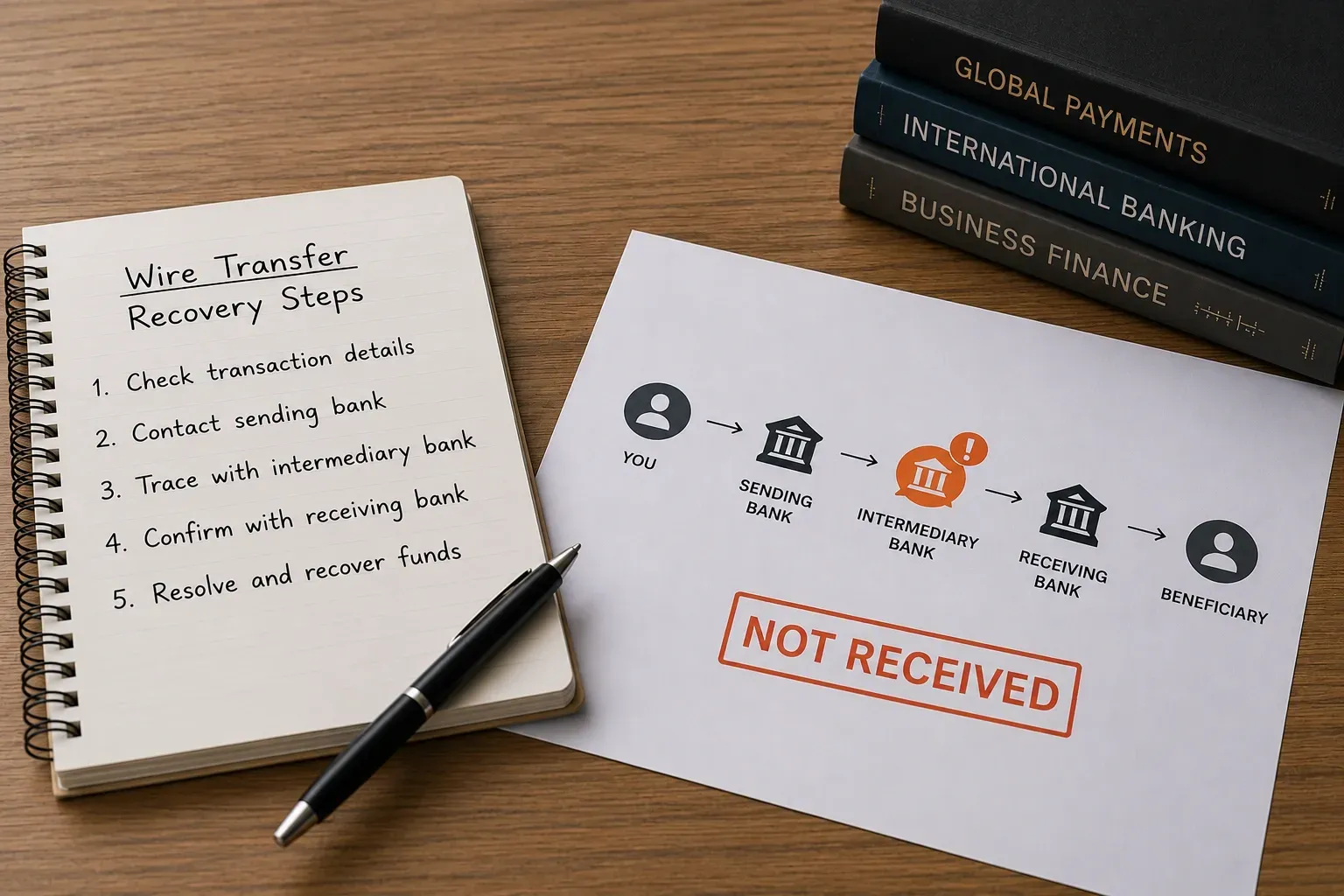
When an international wire transfer has not arrived, do not send a replacement payment straight away. First, confirm the expected delivery date, check the payment status, verify the beneficiary details and ask the sending bank or payment provider to trace the transfer. If the payment was sent through the SWIFT network, the provider may also be able to locate it using its payment reference or Unique End-to-End Transaction Reference (UETR).
Quick overview: If an international wire has not arrived, ask the sending provider to trace it using the payment reference or UETR. Do not resend the funds until the original transfer has been located, rejected or returned.
This guide is for Canadian business owners, finance teams and accounts payable teams dealing with a supplier, contractor or overseas business partner who has not received an expected payment. It explains how to tell whether a wire is genuinely delayed, what each payment status means and what to do next without creating a costly duplicate.
How long should an international wire transfer take?
An international wire transfer commonly takes between one and five business days, although the actual delivery time depends on the currency, destination, payment route, banking cut-off times and any compliance checks involved. A payment that is still within that window may be processing normally rather than delayed.
The sending date does not always count as the first processing day. For example, imagine that a Toronto company approves a payment to a German supplier late on Friday. If it misses the Canadian bank’s cut-off time, processing may not begin until Monday. A bank holiday in Germany could push the first full receiving-bank processing day to Tuesday.
Intermediary banks, time zones and banking hours can all affect delivery, which is why it helps to understand how long international SWIFT transfers typically take.
What do international wire transfer statuses mean?
The correct response depends on whether the transfer is pending, rejected, returned, recalled or reported as completed. These terms can vary slightly between providers, but they generally mean the following:
A transfer can also be held for additional information without being rejected. If a provider asks for an invoice, contract or explanation of the payment purpose, respond promptly and make sure the document matches the names and amount on the transfer.
Why has the recipient not received the international payment?
The most common reasons are incorrect beneficiary information, bank processing times, intermediary-bank routing and compliance reviews. The problem is not always with the sending bank; a payment can reach the recipient’s bank and still wait for review or allocation.
Potential causes include:
- A beneficiary name that does not match the receiving account
- An incorrect account number, IBAN, SWIFT/BIC or routing number
- Missing recipient address or payment-purpose information
- Processing by one or more intermediary banks
- Receiving-bank cut-off times or internal review
- Weekends, public holidays and time-zone differences
- Currency or destination restrictions
- Fraud-prevention, anti-money laundering or sanctions screening
- An incomplete invoice number or supplier reference
- Fees deducted along the payment route, leaving the invoice short-paid
Canadian sanctions can affect whether certain payments, recipients or financial institutions may be processed. The Government of Canada maintains current sanctions information and guidance, but a business should obtain professional advice when a transaction raises a legal or regulatory question.
| Field | Value |
|---|---|
Amount Payable (USD) 30,000 | |
Bank Exchange Rate 1.4428 / 0.6931 | |
Total cost 43,285.23CAD |
| Field | Value |
|---|---|
Amount Payable (USD) 30,000 | |
MTFX Exchange Rate 1.4181 / 0.7052 | |
Total cost 42,542.59CAD |
You Save
CAD 742.64
with MTFX
24 September 2026
We use mid-market rates. This is for informational purposes only. Log in to view send rates.
What should you do if an international wire transfer has not arrived?
Start with the sending provider and work through the transfer in order. That creates a clear record of the investigation and reduces the risk of a duplicate payment.
Step 1: Confirm the expected delivery date
Check the date and time the payment was submitted, when it was released and whether it missed a cut-off time. Count business days in both the sending and receiving countries rather than counting calendar days.
Also confirm whether the payment required currency conversion before it could be released. A payment entered into an online portal is not necessarily the same as a payment that has been funded, approved and sent.
Step 2: Review the beneficiary instructions
Compare the submitted details with the supplier’s latest verified instructions. Do not rely only on an old invoice or an email requesting a last-minute bank-account change.
- Confirm the recipient bank with the MTFX SWIFT/BIC code checker.
- Validate the format of an international account number with the MTFX IBAN tool.
- For payments involving a US bank, confirm the appropriate wire number using the routing number lookup.
A correctly formatted code does not prove that an account belongs to the intended supplier, so confirm changed payment instructions through a trusted contact.
Step 3: Collect the payment confirmation
Gather the transfer date, amount, currency, beneficiary details and transaction reference. For a SWIFT payment, ask the provider whether a UETR is available.
SWIFT describes the UETR as part of the information used for end-to-end payment tracking, alongside status, timestamps, amounts and routing information. Its payment-tracking overview explains how participating financial institutions and payment providers can use this information.
Step 4: Ask the sending provider to investigate
The sending institution is normally the best starting point because it can see the payment instruction and the route used to send it. Ask a specific question: Is the payment still processing, being reviewed, rejected, returned or completed?
If the expected delivery date has passed, request a payment trace. The provider may need time to contact an intermediary or receiving bank, so record the case number and ask when the next update should be available.
Step 5: Coordinate with the recipient
Give the supplier the payment date, sender name, amount, currency and permitted payment reference information. If the sending provider reports that the transfer has reached the receiving bank, the supplier may need to ask its bank to check for an incoming payment awaiting allocation.
This is especially useful when the supplier trades under one name but its bank account uses another legal name, or when the payment arrived without a clear invoice reference.
Step 6: Respond to information requests promptly
Compliance teams may ask for an invoice, contract, purchase order, explanation of the payment purpose or confirmation of the relationship between the businesses. Make sure the information is accurate and consistent with the payment.
Example: A Canadian importer sends USD 40,000 to a US manufacturer. The payment misses its expected date because the receiving bank needs an invoice showing what the funds cover. Once the importer supplies the matching invoice through its payment provider, the review can continue without creating a second transfer.
Step 7: Confirm the outcome before resending
Do not assume that a late payment has failed. If the original transfer eventually arrives after a replacement is sent, the business may have to recover a duplicate from the supplier.
Wait until the first payment has been formally rejected, returned or otherwise accounted for. If an urgent commercial deadline is involved, agree on a written plan with the supplier while the investigation continues.
What information is needed to trace an international wire transfer?
Having the payment file ready can reduce back-and-forth during an investigation. Your bank or payment provider may request:
- The sender’s legal name and account information
- The beneficiary’s legal name
- The recipient’s account number or IBAN
- The sending and receiving bank details
- The payment date, amount and currency
- The transaction reference
- The UETR, where available
- The invoice, purchase order or payment-purpose reference
- The payment confirmation
- Any rejection, return or amendment message
Keep these records with the supplier invoice. They are useful for the investigation, accounting reconciliation and audit trail.
What happens when an international wire transfer is returned?
A returned wire is sent back because it could not be credited as instructed. The reason might be an invalid account, a closed account, a beneficiary-name mismatch, missing information, currency restrictions or a compliance decision.
The returned amount may be lower than the amount originally sent because an intermediary or receiving bank may have deducted a handling fee. If the funds must be converted back into Canadian dollars, the exchange rate may also have moved.
Example: Suppose a Canadian company sends EUR 25,000 and the payment is returned with EUR 50 deducted in bank charges. The business receives EUR 24,950 back. If it converts those funds into CAD at a different rate from the original transaction, the final Canadian-dollar value can differ again.
Before resending, ask for the return reason and correct it. Reusing the same instructions could produce the same result.
Should your business resend a delayed international payment?
Your business should normally wait until the original payment’s status is confirmed. The commercial pressure to pay a supplier quickly is understandable, but a duplicate payment can be harder to recover than a delayed one.
If the supplier cannot release an important shipment until payment arrives, discuss alternatives with the supplier and your payment provider. Any replacement arrangement should clearly identify how the original payment will be handled if it later appears.
How can a delayed payment affect your business?
A missing supplier payment can disrupt more than the accounts payable schedule. It can delay inventory, trigger late fees, strain a supplier relationship and create uncertainty in cash-flow forecasting. It can also expose the business to further currency movement if a returned payment must be converted and sent again.
Example: A Canadian company plans to pay a USD 50,000 invoice when USD/CAD is 1.4500, giving a cost of CAD 72,500 before fees. If the payment is returned and the business must rebook it when USD/CAD is 1.4700, the same invoice would cost CAD 73,500, a difference of CAD 1,000.
Businesses can check current market levels with MTFX live exchange rates and estimate a conversion with the currency calculator. The displayed mid-market rate is a reference rate; the actual customer rate may differ.



We use mid-market rates. This is for informational purposes only. Log in to view send rates.
Compare FX rates and save on global business payments.
Possible payment-related costs include trace, recall or amendment fees, intermediary-bank charges, receiving-bank deductions and the cost of a second currency conversion. Fees vary by provider, route, currency and the circumstances of the payment.
How can businesses prevent future wire transfer delays?
Most delays cannot be eliminated completely, but a consistent payment process makes them less likely and easier to resolve.
- Verify beneficiary details before release. Match the legal name, account information, bank codes and currency to the supplier’s verified instructions.
- Treat account changes as high risk. Confirm new banking details through a known supplier contact rather than replying to the change request.
- Include a clear payment reference. Use the invoice or purchase-order number the supplier expects.
- Send ahead of the commercial deadline. Allow for cut-off times, weekends, holidays and possible review.
- Retain the full payment record. Keep confirmations, approvals and supplier documents together.
- Use dual approval for material payments. A second review can catch mismatched names, currencies and bank details.
- Plan the FX component separately. MTFX currency rate alerts can help teams monitor a target rate before a scheduled payment.
- Watch upcoming market risks. The weekly FX forecast highlights economic events and currency trends that may affect the cost of a future invoice.
- Check the event schedule. The MTFX economic calendar can help teams see when major data releases or central-bank decisions may increase currency volatility.
- Review unsuccessful payments. Use each rejection or return reason to improve the next payment workflow.
Finance teams can reduce avoidable delays by reviewing these common international business payment mistakes before sending funds.
How can MTFX support international business payments?
MTFX gives Canadian companies a practical way to manage overseas payments, currency conversions and related FX exposure through one business-focused service.
Manage cross-border payments
Businesses can use MTFX to manage cross-border business payments for international suppliers, contractors and other commercial obligations, with competitive exchange rates and dedicated payment support.
Pay overseas invoices
Companies can pay overseas business invoices in multiple currencies while gaining greater visibility over payment timing, conversion costs and recipient details.
Control currency exposure
Finance teams managing large or recurring payments can use an FX risk management strategy to improve cost certainty and reduce the effect of unfavourable exchange-rate movements.
Strengthen the payment process
Businesses developing a wider payment policy can compare methods, fees, timelines and compliance requirements in this international business payments guide for Canadian companies.
Work with an established Canadian provider
MTFX is Canadian-based, has served clients since 1996 and is regulated by FINTRAC. Businesses can review its Canadian compliance information and learn more about FINTRAC’s regulation of money services businesses.


Turn payment uncertainty into a controlled next step
When an international wire transfer is not received, the safest response is a structured one: check the expected date, verify the beneficiary instructions, collect the payment reference and ask the sending provider to investigate. Keep the supplier informed, but do not resend until the original payment is accounted for.
That approach protects cash flow, reduces duplicate-payment risk and gives both businesses a clearer path to resolution. For companies making international payments regularly, accurate data, organized records and responsive payment support can turn a stressful exception into a manageable process.
Set up your MTFX business account in minutes and talk to an FX specialist for international payment needs.
FAQs
1. How do you trace an international wire transfer?
Ask the sending bank or payment provider to initiate a trace using the transaction reference and UETR, where available. Provide the payment date, amount, currency, beneficiary details and payment confirmation.
2. Who should investigate a wire transfer that has not arrived?
The sender should normally contact the institution that sent the payment. The recipient may also need to contact its bank if the sending provider says the funds have reached the receiving institution.
3. What is a UETR number?
A UETR is a unique reference used to identify and track an individual SWIFT payment. The sending bank or payment provider can confirm whether one is available for the transfer.
4. Can an international wire transfer be delayed for a week?
Yes. Intermediary banks, compliance reviews, incorrect details, weekends and holidays can extend the delivery time. Once the expected window has passed, ask the sending provider to investigate.
5. Why does a wire transfer show as completed but not received?
The payment may have reached the receiving bank but not yet been credited to the beneficiary’s account. The recipient should ask its bank to search using the amount, currency, date and payment reference.
6. What happens when an international payment is returned?
The funds are sent back to the sender, sometimes after bank charges have been deducted. The sender should review the return reason and correct the underlying problem before resending.
7. Can an international wire transfer be recalled?
A recall can be requested, but recovery is not guaranteed. Whether it succeeds depends on the payment status, the institutions involved and whether the funds have already been credited or withdrawn.
8. Should a business resend a delayed supplier payment?
Not until the original transfer’s status is confirmed. Resending too early can create a duplicate payment that the business must later recover.
9. Are wire transfer fees refunded when a payment is returned?
Not necessarily. Sending, intermediary, receiving, trace or return fees may still apply, depending on the provider and payment route.
10. How can businesses prevent international payment delays?
Verify beneficiary details, confirm account changes independently, include clear invoice references, send before the deadline and retain complete payment records. A provider offering responsive support and payment tracking can also make exceptions easier to resolve.
Disclaimer: The information and examples in this article are provided for general informational purposes only and do not constitute legal, regulatory, tax or financial advice. Payment timelines, fees, tracing options, recall availability and exchange-rate outcomes vary by provider, route, currency and destination. MTFX can only investigate transfers processed through MTFX; consult your payment provider and relevant advisers for guidance specific to your transaction.
Compare FX rates and save on global business payments.