A Practical Guide to Calculating Canadian dollars in US dollars for Personal and Business Payments
A practical guide to calculating Canadian dollars in US dollars for personal budgets and business payments. Understand exchange rate quotes, follow worked examples and avoid common calculation mistakes.
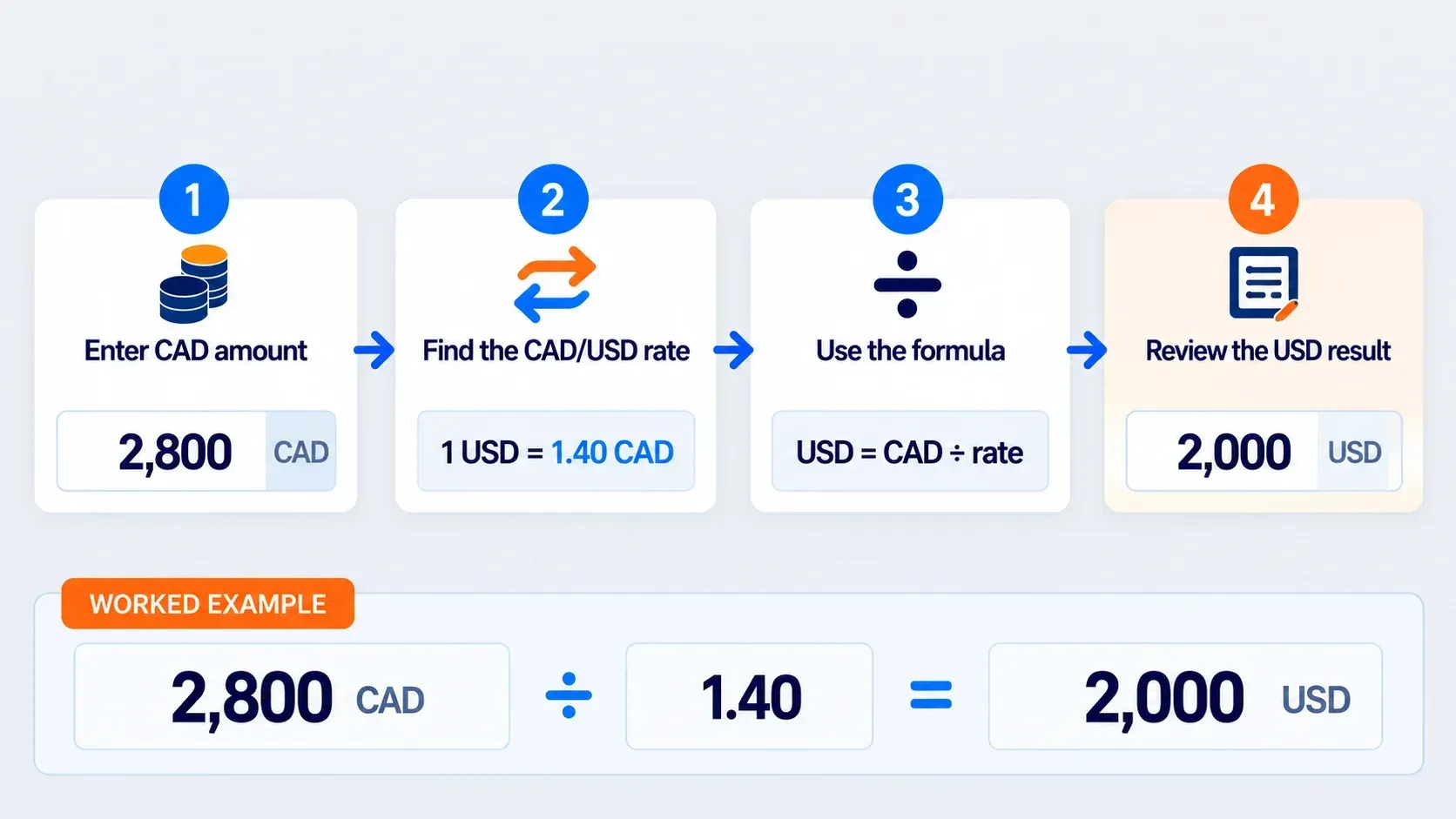
To calculate CAD to USD, multiply your Canadian dollar amount by the exchange rate if it shows US dollars per CAD 1. If the rate shows Canadian dollars per USD 1, divide instead. Both methods work. The key is understanding which way the rate is quoted.
Whether you are setting a travel budget, checking a US purchase or working out the value of a business payment, the arithmetic follows the same rules. Once you know how to calculate CAD to USD, you can check a converter’s result, understand a quote and spot mistakes before they affect your budget.
The rates and fees in the examples below are hypothetical. The main reference rate is USD 1 = CAD 1.40, with an inverse of approximately USD 0.7143 per CAD. Calculations use the unrounded inverse, 1 ÷ 1.40. These examples are not current market rates or MTFX quotes.
How does the CAD to USD calculation work?
Before calculating, check how the exchange rate is quoted. The direction of the rate determines whether you multiply or divide.
If 1 CAD ≈ USD 0.7143, each Canadian dollar is worth about 71.43 US cents. This can be written as CAD/USD ≈ 0.7143. To convert CAD to USD, multiply your Canadian dollar amount by the USD per CAD rate.
Using 1 ÷ 1.40 rather than rounding the inverse rate helps preserve precision in the calculation.
If the rate is instead shown as 1 USD = CAD 1.40, or USD/CAD = 1.40, one US dollar costs CAD 1.40. In this case, divide your Canadian dollar amount by the CAD-per-USD rate.
Both quotes describe the same currency relationship from opposite directions. The calculation changes because the quote direction changes, but the result in this example is the same.
The formula stays the same, but the exchange rate you apply can change the cost of buying US dollars. Compare CAD to USD exchange rates below to see the difference between the Canadian-dollar cost with MTFX and a bank.
| Field | Value |
|---|---|
Amount Payable (USD) 15,000 | |
Bank Exchange Rate 1.4252 / 0.7016 | |
Total cost 21,378.69CAD |
| Field | Value |
|---|---|
Amount Payable (USD) 15,000 | |
MTFX Exchange Rate 1.4008 / 0.7139 | |
Total cost 21,011.9CAD |
You Save
CAD 366.79
with MTFX
30 October 2026
We use mid-market rates. This is for informational purposes only. Log in to view send rates.
Should you multiply or divide by the exchange rate?
Whether you multiply or divide depends on how the exchange rate is quoted, not which currency is stronger.
The first currency in a currency pair is the base currency. A simple rule is to multiply when converting from the base currency and divide when converting into it.
If the terminology feels unfamiliar, read the rate in plain language. For example, “one US dollar costs 1.40 Canadian dollars” makes it easier to see why you divide a CAD amount by 1.40 when calculating its USD value.
How do you calculate CAD to USD step by step?
Start with your amount, identify the rate direction, apply the formula and check the result. Let’s use a CAD 2,800 budget for a US trip, with a hypothetical rate of USD 1 = CAD 1.40.
Step 1: Write down the Canadian dollar amount
Your starting budget is CAD 2,800. Label it CAD rather than simply using a dollar sign, since both currencies use “$”. For this example, the full amount is available for conversion and there are no fees.
Step 2: Check the rate direction
The quote tells you how many Canadian dollars buy one US dollar. That means you have a CAD-per-USD rate, so division is the correct operation.
Step 3: Calculate the US dollar value
Step 4: Check the answer and round at the end
Reverse the arithmetic: 2,000 × 1.40 = 2,800. Getting back to the starting amount confirms that the calculation is consistent.
Keep the available exchange-rate precision while calculating, then round the final amount to cents. If your rate has several decimal places, rounding it early can change the result, particularly on larger amounts.
The MTFX currency exchange calculator offers another way to check an estimated value. When comparing it with your manual answer, make sure both calculations use the same rate and conversion direction.
How do you calculate CAD to USD in Excel or Google Sheets?
You can calculate CAD to USD in a spreadsheet by placing the amount and exchange rate in separate cells, then applying the matching formula. Clear column labels make the sheet easier to use and reduce the chance of multiplying when you should divide.
Divide when the rate is CAD per USD
Suppose you want to calculate the US dollar value of CAD 14,000 at a hypothetical USD/CAD rate of 1.40. Set up your spreadsheet as follows:
The formula divides the CAD amount by the rate, then rounds the final answer to two decimal places.
Multiply when the rate is USD per CAD
If B2 contains the number of US dollars per Canadian dollar, use multiplication instead. For the same hypothetical rate, enter =1/1.40 in B2 to retain the inverse rate’s precision.
Rename the B column “Exchange rate: USD per CAD” so its heading matches the value it contains.
Label the rate and its date clearly
Add a column for the rate date or source if you are comparing budgets, purchases or invoices over time. A correct formula can still produce an unsuitable estimate when the rate belongs to the wrong date.
Enter amounts as numbers and apply currency formatting to the cells. Keep separate fees in their own clearly labelled cells, and avoid rounding the exchange rate before the calculation is complete.
How do you reverse the calculation from USD to CAD?
To reverse the calculation, change the operation while keeping the same rate. This is useful when you know a US purchase price or invoice amount and want to work out its Canadian dollar equivalent.
Calculate the CAD needed for a USD amount
Suppose a Canadian business has a USD 2,000 supplier invoice. At the hypothetical rate of CAD 1.40 per USD, the calculation is:
The same method works for a personal expense, such as a USD hotel bill. The purpose of the payment changes, but the formula stays the same.
Find the inverse exchange rate
You can also express a reference rate in the opposite direction by dividing 1 by that rate.
A reverse USD to CAD calculation should return the original amount when you use the same underlying rate without fees or rounding differences. Actually exchanging money and then exchanging it back can produce a different result because customer buy and sell rates, charges and market prices may differ.
How to calculate the exchange rate from two amounts?
If you know the Canadian dollar amount paid and the US dollar amount received, you can work backwards to calculate the rate. The order of the division determines whether your answer shows CAD per USD or USD per CAD.
Calculate the rate in Canadian dollars per US dollar
Suppose CAD 7,050 was converted into USD 5,000, with no separate fees included in either amount. Divide the Canadian dollar amount by the US dollar amount to find the CAD cost of each US dollar.
You can check the result by multiplying USD 5,000 by 1.41, which returns CAD 7,050.
Calculate the rate in US dollars per Canadian dollar
To find how many US dollars each Canadian dollar bought, reverse the order of the division.
This expresses the same conversion in the opposite direction.
Know the difference between conversion rate and cost
If the CAD amount includes a separate fee, dividing the total paid by the USD received gives an effective cost per US dollar. That figure may differ from the exchange rate shown on your quote.
For example, suppose CAD 7,000 was converted at USD/CAD 1.40, producing USD 5,000. A separate CAD 50 fee brings the total paid to CAD 7,050.
Both figures are correct, but they answer different questions. One identifies the conversion rate; the other shows the total Canadian dollar cost of each US dollar received. Check which amounts you are using before interpreting the result.
Which exchange rate should you use in your calculation?
Use a rate that matches what you are trying to estimate. A reference rate can help you understand a value, while a customer quote is more relevant to the amount available for a particular transaction.
Use reference rates for estimated values
The Bank of Canada’s daily exchange rates express the Canadian dollar value of one unit of foreign currency. Its US dollar figure therefore tells you how many Canadian dollars equal USD 1. Divide a CAD amount by that figure to calculate its indicative USD value.
These are daily average reference rates, not live customer quotes. If you are checking a value from an earlier date, historical exchange rates can help you find a date-appropriate reference instead of applying today’s rate to an old amount.
Use customer rates for a actual conversions
A customer rate may include the provider’s pricing margin. That helps explain why a calculation using a mid-market exchange rate can differ from the amount shown on a transaction quote.
If the margin is already included in the quoted rate, do not subtract it again. Apply that rate to the amount being converted, then account for any separate fees according to how they are charged.
Do the fees change the CAD to USD calculation?
Yes. A fee affects the calculation differently depending on its currency and whether it is deducted from your funds or charged separately. The following are two separate examples using a hypothetical rate of CAD 1.40 per USD. The calculations divide by 1.40 to avoid rounding the inverse rate.
When a CAD fee is deducted before conversion
You have a total CAD 1,400 budget, and a CAD 10 fee comes out of that budget. Only CAD 1,390 remains to convert.
When a USD fee is deducted after conversion
In this separate scenario, all CAD 1,400 is converted, but a USD 10 fee is deducted from the proceeds.
If a CAD 10 fee is charged on top of a CAD 1,400 conversion instead, you pay CAD 1,410 in total and receive USD 1,000, assuming no other deductions. Checking whether the fee is included in your budget or added to it avoids an easy mistake.
How does a changing rate affect your calculation?
The formula stays the same when exchange rates move, but the result changes. For a fixed CAD budget, a higher USD-per-CAD rate means more US dollars. For a fixed USD bill, a higher CAD-per-USD rate means a larger Canadian dollar cost.
Consider a hypothetical USD 5,000 expense, such as tuition or a supplier invoice:
The USD expense is unchanged, but its Canadian dollar cost rises by CAD 250. This is why a budget calculated earlier may need updating before payment.
Currency charts help put rate changes in context. Check the pair displayed: a rising USD/CAD rate means CAD buys fewer US dollars, while a rising CAD/USD rate means CAD buys more.
For future budgeting, the Canadian dollar forecast can provide context for testing different rate assumptions. Keep forecast-based calculations labelled as scenarios, since a forecast is not a guaranteed rate or a current quote.
How do you calculate the percentage change in USD received?
To measure how your USD result changes, subtract the original result from the new result, divide by the original result and multiply by 100. Use the same starting CAD amount in both calculations so the comparison is meaningful.
Calculate the dollar difference first
Suppose your available budget is CAD 14,000. Compare its USD value at two hypothetical USD/CAD rates:
The same Canadian dollar budget produces approximately USD 140.85 less at the higher USD/CAD rate.
Express the change as a percentage
Use the original USD result as the starting point for your percentage calculation. Keep the new conversion result unrounded until the final step.
The negative sign means the USD amount has decreased.
Separate the rate change from the amount change
The USD/CAD quote rises from 1.40 to 1.42, an increase of approximately 1.43%. However, the USD amount received falls by approximately 1.41%.
Those percentages differ because the USD amount is calculated by dividing by the rate. When measuring the effect on your budget, calculate the change in the amount you receive rather than assuming it exactly matches the percentage movement in the quote.
How much difference does rounding the exchange rate make?
Rounding the exchange rate before calculating can change the result more than you might expect. The difference becomes larger as the amount being converted increases.
Avoid rounding the rate too early
At a hypothetical USD/CAD rate of 1.40, the inverse rate is approximately USD 0.714285… per CAD. Rounding that inverse to 0.71 before multiplying removes precision from every Canadian dollar being converted.
Here is what happens with CAD 100,000:
That difference comes entirely from the calculation method, not from a fee or a market movement.
Round the money amount, not the rate
Use the available precision of the rate throughout your calculation, then round the final CAD or USD amount to cents. If you need an inverse rate, use 1 ÷ rate directly rather than manually entering a shortened decimal.
In a spreadsheet, displaying fewer decimal places is different from replacing the underlying value with a rounded number. Keep the full value available to the formula even when the cell displays a shorter version.
What mistakes can result in an incorrect CAD to USD calculation?
Most errors come from using the rate in the wrong direction, mixing currencies or overlooking what the quoted amount includes. A quick check of the inputs is often enough to catch them.
How can you check whether your conversion answer makes sense?
You can check a CAD to USD calculation by looking at the expected size of the result, reversing the arithmetic and confirming that the currencies are labelled correctly. These checks help catch mistakes before you use the figure in a budget or payment estimate.
Check whether the result makes sense
At the hypothetical rate of USD 1 = CAD 1.40, the numerical USD amount should be smaller than the starting CAD amount. Each US dollar requires more than one Canadian dollar.
For CAD 1,400, compare these two calculations:
This check depends on the rate being used. It is not a permanent rule that a CAD amount must produce a smaller USD number under every possible exchange rate.
Reverse the arithmetic
Use the opposite operation to check whether you recover the starting amount.
A small difference can occur if you reverse a result that has already been rounded to cents. If fees were deducted, check the currency conversion before those deductions, or account for them separately.
Check that the amounts scale consistently
At the same rate and before fees, doubling the starting amount should double the converted amount. If CAD 1,400 equals USD 1,000, then CAD 2,800 should equal USD 2,000.
If your results do not follow that relationship, check for a mistyped amount, an incorrect spreadsheet reference or different rates being used in the two calculations.


Make your next CAD to USD conversion count with MTFX
A reliable currency calculation starts with one simple question: what does one unit of this currency equal? Once that is clear, choosing multiplication or division becomes much easier.
For a personal budget or a business payment, label the currencies, keep the rate’s precision and check how fees are applied. When you are ready to put a current value to your amount, check the CAD to USD exchange rate with MTFX and use the same steps to understand the result.
You’ve done the maths. Now get more from your Canadian dollars. Sign up with MTFX for a competitive CAD to USD quote and see how much you could save on your next transfer.
FAQs
1. How do I calculate CAD to USD manually?
Multiply your CAD amount by a rate expressed as USD per CAD, or divide it by a rate expressed as CAD per USD. For example, at a hypothetical CAD 1.40 per USD, CAD 140 ÷ 1.40 equals USD 100 before fees.
2. Do I multiply or divide by 1.40 to convert CAD to USD?
Divide by 1.40 if the quote means USD 1 equals CAD 1.40. For example, CAD 560 ÷ 1.40 equals USD 400. The number alone is not enough; confirm which currency the rate treats as one unit.
3. Is CAD/USD the same as USD/CAD?
No. CAD/USD expresses US dollars per Canadian dollar, while USD/CAD expresses Canadian dollars per US dollar. For the same underlying reference rate, they are reciprocals: divide 1 by one rate to obtain the other, subject to rounding.
4. How do I calculate USD to CAD using the same rate?
Reverse the operation used for Canadian to US dollars. If your rate is CAD 1.40 per USD, multiply the USD amount by 1.40. If you are using the inverse USD-per-CAD rate, divide the USD amount by that unrounded inverse.
5. How many decimal places should I use?
Use the available precision of the supplied rate throughout the calculation, then round the final CAD or USD amount to two decimal places. Rounding a rate too early can create noticeable differences when converting larger amounts.
6. Why does my calculation differ from an online converter?
You may be using a different rate, timestamp or rounding method. Your calculation might also use a reference rate while the other figure includes customer pricing or fees. Compare the inputs before assuming the arithmetic is wrong.
7. Does the CAD to USD formula include fees?
The basic conversion formula does not include separate fees. Adjust it according to the fee’s currency and treatment. A CAD fee deducted from the starting budget reduces the amount converted; a USD deduction reduces the proceeds after conversion.
8. Can I calculate CAD to USD using a Bank of Canada rate?
Yes, for an indicative calculation. The Bank of Canada expresses its US dollar rate as Canadian dollars per USD 1, so divide your CAD amount by that rate. A transaction quote may differ from this daily average reference rate.
Disclaimer: This article is for general educational purposes. Rates and fees used in examples are hypothetical. Actual conversion amounts depend on the applicable exchange rate, charges, rounding and transaction terms.