What is a SWIFT Code? Meaning, Format, Examples & How It Works
A SWIFT code is an internationally recognized bank identifier used to route cross-border payments through the SWIFT network. It identifies the recipient's bank during an international transfer, helping financial institutions send money securely and accurately across countries.
International money transfers rely on more than a recipient's name and bank account number. To ensure your payment reaches the correct bank anywhere in the world, financial institutions use a unique identifier known as a SWIFT code. Whether you're paying overseas tuition, purchasing property abroad, supporting family, or sending business payments, providing the correct SWIFT code helps your transfer reach the right destination without unnecessary delays.
Although SWIFT codes are commonly requested when sending money internationally, many people are unsure what they actually do or how they differ from other banking details like IBANs, routing numbers, or account numbers. Understanding how these codes work can help you avoid payment errors, speed up international transfers, and ensure your funds arrive where they're supposed to.
MTFX has been helping Canadians send money globally since 1996. As a Canadian-based, FINTRAC-registered Money Services Business (MSB), MTFX offers secure international money transfers, competitive exchange rates, and dedicated support for personal and business payments to more than 190 countries. Whether you're making a one-time transfer or sending money regularly, knowing how SWIFT codes work is an important part of every successful international payment.
What is a SWIFT code?
A SWIFT code is a unique identifier assigned to a financial institution that allows banks and payment providers to identify one another when processing international money transfers. Rather than identifying an individual bank account, it identifies the bank receiving the payment, ensuring funds are routed to the correct financial institution through the global SWIFT network.
Think of a SWIFT code as an international address for a bank. Just as a postal code helps deliver a letter to the correct location, a SWIFT code helps route your payment to the correct bank, even when multiple institutions have similar names or operate in different countries.
Today, more than 11,000 financial institutions across over 200 countries and territories use the SWIFT network to exchange secure payment instructions. While SWIFT itself does not hold or transfer money, it provides the standardized messaging system that banks use to communicate payment information quickly and securely. For this reason, it remains one of the most widely used systems for international banking.
Why is a SWIFT code important?
Entering the correct SWIFT code helps ensure that:
- Your payment reaches the intended bank.
- Banks can process international transfers efficiently.
- The risk of payment delays or rejected transactions is reduced.
- Cross-border payments follow internationally recognized banking standards.
Without a valid SWIFT code, an international payment may be delayed, returned to the sender, or routed to the wrong financial institution, potentially resulting in additional bank charges and longer processing times.
When is a SWIFT code required?
You may be asked for a SWIFT code when sending money internationally for purposes such as:
- Supporting family or friends overseas
- Paying international tuition fees
- Purchasing property abroad
- Sending retirement or pension income overseas
- Paying overseas suppliers or contractors
- Receiving international business payments
- Transferring funds between your own foreign bank accounts
In many cases, you'll also need the recipient's account number or IBAN (International Bank Account Number), depending on the destination country.
| Field | Value |
|---|---|
Amount Payable (USD) 20,000 | |
Bank Exchange Rate 1.4372 / 0.6958 | |
Total cost 28,743.19CAD |
| Field | Value |
|---|---|
Amount Payable (USD) 20,000 | |
MTFX Exchange Rate 1.4125 / 0.7080 | |
Total cost 28,250.05CAD |
You Save
CAD 493.14
with MTFX
23 September 2026
We use mid-market rates. This is for informational purposes only. Log in to view send rates.
What does SWIFT stand for?
SWIFT stands for the Society for Worldwide Interbank Financial Telecommunication. Founded in 1973, the organization was created to establish a standardized and secure way for banks around the world to exchange payment instructions electronically.
Before SWIFT existed, international banking communication often relied on manual processes and telex messages, which were slower, inconsistent, and more prone to errors. By introducing a common messaging standard, SWIFT transformed how financial institutions communicate across borders and significantly improved the speed, reliability, and security of international payments.
Today, SWIFT serves as the backbone of global banking communications. Every day, millions of standardized financial messages pass through the network, supporting international wire transfers, securities trading, foreign exchange transactions, trade finance, and other financial services. SWIFT
Does SWIFT move your money?
This is one of the biggest misconceptions.
A SWIFT code does not transfer money itself.
Instead, the SWIFT network securely transmits payment instructions between financial institutions. Once those instructions are received, the participating banks complete the movement of funds using their own settlement processes and correspondent banking relationships.
How does a SWIFT code work?
When you send money overseas, several financial institutions often work together behind the scenes to move your payment from one country to another. The SWIFT code tells each institution exactly which bank should receive the payment instructions, reducing confusion and helping the transaction move smoothly.
Although the process usually takes only a few clicks from the sender's perspective, there's a sophisticated communication network operating in the background.
Here's what typically happens during an international transfer:
- Initiate the international transfer through your bank or payment provider.
- Provide the recipient's bank details, account number or IBAN, and SWIFT code.
- Your bank sends the payment instructions through the SWIFT network.
- Intermediary banks route the payment if required.The receiving bank verifies the details and deposits the funds into the recipient's account.
For many transfers, the sender never notices these intermediate steps. However, understanding this process helps explain why international payments may occasionally take longer than domestic transfers, particularly when multiple correspondent banks are involved or additional compliance checks are required.
Example
Imagine you're a Canadian parent paying tuition fees to a university in Germany.
Rather than sending money directly to the university, your bank first creates a payment instruction containing:
- The recipient's name
- Their account number or IBAN
- The university's bank's SWIFT code
- The payment amount and currency
Using the SWIFT network, this information is securely transmitted to the appropriate financial institutions. Once the receiving bank confirms the payment details, the funds are deposited into the university's account.
The SWIFT code acts like a routing guide throughout this journey, helping every participating bank identify exactly where the payment needs to go.
What does a SWIFT code look like?
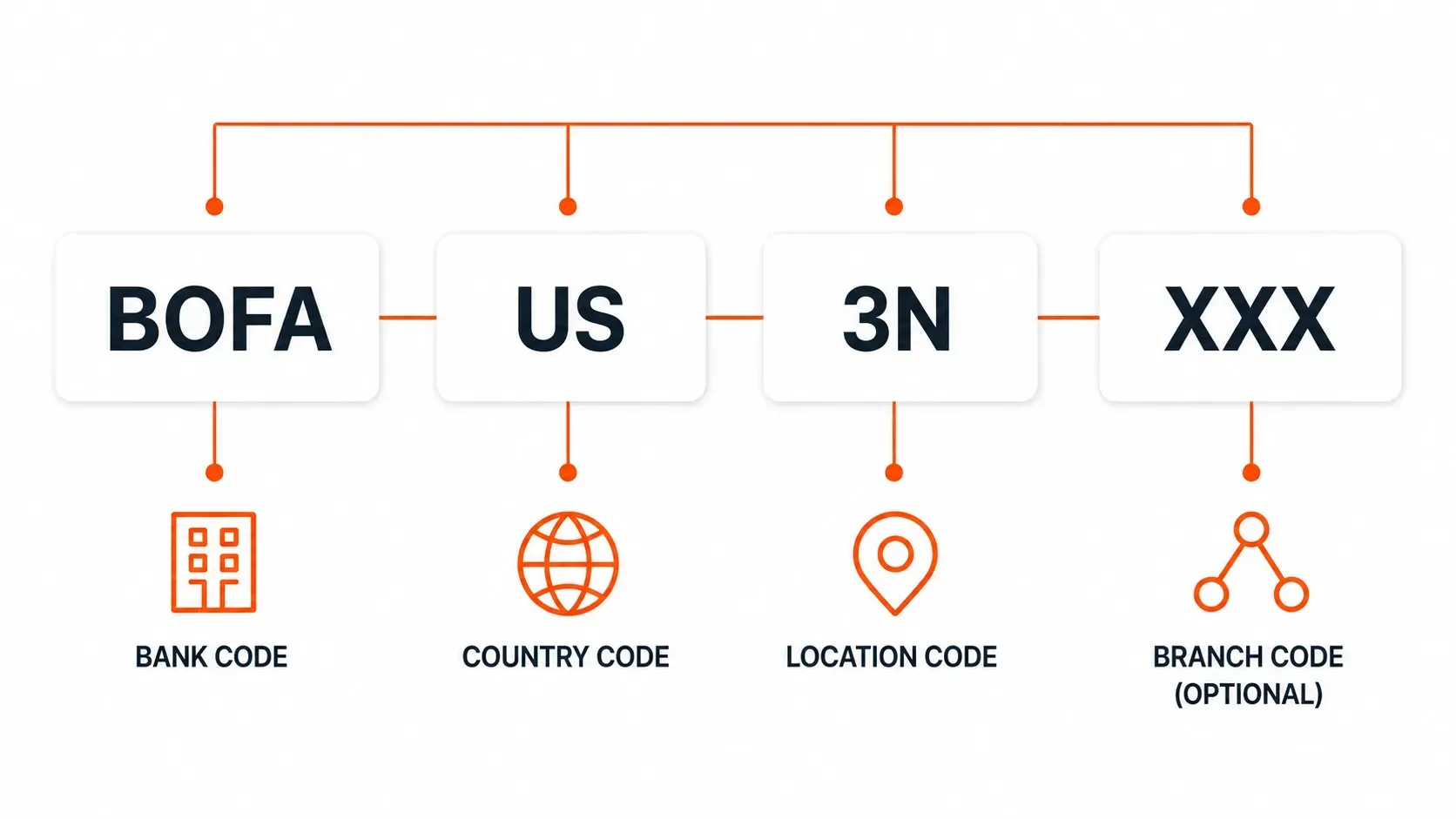
Although every bank has its own unique SWIFT code, they all follow the same internationally recognized structure defined under the ISO 9362 standard. This standardized format allows financial institutions worldwide to identify banks quickly and consistently.
A SWIFT code contains 8 or 11 characters, with each section providing specific information about the receiving bank. SWIFT explains that a BIC contains an 8-character business party identifier, with an optional 3-character branch identifier used for specific locations, departments, services, or units.
SWIFT code format
Example
BOFAUS3NXXX
Many banks use an 8-character SWIFT code for their main office, while the 11-character version identifies a specific branch. If no branch code is provided, the transfer is generally routed through the bank's primary office.
Where can you verify a SWIFT code?
Before sending money internationally, it's worth confirming that the SWIFT code provided is accurate. Even a single incorrect character can delay or interrupt a payment.
You can verify a bank's SWIFT code by:
- Checking the recipient bank's official website
- Reviewing bank statements
- Contacting the recipient directly
- Using the MTFX BIC/SWIFT Code Checker to validate bank details before initiating your transfer
What is the difference between a SWIFT code, BIC, and IBAN?
These three banking terms are often mentioned together, but they serve different purposes. Knowing the difference can help you avoid errors when completing an international money transfer.
A SWIFT code identifies the recipient's bank, while an IBAN (International Bank Account Number) identifies the recipient's individual bank account. The term BIC (Bank Identifier Code) is often used interchangeably with SWIFT code because both refer to the same international bank identifier.
Think of it this way: if you're mailing a package overseas, the SWIFT/BIC code identifies the post office, while the IBAN identifies the exact mailbox where the package should be delivered.
SWIFT vs. BIC vs. IBAN at a glance
In many international transfers, you'll need both the SWIFT code and the IBAN. The SWIFT code ensures your payment reaches the correct financial institution, while the IBAN directs the receiving bank to the correct account.
If you're unsure whether an IBAN is valid, you can use the MTFX IBAN Checker before initiating your transfer. Besides, keep an eye on live exchange rates to get more value for your international payment transfer.
Monitor live exchange rates before sending money internationally
| Currency | Rates | High | Low | Daily |
|---|---|---|---|---|
 USD | 1.4090 | 1.4092 | 1.4054 | 0.24% |
 EUR | 1.6074 | 1.6104 | 1.6059 | -0.13% |
 INR | 67.93 | 68.21 | 67.91 | -0.42% |
 GBP | 1.8711 | 1.8770 | 1.8697 | -0.22% |
 CNY | 4.7587 | 4.7778 | 4.7450 | -0.35% |
 JPY | 112.10 | 112.15 | 111.84 | 0.18% |
 MXN | 12.37 | 12.43 | 12.34 | -0.08% |
Use MTFX for secure international transfers and competitive exchange rates.
Is a SWIFT code the same as a BIC?
Yes. For most practical purposes, SWIFT code and BIC mean the same thing.
BIC stands for Bank Identifier Code, the official name defined under the ISO 9362 international standard. Because the SWIFT organization administers these codes worldwide, banks and payment providers commonly refer to them as SWIFT codes.
Whether a bank asks for a SWIFT code or a BIC, you'll typically provide the same 8- or 11-character identifier.
When do you need a SWIFT code?
A SWIFT code is generally required whenever money is transferred between banks in different countries. It allows financial institutions to exchange payment instructions accurately, particularly when multiple banking networks are involved.
Although domestic transfers often rely on local payment systems, international transfers typically require additional information to ensure funds reach the intended bank.
Common situations where you'll need a SWIFT code
- Sending money to family overseas
Whether you're helping relatives with living expenses or sending a one-time financial gift, the recipient's bank may require a SWIFT code to receive international funds securely.
If you regularly support loved ones abroad, using a specialist provider such as MTFX Regular Money Transfers can simplify recurring payments while providing competitive exchange rates.
- Paying international tuition fees
Many Canadian students study overseas, and universities commonly request both an IBAN and a SWIFT code for tuition payments.
Providing accurate banking details helps ensure your payment arrives before important enrollment deadlines.
- Purchasing property abroad
Buying real estate overseas often involves sending large international transfers to lawyers, escrow companies, or property developers.
In addition to verifying the recipient's account details, confirming the correct SWIFT code can help prevent delays during time-sensitive property transactions. Learn more about international property payments.
- Paying overseas suppliers
Canadian businesses frequently use SWIFT transfers when paying international suppliers, manufacturers, and contractors.
Accurate banking information helps reduce payment delays while supporting stronger supplier relationships.
Businesses managing frequent international payments may benefit from MTFX Global Payments, which offers streamlined cross-border payment solutions.
- Receiving international payments
If someone is sending money to your Canadian bank account from another country, they may also request your bank's SWIFT code to ensure the payment reaches the correct institution.
How do you find a SWIFT code?
Fortunately, finding a SWIFT code is usually straightforward. Most banks make this information publicly available because customers regularly need it for international transfers.
If you're receiving funds, always confirm the code directly with your bank rather than relying on outdated information from unofficial websites.
Ways to locate a SWIFT code
- Check your bank's website
Most financial institutions publish their SWIFT codes on their international payments or wire transfer pages.
- Review your bank statement
Some banks include SWIFT or BIC information on monthly account statements.
- Use online banking
International wire transfer instructions within your online banking portal often display the appropriate SWIFT code.
- Contact customer support
Your bank's customer service team can confirm the correct SWIFT code for your specific account or branch.
- Use a trusted SWIFT lookup tool
The MTFX BIC/SWIFT Code Checker allows you to search and validate SWIFT codes before submitting your transfer.
Banks occasionally merge, rebrand, or update branch information. Verifying the SWIFT code before initiating a payment reduces the likelihood of processing delays or returned transfers.
Can you send money internationally without a SWIFT code?
Sometimes—but it depends on where you're sending money and which payment network is being used.
Not every international payment travels through the SWIFT network. Some regions use alternative payment systems that don't require a SWIFT code.
Examples where a SWIFT code may not be required
For example, transfers made within the Single Euro Payments Area (SEPA) often rely on an IBAN rather than a SWIFT code. The European Payments Council provides detailed guidance on SEPA payment standards.
However, once funds move beyond domestic or regional payment systems, a SWIFT code is usually required to identify the receiving bank.
If you're uncertain about which banking details are needed, your payment provider can confirm the requirements before the transfer is initiated.
Common mistakes people make with SWIFT codes
Even small mistakes can delay an international payment or result in additional bank charges. Taking a few moments to review your banking details before sending money can save both time and frustration.
Some of the most common mistakes include:
- Confusing a SWIFT code with an IBAN.
- Entering the wrong bank's SWIFT code.
- Using an outdated branch code after a bank merger.
- Omitting required characters from the code.
- Copying the code incorrectly from unofficial sources.
- Assuming every international transfer uses the SWIFT network.
- Providing incomplete recipient banking information.
- Forgetting to verify the code before submitting the payment.
Whenever possible, confirm all banking details directly with the recipient or their financial institution before authorizing the transfer.
Why international transfers can be delayed even with the correct SWIFT code
Providing the correct SWIFT code is an important step, but it doesn't guarantee immediate delivery.
International payments pass through several verification and compliance processes before reaching the recipient, and delays can occur for reasons unrelated to the SWIFT code itself.
Common causes of international payment delays
Choosing an experienced international payment provider can help minimize avoidable delays by verifying payment information before funds are sent.
With MTFX, Canadian individuals and businesses benefit from secure international transfers, competitive foreign exchange rates, payment tracking, and dedicated customer support throughout the transfer process.
In the next section, we'll look at how to verify a SWIFT code step by step before sending an international payment, helping you reduce errors and improve the chances of a smooth transfer.
How to verify a SWIFT code before sending money
Taking a few minutes to verify a SWIFT code before initiating an international transfer can save you from unnecessary delays, returned payments, and additional banking fees. While SWIFT codes are standardized, entering even one incorrect character can prevent your payment from reaching the intended financial institution.
Whether you're sending money to family, paying tuition overseas, purchasing property abroad, or making international business payments, following a simple verification process helps ensure your transfer is processed the first time correctly.
Follow these steps to verify a SWIFT code
Step 1: Request the bank details directly from the recipient
Start by asking the recipient to provide their banking information exactly as it appears on official bank documents. This should include:
- Recipient's full legal name
- Bank name
- Account number or IBAN
- SWIFT/BIC code
- Bank branch, if applicable
Avoid relying on old emails or copied banking details, especially if the recipient has recently changed banks or accounts.
Step 2: Check the bank's official website
Most financial institutions publish their SWIFT codes on their international wire transfer or receiving payment pages.
Reviewing the information directly from the bank helps confirm that you're using the correct code for the intended branch or head office.
Step 3: Use a trusted SWIFT code lookup tool
If you're unsure whether the code is valid, use the MTFX BIC/SWIFT Code Checker to search and verify bank information before submitting your transfer.
A trusted lookup tool can help confirm:
- Bank name
- Country
- City
- Branch, if applicable
- SWIFT code format
Step 4: Confirm the IBAN or account number
A valid SWIFT code alone isn't enough. The recipient's account number or IBAN must also be correct to ensure the receiving bank can deposit the funds into the intended account.
If you're sending money to an IBAN country, you can also validate it using the MTFX IBAN Checker.
Step 5: Double-check everything before sending
Before confirming your payment, review:
- Recipient's name
- Bank name
- SWIFT code
- IBAN or account number
- Currency
- Payment amount
A quick review can help prevent avoidable mistakes that may delay your transfer.
Quick checklist before you send an international transfer
Use this simple checklist before authorizing any international payment.
- Recipient's name matches bank records.
- SWIFT code has been verified.
- IBAN or account number is correct.
- Currency matches the recipient's requirements.
- Payment amount has been confirmed.
- Supporting documents are available if required.
- Exchange rate has been reviewed.
- Transfer fees have been compared.
Completing these checks only takes a few minutes and can help reduce costly corrections after your payment has already been processed.
Why choose MTFX for international money transfers?
Entering the correct SWIFT code is only one part of sending money internationally. Choosing the right transfer provider can also make a significant difference to the overall cost, delivery speed, and customer experience. Instead of relying solely on traditional banks, many Canadians choose MTFX for secure cross-border payments backed by competitive foreign exchange rates and dedicated support.
Other notable benefits of choosing MTFX include;
- Secure international money transfers to more than 190 countries.
- Competitive exchange rates that may help you save compared to many traditional banks.
- Access to the BIC/SWIFT Code Checker and IBAN Checker.
- Personal and business payment solutions for global transfers.
- Dedicated customer support from experienced foreign exchange specialists.


Send international payments with MTFX
A SWIFT code may seem like a small piece of information, but it plays a critical role in ensuring international payments reach the correct financial institution safely and efficiently. Understanding what a SWIFT code is, how it works, and how to verify it before sending money can help reduce delays, avoid unnecessary fees, and improve the overall payment experience.
Whether you're supporting family overseas, paying tuition, purchasing property, or managing international business payments, taking the time to confirm your banking details is one of the simplest ways to avoid costly mistakes.
If you're looking for a smarter way to send money internationally, sign up with MTFX to access competitive exchange rates, secure global transfers, payment tracking, and expert support for personal and business payments to more than 190 countries.
FAQs
1. Is a SWIFT code required for every international transfer?
No. Some regional payment systems, such as SEPA within Europe, may not require a SWIFT code. However, most international bank wire transfers do.
2. Can one bank have multiple SWIFT codes?
Yes. Large banks often have different SWIFT codes for individual branches, departments, or regions, while others use one code for all international transfers.
3. How many characters are in a SWIFT code?
A SWIFT code contains either 8 or 11 characters. The first eight identify the bank and its location, while the final three identify a specific branch when applicable.
4. What happens if I enter the wrong SWIFT code?
Your payment may be delayed, rejected, returned, or sent to the wrong financial institution, depending on the error and how it is processed.
5. Can I find a SWIFT code using an IBAN?
Sometimes. Many banks can identify the associated financial institution from an IBAN, but it's always best to verify the SWIFT code separately before sending money.
6. Are SWIFT codes public?
Yes. Banks publish their SWIFT codes on their websites and through official banking directories because customers need them for international transfers.
7. Is a SWIFT code the same as a routing number?
No. A routing number is used primarily for domestic transfers within the United States, while a SWIFT code identifies banks during international payments.
8. Does Canada use SWIFT codes?
Yes. Canadian banks use SWIFT codes to send and receive international wire transfers. If you're sending money to or from Canada, the SWIFT code helps route the payment to the correct financial institution.
9. Can businesses use SWIFT codes?
Yes. Businesses use SWIFT codes for international supplier payments, overseas invoices, global payroll, and cross-border trade. The correct SWIFT code helps reduce payment errors and delays.
10. Is it safe to share a SWIFT code?
Yes. A SWIFT code identifies a financial institution, not your personal bank account. Sharing your SWIFT code for the purpose of receiving an international payment is generally considered safe, provided you only share your banking information with trusted parties.