Intercompany vs Supplier Payments: Choosing the Right Payment Approach
Intercompany and supplier payments may look similar when money moves across borders, but the relationship between the entities and purpose of the payment can change how the transaction is documented and reconciled. This guide explains the key differences with practical business examples.
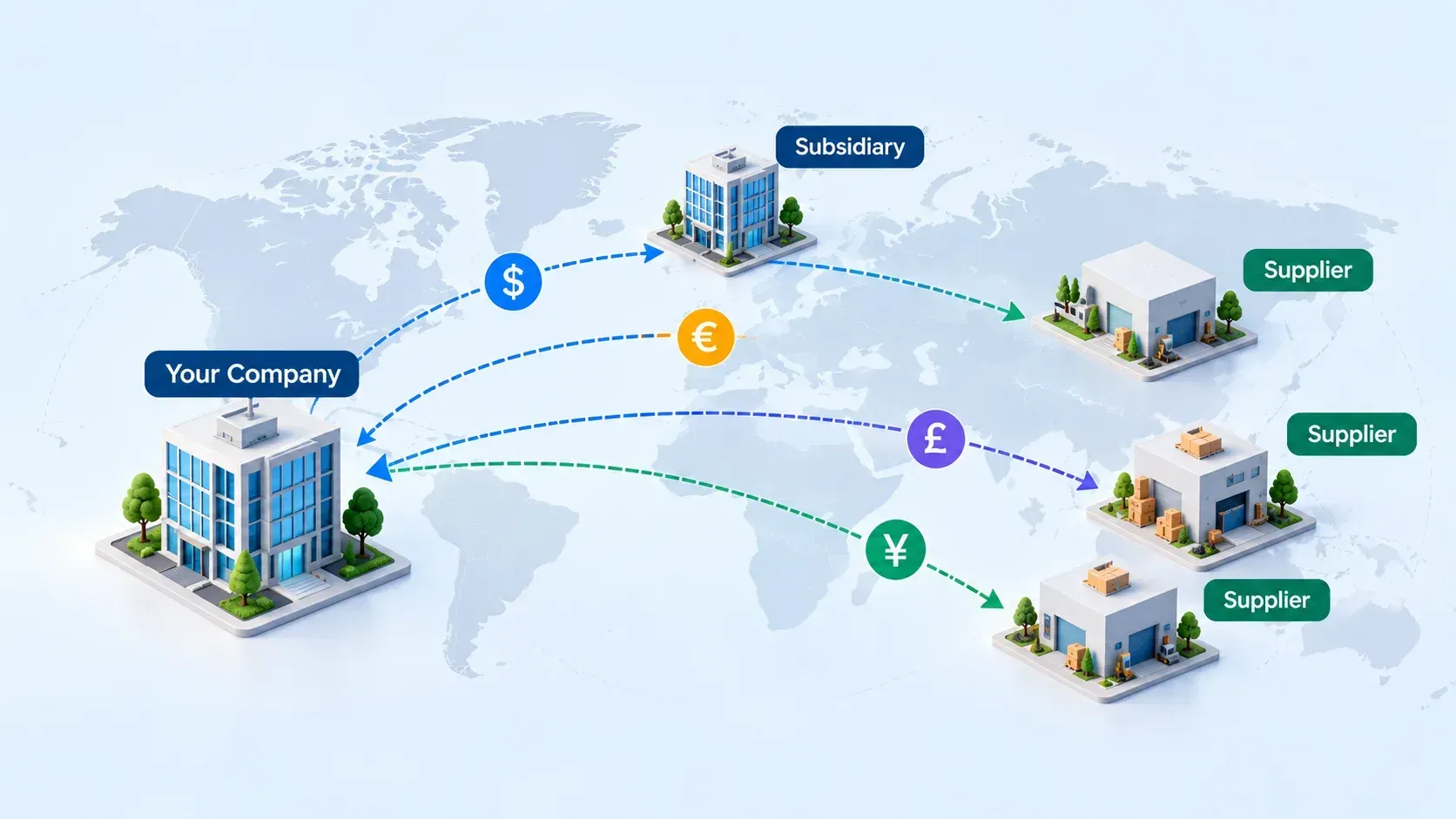
Intercompany and supplier payments can both involve moving money across borders, but they are not classified or documented in the same way. An intercompany payment takes place between entities within the same corporate group, while an independent supplier payment settles an obligation to a business outside the group.
The distinction matters for Canadian businesses because it can affect the supporting documents, approvals, accounting treatment, payment references and reconciliation process surrounding the transaction.
There is also an important overlap. A supplier payment can sometimes be an intercompany payment. If a US subsidiary sells products to its Canadian parent, for example, the payment relates to a supplier transaction while also taking place between two companies in the same corporate group.
For finance, accounting, accounts payable and treasury teams, the practical question is therefore not simply where the money is going. It is who the entities are, why the payment exists and what records support it.
What is the difference between intercompany and supplier payments?
The main difference between intercompany and supplier payments is the relationship between the payer and recipient. Intercompany payments move between related entities within a corporate group, while independent supplier payments are made to businesses outside that group for goods or services.
The underlying purpose of an intercompany payment can also vary considerably. It may settle an invoice, fund a subsidiary, repay a loan, distribute capital, recharge shared costs or settle several balances at once.
Intercompany describes the relationship
An intercompany transaction occurs between separate entities that form part of the same corporate structure, such as a parent and subsidiary or two subsidiaries under the same parent.
However, “related party” can be broader than simply parent companies and subsidiaries. IAS 24 Related Party Disclosures includes several types of relationships within its definition of a related party, so businesses should not automatically treat every related-party situation as identical.
A transfer between two bank accounts belonging to the same legal entity is also different. Even if one account is in Canada and another is overseas, that does not create an intercompany transaction because two separate companies are not involved.
Supplier describes the commercial role
Supplier describes why one party is being paid.
If a company purchases components, software, consulting services or raw materials from another business, the recipient is acting as a supplier. Whether that supplier is independent or part of the same corporate group is a separate question.
Keeping these two classifications separate avoids a common mistake: assuming “supplier payment” always means an external payment.
| Field | Value |
|---|---|
Amount Payable (USD) 25,000 | |
Bank Exchange Rate 1.4526 / 0.6884 | |
Total cost 36,314.29CAD |
| Field | Value |
|---|---|
Amount Payable (USD) 25,000 | |
MTFX Exchange Rate 1.4277 / 0.7005 | |
Total cost 35,691.26CAD |
You Save
CAD 623.04
with MTFX
8 October 2026
We use mid-market rates. This is for informational purposes only. Log in to view send rates.
Can a supplier payment also be an intercompany payment?
Yes. A company within the same corporate group can supply goods or services to another group company, making the payment both supplier-related and intercompany.
Consider a Canadian parent company that purchases USD 50,000 of inventory from its US subsidiary.
The transaction is:
- supplier-related because the US company supplied inventory
- intercompany because the Canadian and US entities belong to the same corporate group
- potentially subject to additional related-party accounting, documentation and pricing considerations
Now compare that with the same Canadian business buying USD 50,000 of inventory from an unrelated US manufacturer. The commercial purpose may look almost identical, but the relationship is different. That second transaction is an independent supplier payment.
For finance teams, this is why payment classification should start with two separate questions:
- What is the commercial or financial purpose of the payment?
- What is the relationship between the entities involved?
The answers determine what supporting records may be needed and how the transaction should be recorded.
How does intercompany payment documentation differ from supplier payment documentation?
Intercompany payment documentation should reflect the underlying purpose of the transaction. There is no single document that supports every payment simply because it occurs between companies in the same group.
An independent supplier payment will often begin with a commercial invoice or purchasing agreement. An intercompany payment could instead represent a service charge, loan repayment, capital contribution, dividend or settlement of multiple balances.
These are examples of typical records rather than a universal checklist. Documentation requirements can depend on the transaction, jurisdictions, corporate structure and applicable accounting, tax or regulatory rules.
Supplier documentation usually starts with the commercial obligation
For a conventional supplier payment, the audit trail may follow a relatively straightforward path:
Purchase order or contract → supplier invoice → internal approval → payment → supplier allocation → reconciliation
For example, suppose a Canadian importer receives a USD 30,000 invoice from an independent US supplier. The finance team may match the invoice to the purchase order, confirm that the goods were received, approve the payment and then reconcile the resulting payment against the supplier account.
The documents collectively show why the supplier was paid and which obligation was settled.
Intercompany documentation depends on why the money is moving
A payment between two subsidiaries should not automatically be treated as an expense.
For example, if a Canadian parent transfers USD 100,000 to a US subsidiary, the payment could represent:
- a loan to the subsidiary
- an equity contribution
- settlement of an intercompany invoice
- reimbursement of shared costs
- payment for inventory
- settlement of several intercompany balances
Each situation creates a different accounting story.
An invoice may support an intercompany purchase of goods or services, but it would not replace the appropriate documentation for a loan or capital contribution.
Canadian businesses with cross-border non-arm's-length transactions should also be aware of the Canada Revenue Agency's transfer pricing guidance. The CRA states that qualifying cross-border transactions between non-arm's-length parties are subject to Canada's transfer pricing framework and related record-keeping requirements.
Internal records and payment requirements are not the same thing
There is another distinction worth making.
The information required by a bank or international payment provider to process a transaction is not necessarily the same as the accounting, tax or corporate documentation a business should maintain internally.
A payment successfully reaching the beneficiary does not, by itself, establish the appropriate accounting or tax treatment.
Finance teams should therefore think about the transaction in two layers:
- What information is required to execute the payment?
- What records are required to explain and support the underlying transaction?
Both matter, but they serve different purposes.
What changes when intercompany or supplier payments cross borders?
When either type of payment becomes international, finance teams have additional details to consider, including the legal entities involved, currencies, beneficiary information, destination requirements and jurisdiction-specific rules.
Confirm the exact legal entities
Start by confirming:
- which entity owes the obligation
- which entity is making the payment
- which entity owns the beneficiary account
- which entity should record the transaction
- whether another group company is paying on behalf of the entity that originally incurred the obligation
These questions become particularly important in corporate groups with centralized treasury functions or multiple operating subsidiaries.
Cross-border does not always mean foreign exchange
An international payment does not automatically involve currency conversion.
A Canadian parent could, for example, maintain a USD account and send USD to a US subsidiary's USD account. The money crosses a border, but there may be no currency conversion at the time of payment.
Where currencies do need to be exchanged, however, FX movements can change the Canadian-dollar cost or value of the obligation between the invoice date and settlement date.
Finance teams can check current conversions using the MTFX live currency converter or follow broader market movements through live exchange rates. Businesses with a future payment date can also use currency rate alerts to monitor a chosen level rather than repeatedly checking the market.
Where payment timing extends further out, the Canadian dollar forecast provides a longer-term view of major CAD currency pairs, while the daily Canadian dollar update focuses on current market drivers. These tools provide market context, but the actual accounting classification of an intercompany or supplier payment still depends on the underlying transaction.
Check destination and beneficiary requirements
Cross-border payments may also require information that would not appear on the underlying invoice, such as:
- beneficiary account details
- routing information
- beneficiary address
- payment purpose information
- intermediary bank details where applicable
- locally required banking information
Requirements vary by country, currency and payment route, so finance teams should verify the information before initiating settlement.
How does supplier vs intercompany settlement differ?
Independent supplier settlement usually closes an external payable against one or more commercial invoices. Intercompany settlement can be more varied because the balance may relate to invoices, loans, recharges, funding or multiple transactions between group entities.
How supplier settlement works
A straightforward supplier settlement could look like this:
- The supplier issues an invoice.
- The company verifies the goods or services received.
- The invoice is approved for payment.
- The payment is sent.
- The supplier receives and applies the funds.
- Accounts payable reconciles the invoice and payment.
For example, a Canadian business pays EUR 40,000 against invoice INV-2057 from an independent German equipment supplier. Once the supplier applies the funds to INV-2057 and the Canadian company's payable is cleared, the settlement cycle is complete.
How intercompany settlement works
Intercompany settlement often requires both entities to agree on the balances before cash moves.
A basic process may include:
- Both entities record the underlying transactions.
- Intercompany balances are compared.
- Differences are investigated.
- Eligible balances are approved for settlement.
- Payment or an agreed offset is completed.
- Both entities reconcile their ledgers.
Timing differences, FX translation, inconsistent invoice numbers or different accounting periods can all cause the balances recorded by two group companies to differ.
What does intercompany netting mean?
Some corporate groups use netting to reduce the number or value of payments needed between entities.
Consider this simplified example:
The important point is that the USD 15,000 obligation has not simply disappeared. The finance team should still be able to trace the two original balances and show how the USD 25,000 settlement was calculated.
Netting eligibility and treatment can vary, so businesses should not assume every cross-border balance can automatically be offset.
Businesses dealing with broader multi-entity payment structures can also encounter centralized treasury, netting and funding arrangements. These are covered in more detail in MTFX's guide to intercompany transfers between global subsidiaries.
What should intercompany payment references include?
A useful intercompany payment reference should help the finance team connect the cash movement to the underlying document, entity, accounting period or settlement record.
A vague description such as “TRANSFER” may tell someone that money moved, but it does little to explain what the payment settled.
Consider the following illustrative references:
Take this example:
CA01-US02 SVC SEP26 IC1048
A finance team might use the elements as follows:
- CA01 identifies the Canadian entity
- US02 identifies the US entity
- SVC indicates a service charge
- SEP26 identifies the accounting period
- IC1048 points to the internal intercompany record
These are illustrative internal conventions, not official SWIFT or regulatory purpose codes. Businesses should adapt references to their own accounting controls, provider character limits and destination requirements.
A reference also does not replace the underlying documentation. SWIFT's structured remittance guidance illustrates how payment information can be connected to underlying documents and creditor references to support reconciliation.
Sensitive tax, ownership or commercially confidential information should normally remain within the appropriate internal records rather than being packed into a beneficiary-visible payment reference.
Three examples of how to classify a cross-border payment
The easiest way to see the difference between intercompany and supplier payments is to compare realistic situations.
Example 1: Paying an independent US supplier
A Canadian manufacturer purchases components from an unrelated US supplier.
Invoice: USD 25,000
Payer: Canadian manufacturer
Recipient: Independent US supplier
Purpose: Purchase of components
Classification: Independent supplier payment.
Typical supporting records could include the purchase order, supplier invoice, proof that the goods were received, internal approval and payment confirmation.
Once the supplier applies the USD 25,000 against the correct invoice, accounts payable can reconcile the transaction.
Example 2: Funding a US subsidiary
The same Canadian company sends USD 25,000 to its wholly owned US subsidiary.
The currency and amount are identical to the first example, but the payment cannot be classified correctly without knowing its purpose.
If the USD 25,000 is repayable under a loan agreement, it could be an intercompany loan.
If it represents permanent funding in return for equity, it could be a capital contribution.
If it settles a service invoice issued by the subsidiary, it could be an intercompany supplier payment.
The cash movement alone does not tell the whole story. The underlying obligation does.
Example 3: A parent company pays its subsidiary's supplier
Now suppose the US subsidiary owes USD 25,000 to an independent US supplier, but the Canadian parent sends the USD 25,000 directly to that supplier.
There are now two relationships to consider.
First, there is an external supplier obligation between the US subsidiary and the supplier.
Second, the Canadian parent has paid an obligation on behalf of its subsidiary. That can create a separate intercompany balance or funding relationship between the Canadian parent and US subsidiary.
This is why identifying only who received the payment is not always enough. Finance teams also need to understand whose obligation was settled and how any resulting group balance should be recorded.
What should finance teams check before closing a cross-border payment?
A cross-border payment should not automatically be considered fully reconciled because money has left the company's bank account. Finance teams should confirm that the payment reached the right destination and was applied to the correct obligation.
1. Confirm the correct legal entity
Check that the payer, beneficiary and accounting entity match the intended transaction.
2. Match the amount to the underlying obligation
Confirm whether the payment covers the full balance, a partial balance or several items.
If the amount received differs, investigate possible bank charges, deductions, FX conversion or partial settlement.
3. Confirm receipt
Payment instruction, bank confirmation and beneficiary receipt are separate checkpoints.
A successfully initiated payment does not necessarily mean the recipient has already applied the funds.
4. Confirm how the recipient allocated the payment
For supplier payments, check that the supplier applied the funds against the intended invoice or invoices.
For intercompany transactions, ensure the receiving entity clears the corresponding balance.
5. Match the payment reference
The reference on the transaction should connect clearly with the company's internal records.
Consistent reference formats become especially useful when businesses handle recurring or high-volume cross-border payments.
6. Reconcile both sides of intercompany transactions
Group entities should investigate differences rather than allowing mismatched balances to accumulate.
Common causes can include:
- different posting dates
- FX translation differences
- missing invoices
- inconsistent references
- disputed allocations
- payments recorded in different accounting periods
7. Retain the supporting records
Keep the records that explain the transaction, not only the bank confirmation.
Depending on the payment, that may include contracts, invoices, agreements, approvals, allocation calculations, loan records, netting statements and settlement confirmations.
What are common mistakes when classifying cross-border business payments?
Errors often occur when businesses classify a transaction based only on how the money moved rather than why it moved.
Treating every intercompany transfer as an expense
A transfer to a subsidiary could represent a loan, equity contribution, invoice payment, recharge or another balance. The accounting treatment should follow the transaction's substance.
Assuming every supplier payment is external
A subsidiary or another group company can also provide goods or services. Supplier status and entity relationship should therefore be considered separately.
Assuming every international payment involves currency conversion
Businesses can hold foreign-currency accounts and settle cross-border obligations without converting currency during the payment itself.
Using references that are too vague
Descriptions such as “payment,” “transfer” or “September” provide little information when finance teams later need to reconcile the transaction.
Treating payment confirmation as complete documentation
A payment receipt proves that money moved. It does not necessarily explain whether the transfer was a supplier expense, loan, equity contribution, recharge or another transaction.
Netting balances without preserving the underlying records
A net payment may simplify cash settlement, but finance teams should still be able to trace the gross obligations that produced the final amount.


Clear classification makes every payment easier to follow
Cross-border business payments become easier to manage when finance teams start with the transaction rather than the transfer itself.
Before deciding how an intercompany or supplier payment should be recorded and reconciled, establish who the entities are, why the obligation exists, what documents support it and how the settlement connects back to those records.
That approach is particularly valuable when the same corporate group is handling supplier invoices, subsidiary funding, recharges, loans and netted balances across several countries.
Once the obligation has been classified and approved, the actual transfer is the execution step. Businesses making cross-border settlements can use international business payment services to send funds to suppliers, subsidiaries and other business recipients while keeping the payment process separate from the accounting decision behind it.
The payment may take seconds or days to reach its destination. A clear audit trail should last much longer.
FAQs
1. Is a transfer to your own foreign bank account an intercompany payment?
No. If both accounts belong to the same legal company, the transaction is generally a transfer between accounts rather than an intercompany payment between two separate entities.
2. Does every intercompany payment require an invoice?
No. The correct documentation depends on why the payment is being made. Goods and services may be supported by an intercompany invoice, while a loan, capital contribution or distribution normally requires different supporting records.
3. Can a subsidiary be a supplier?
Yes. A subsidiary can supply goods or services to another company in the same corporate group. In that situation, the transaction can be both supplier-related and intercompany.
4. Can a parent company pay a supplier on behalf of its subsidiary?
Yes, this type of arrangement can occur. However, the external supplier payment and any balance or funding relationship created between the parent and subsidiary need to be identified and recorded appropriately.
5. Is an intercompany payment reference the same as a payment purpose code?
No. An internal payment reference helps a business identify and reconcile its transaction. A payment purpose code may instead be required by a bank, payment system or local regulation and can follow a prescribed format.
6. Does intercompany netting remove the need to keep the original invoices?
No. Netting can reduce the amount of cash that needs to move, but businesses should still retain records supporting the underlying balances and show how the net settlement was calculated.
7. Do cross-border intercompany payments always involve currency exchange?
No. Two entities in different countries may hold and transfer the same currency. FX conversion occurs only when the payment or funding arrangement requires one currency to be exchanged for another.
8. What records should be kept for an intercompany payment?
The records should support the underlying purpose of the transaction. Depending on the circumstances, that may include intercompany agreements, invoices, loan documentation, approvals, allocation calculations, accounting records, netting statements and payment confirmations.
Compare FX rates and manage global business payments.