Intercompany Money Transfers: Methods, Costs & FX
Businesses use intercompany transfers to settle invoices, fund operations, repay loans, distribute dividends or manage group liquidity. The right transfer method depends on the purpose, currencies, cost, documentation requirements and compliance considerations.
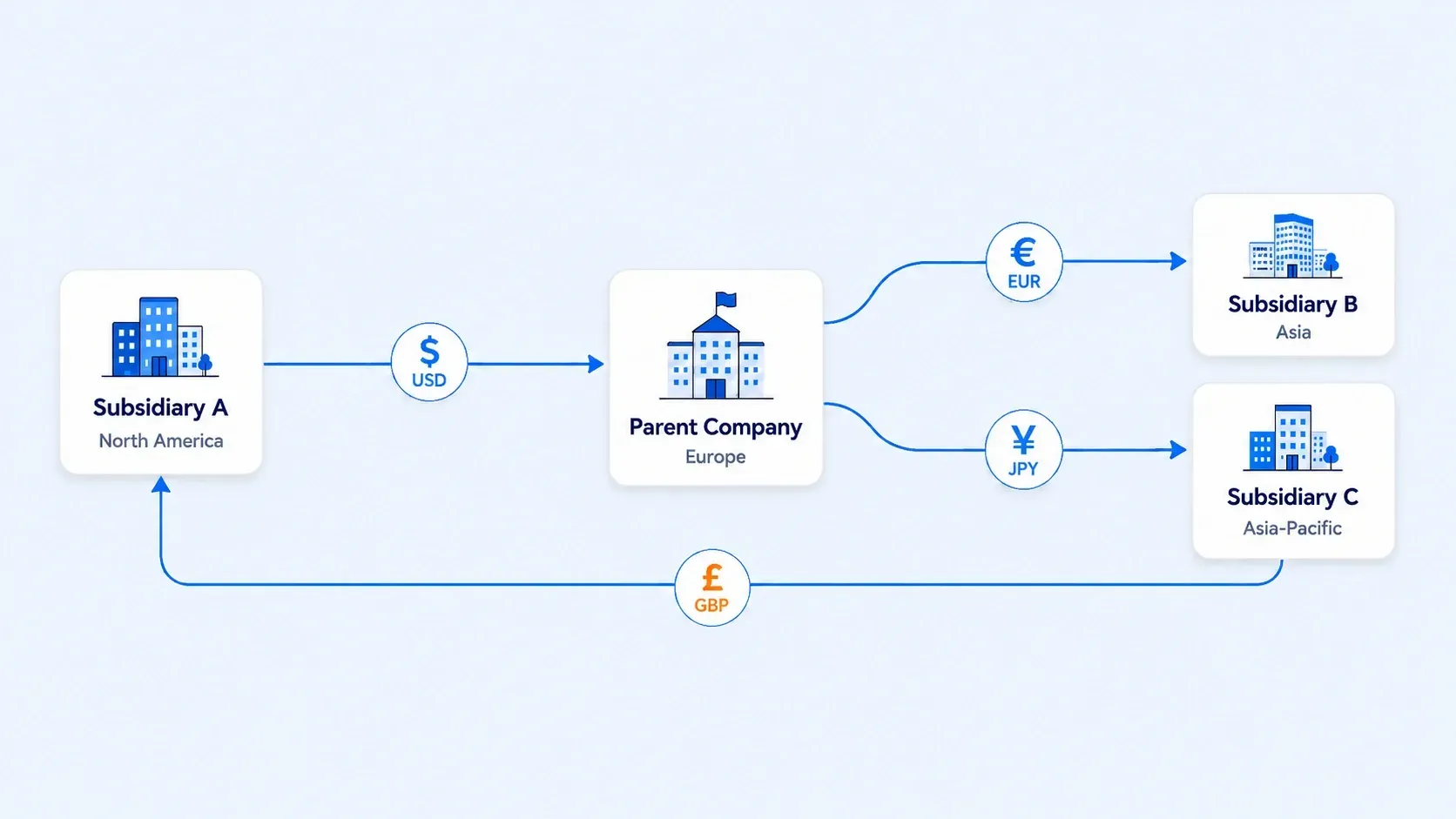
Moving money within the same corporate group sounds simple. In practice, a payment from a parent company in Canada to a subsidiary in the United Kingdom can touch treasury, tax, accounting, compliance and foreign exchange before the funds arrive.
A weak process creates more than an expensive wire. It can leave finance teams chasing unmatched balances, expose the group to unnecessary currency conversions and make an ordinary payment difficult to explain later.
An intercompany transfer moves funds between legal entities under common ownership, such as a parent company and a subsidiary. Businesses may settle these transfers through bank wires, specialized international payment providers, intercompany netting, cash pooling or an in-house bank.
The right approach depends on the transfer's purpose, frequency, currencies, cost and legal or tax treatment. For businesses managing cross-border intercompany payments, MTFX can help simplify international transfers with competitive exchange rates, multi-currency payment support and FX tools.
What is an intercompany transfer?
An intercompany transfer is the movement of money between two legal entities in the same corporate group. The payment may travel from a parent to a subsidiary, from a subsidiary back to its parent, or between sister companies that share common ownership.
These transfers can be domestic or cross-border. The international version is more demanding because the entities may use different functional currencies, operate under different tax rules and bank through separate payment networks. Common ownership does not make their bank accounts interchangeable. Each entity still needs a defensible reason for sending or receiving the funds.
Intercompany transfer vs. intercompany transaction
The terms are related, but they are not identical. An intercompany transaction is the underlying economic activity: one subsidiary sells inventory to another, the parent provides a loan, or a regional office charges a management fee. The intercompany transfer is the payment that settles or finances that activity.
This distinction matters. A wire can move the money, but it cannot decide whether the amount should be treated as an invoice payment, loan, dividend or capital contribution. That classification should be established before the payment is released.
Common reasons companies move money between entities
- Paying invoices for goods or services supplied within the group
- Funding payroll, inventory or other working-capital needs
- Advancing or repaying an intercompany loan
- Settling management fees, royalties or shared-service charges
- Making a dividend distribution or capital contribution
- Rebalancing liquidity across regions
- Settling several intercompany invoices through a netting cycle
How do intercompany money transfers work?
A reliable transfer starts before the payment instruction. The finance team should be able to trace the transfer from its business purpose to the ledger entry and bank confirmation.
1. Define the purpose: Identify what created the balance and why the recipient needs the funds. An invoice, loan agreement, dividend resolution and capital contribution require different support.
2. Confirm the entities: Verify the exact legal names, ownership relationship, bank details and jurisdictions of the sender and recipient.
3. Choose the classification: Work with accounting, tax or legal advisers where necessary to determine how the transfer should be treated and recorded.
4. Prepare the evidence: Gather the agreement, invoice, approval, pricing support and payment reference before execution.
5. Select the currency and route: Decide which entity should convert the funds and whether a wire, payment provider, netting process or treasury structure is appropriate.
6. Review the full cost: Compare the exchange rate, explicit fees, possible intermediary deductions and amount expected to arrive.
7. Approve and send: Apply the group's authorization controls and validate any new or changed beneficiary details independently.
8. Reconcile promptly: Match the bank confirmation to the underlying transaction, record the exchange rate and fees, and resolve differences while the information is fresh.
A complete payment reference is surprisingly valuable. References such as “funding” or “transfer” create detective work. A structured reference tied to an invoice, agreement or approved treasury cycle gives both entities a common record.
| Field | Value |
|---|---|
Amount Payable (USD) 50,000 | |
Bank Exchange Rate 1.4464 / 0.6914 | |
Total cost 72,320.04CAD |
| Field | Value |
|---|---|
Amount Payable (USD) 50,000 | |
MTFX Exchange Rate 1.4216 / 0.7034 | |
Total cost 71,079.26CAD |
You Save
CAD 1,240.78
with MTFX
16 October 2026
We use mid-market rates. This is for informational purposes only. Log in to view send rates.
Ways to transfer money between global subsidiaries
There is no single best method. A company that sends one quarterly payment has different needs from a group settling hundreds of two-way invoices every month.
1. Bank wire transfers
Bank wires are familiar and widely available, which makes them practical for occasional or straightforward transfers. Their simplicity can be deceptive, however. The visible transfer fee is only one part of the cost. The sending bank's FX spread, correspondent-bank deductions and receiving fee can all reduce the amount delivered.
Before approving a wire, ask for the exchange rate and expected recipient amount. That makes comparison easier than looking at a low headline fee in isolation.
2. Specialized FX and international payment providers
A specialized provider can combine currency conversion and payment execution in one workflow. This may give treasury teams more visibility over exchange rates, beneficiaries and recurring payments, while also providing access to tools designed for multi-currency operations.
Provider coverage, controls, settlement routes and pricing still need to be evaluated. The sensible comparison is not “bank fee versus provider fee”; it is the total home-currency cost required to deliver the intended foreign-currency amount.
3. Intercompany netting
Netting offsets payables and receivables between related entities so that only the difference is settled. In bilateral netting, two companies offset what they owe each other. Multilateral netting extends the process across several group entities, usually through a central calculation.
Simple example: A Canadian parent owes its UK subsidiary the equivalent of CAD 500,000, while the UK subsidiary owes the parent the equivalent of CAD 350,000. Instead of sending two gross payments, the group can calculate a net amount equivalent to CAD 150,000 for settlement, subject to its agreements, accounting treatment and local rules.
Netting can reduce the number of external payments and conversions, but it does not erase the underlying invoices. Each entity still records the gross transactions, agrees the balances and retains the supporting evidence.
4. Cash pooling
Cash pooling brings the balances of participating group entities into a coordinated liquidity structure. With physical pooling, funds may be swept into or from a central account. Notional pooling generally calculates interest on combined balances without physically moving every balance in the same way.
Pooling can reduce idle cash and external borrowing, but it is not simply a payment shortcut. The structure may create intercompany lending positions and raise questions about interest, withholding tax, guarantees, corporate benefit, local restrictions and transfer pricing. It requires specialist design.
5. In-house banking and centralized treasury
Large groups may create an in-house bank that acts as a central hub for payments, internal funding, liquidity and FX. Subsidiaries interact with the treasury centre rather than independently arranging every external transaction.
The model can improve control and consolidate currency exposure, but it needs appropriate systems, governance, staffing and agreements. It is usually a treasury operating model, not a quick fix for a handful of transfers.
6. Multi-currency business accounts
A multi-currency account allows a business to receive, hold, convert and pay in supported currencies. It can be useful when the group has recurring inflows and outflows in the same currency because funds do not have to be converted automatically on receipt.
Holding several currencies does not eliminate FX risk. It changes when and where conversion occurs, giving the business more control over that decision.
7. Intercompany loans, dividends and capital contributions
These are reasons or legal structures for moving money, not payment rails. An intercompany loan can provide temporary or long-term funding, while a capital contribution increases the subsidiary's equity and a dividend returns distributable profits to shareholders. The same bank network could carry all three payments, yet their approvals, documentation, tax consequences and accounting entries may differ significantly.
Important: Intercompany funding and distributions can create legal, tax, transfer-pricing and reporting obligations. Obtain advice that reflects the entities, jurisdictions and facts involved.
Which intercompany transfer method should you choose?
Start with the transaction's purpose and operating pattern. Technology comes later.
Five questions usually narrow the choice:
- Why is the money moving, and how should it be classified?
- Is the transfer occasional, scheduled or part of a high-volume cycle?
- Which currencies are involved, and where does the exposure sit?
- Do any countries restrict pooling, lending, dividends or cross-border currency movement?
- What approvals, audit trail, ERP integration and payment visibility does the group require?
What does an intercompany transfer really cost?
The cheapest-looking payment is not always the cheapest transfer. A zero-dollar wire fee can still be costly if the exchange rate contains a wide margin or an intermediary bank deducts charges before delivery.
A practical cost model: Total transfer cost = FX conversion cost + payment fees + intermediary deductions + internal processing cost + timing-related FX impact
The comparison should begin with a fixed outcome. If a subsidiary must receive EUR 250,000, calculate how many Canadian dollars each route requires to deliver that amount after known fees. This prevents unlike-for-like quotes from distorting the decision.
Operational cost belongs in the calculation too. Manual approvals, duplicate data entry, rejected payments and month-end investigations consume finance capacity even when they never appear on a bank statement.
How exchange rates affect intercompany transfers
1. Transaction exposure
Transaction exposure arises when an amount is denominated in a foreign currency and the rate changes before settlement. If a Canadian parent records a USD 1 million payable today but pays it in 45 days, the Canadian-dollar cost can rise or fall during that period.
2. Transaction exposure is not translation exposure
Transaction exposure concerns a specific foreign-currency receivable, payable or forecast cash flow. Translation exposure appears when a group converts the financial results or net assets of a foreign operation into the reporting currency for consolidation. They may coexist, but they are not managed in exactly the same way.
3. Choose the settlement currency deliberately
The invoice currency, each entity's functional currency, natural inflows and outflows, and available hedging tools should inform the decision. Converting CAD to USD at headquarters and then USD to EUR at the subsidiary can create two spreads when one direct conversion might have achieved the business outcome.
There is no universal rule that the parent or subsidiary should always handle conversion. The better location is the one that supports group visibility, local requirements, natural offsets and a consistent treasury policy.
4. Manage exposure with a policy, not a prediction
Trying to pick the perfect market moment is not a repeatable control. Businesses can instead define which exposures should be hedged, who may act, which instruments are permitted and how performance will be measured. Depending on suitability and availability, tools may include forward contracts, market orders, scheduled conversions and netting of opposite currency flows.
Documentation and compliance considerations
The payment instruction is only the final link in the chain. A defensible transfer also shows what happened, why it happened, how the amount was determined and who approved it.
1. Establish a commercial purpose
Connect each payment to an identifiable invoice, agreement, loan, dividend, capital contribution or approved allocation. If the purpose cannot be explained in plain language, pause before execution.
2. Use agreements that match actual conduct
An intercompany agreement may identify the parties, transaction type, pricing method, currency, payment terms, interest, responsibilities and review process. A signed document has limited value if the entities operate differently in practice, so agreements and actual behaviour should be reviewed together.
3. Apply appropriate transfer pricing
Cross-border transactions between related parties are commonly assessed under the arm's-length principle: broadly, the conditions should be consistent with those that independent parties would agree in comparable circumstances.
For financial transactions, the analysis can involve the transaction's commercial rationale, borrower creditworthiness, terms, risks and the functions performed by a treasury centre.
The OECD provides guidance on intra-group loans, cash pooling, guarantees and treasury functions. Domestic rules determine how those principles apply in each country, so the article should not be used as a substitute for jurisdiction-specific advice.
4. Check withholding tax and local restrictions
Depending on the structure and countries involved, interest, royalties, service fees or dividends may trigger withholding tax. Intercompany funding can also interact with interest-deduction limits, thin-capitalization rules, exchange controls, corporate approvals and beneficial-ownership requirements.
5. Keep records that connect the payment to the books
- Invoice, agreement, resolution or other source document
- Pricing or allocation support
- Payment approval and beneficiary verification
- Exchange rate and fee record
- Payment confirmation and recipient amount
- General-ledger entries and reconciliation evidence
- Explanation and approval of any exception
A note for Canadian businesses
Canadian cross-border transactions with related parties can fall within the transfer-pricing rules administered by the Canada Revenue Agency. The CRA notes that updated rules apply to taxation years beginning after November 4, 2025, and that related guidance is being updated. Businesses should confirm the current requirements for their facts.
International electronic funds transfers can also involve FINTRAC reporting and travel-rule obligations for financial entities, money services businesses and other reporting entities processing qualifying transfers. An operating company should not assume that sending a large payment automatically makes it the party responsible for filing a report; it should confirm its own status and obligations.
Best practices for efficient intercompany payments
- Build one policy that every entity can follow
A group-wide policy should define permitted transfer types, required evidence, approval thresholds, authorized providers, FX ownership, reconciliation timing and exception handling. Local addenda can address jurisdiction-specific rules without forcing each subsidiary to invent a separate process.
- Centralize visibility before centralizing every payment
A group does not need a full in-house bank to improve control. A consolidated view of forecasts, balances and currency exposures can reveal duplicate conversions and natural offsets before the operating model changes.
- Separate beneficiary changes from payment approval
Related-company payments can still be targeted by invoice fraud or account-change scams. Verify new bank details through a trusted channel, restrict who can edit beneficiaries and require a separate approver for material changes.
- Reconcile on a fixed rhythm
Do not wait for year-end to discover that two entities disagree. Monthly or cycle-based confirmations, standardized references and a clear owner for breaks keep small differences from becoming a consolidation problem.
- Measure what the process is hiding
Useful indicators include total FX cost, payment rejection rate, manual touches, unmatched items, average reconciliation time, past-due intercompany balances and the percentage of eligible invoices settled through netting.
Monitor live exchange rates before making cross-border business transfers.
| Currency | Rates | High | Low | Daily |
|---|---|---|---|---|
 USD | 1.4180 | 1.4199 | 1.4171 | -0.03% |
 EUR | 1.5917 | 1.5930 | 1.5902 | 0.02% |
 INR | 66.88 | 67.16 | 66.61 | 0.23% |
 GBP | 1.8856 | 1.8863 | 1.8815 | 0.19% |
 CNY | 4.7281 | 4.7281 | 4.7132 | 0.28% |
 JPY | 111.33 | 111.44 | 111.22 | 0.02% |
 MXN | 12.98 | 13.01 | 12.98 | 0.06% |
Reduce FX costs with competitive exchange rates for global business payments.
Common intercompany transfer mistakes
- Sending funds before deciding whether they are debt, equity, a distribution or settlement of an invoice
- Using vague payment references that cannot be matched to supporting records
- Allowing every subsidiary to convert currency independently without group visibility
- Comparing advertised transfer fees while ignoring the exchange rate and recipient amount
- Assuming netting removes the need to record gross transactions
- Leaving balances unresolved until quarter-end or year-end
- Using one exchange rate in the payment system and another in the ledger without documenting the difference
- Relying on agreements that no longer reflect how the entities operate
- Assuming a structure permitted in one country works everywhere
How to build an intercompany transfer policy
A useful policy is short enough to follow and specific enough to settle disagreements. At minimum, address:
- Entities and transaction types within scope
- Permitted reasons for transferring funds
- Required agreements, invoices and approvals
- Authorized currencies, accounts and payment providers
- Ownership of FX decisions and permitted risk-management tools
- Approval thresholds and segregation of duties
- Payment schedules and netting rules
- Beneficiary setup and change controls
- Accounting, reconciliation and exception ownership
- Record-retention standards and review frequency
Test the policy using real scenarios before launch: an urgent subsidiary funding request, a changed bank account, a late invoice, a failed payment and a disputed netting balance. Those cases expose gaps faster than a policy review conducted only on paper.
How MTFX supports cross-border intercompany payments
MTFX helps businesses send international payments, manage multiple currencies and build more consistent FX workflows. For groups moving funds between countries, the platform can support individual, recurring and bulk payments, while multi-currency accounts allow businesses to hold and manage supported currencies rather than converting every receipt automatically.
Businesses can also access FX risk-management tools, including forward contracts, market orders and rate alerts, subject to availability and suitability. This can help treasury teams connect payment timing with a defined currency policy instead of making every decision at the point of urgency.
MTFX does not replace the legal, tax or accounting analysis behind an intercompany transaction. It supports the currency and payment layer after the business has established why the funds are moving and how the transaction should be documented.


Make intercompany transfers part of the treasury strategy
The most efficient groups do not begin with the payment rail. They begin with purpose, policy and visibility. Once those elements are in place, the business can choose the right settlement method, reduce avoidable conversions and keep a clean trail from approval to reconciliation.
With the right process in place, intercompany transfers can support liquidity planning, reduce FX inefficiencies and give finance teams better control over cross-border movement of funds.
For businesses managing payments between global entities, MTFX provides competitive exchange rates, international business payment solutions and currency tools that help make treasury workflows more efficient. Sign up with MTFX to access secure global payments, better FX visibility and dedicated support for your business transfers.
FAQs
1. What is an intercompany transfer?
An intercompany transfer is a movement of money between legal entities under common ownership. It can settle an invoice, provide funding, repay a loan, distribute a dividend or support another documented group transaction. The payment and the underlying transaction should be recorded separately and connected through a clear reference.
2. How can a parent company transfer money to a subsidiary?
A parent can transfer funds through a bank or international payment provider after determining the payment's purpose and classification. Depending on the facts, the funding might be a loan, capital contribution or payment of an amount owed. Appropriate approvals, agreements, payment records and jurisdiction-specific advice may be required.
3. Can a subsidiary transfer money to its parent company?
Yes, but the transfer needs a valid basis. It might represent an invoice payment, loan repayment, interest, management fee, royalty, dividend or return of capital. Each option can carry different corporate, tax, accounting and withholding consequences, so they should not be treated as interchangeable.
4. Is an intercompany transfer the same as an intercompany loan?
No. A transfer describes the movement of funds. A loan is one possible legal and accounting basis for that movement. A transfer could instead settle an invoice, pay a dividend or make a capital contribution. The classification should be established before the money is sent.
5. Do intercompany loans require interest?
The appropriate terms depend on the jurisdictions and facts. Transfer-pricing rules often require related-party financial arrangements to reflect arm's-length conditions, which may include an interest rate supported by the borrower's credit profile, currency, term and other features. Obtain advice before setting or omitting interest.
6. What documents are needed for an intercompany payment?
The file commonly includes an invoice, agreement, loan document or corporate resolution; pricing support; payment approval; beneficiary verification; exchange-rate and fee records; the payment confirmation; and reconciliation evidence. The exact requirements depend on the transaction type and the countries involved.
7. What is intercompany netting?
Intercompany netting offsets amounts related entities owe one another so that only the net balance is settled externally. It can reduce payment volume and avoid unnecessary currency conversions, but the companies still need to record, agree and retain evidence for the underlying gross transactions.
8. What is the difference between netting and cash pooling?
Netting reduces settlement activity by offsetting intercompany receivables and payables. Cash pooling combines or coordinates bank balances to manage group liquidity. Netting focuses on obligations; pooling focuses on cash positions. A multinational group may use both, subject to legal, banking, tax and operational requirements.
9. Can related companies transfer money without an invoice?
An invoice is not the only valid source document, but every transfer should have a documented basis. A loan agreement, dividend resolution, capital contribution approval or treasury arrangement may support the payment. Moving money first and deciding what it means later creates avoidable accounting and compliance risk.
10. How long does an international intercompany transfer take?
Timing varies by currency, destination, payment route, banking cut-off, compliance review and beneficiary information. Some payments may arrive the same day, while others take several business days. Confirm the expected settlement window for the specific currency corridor before promising funds to the receiving entity.
11. How can a company reduce FX costs on intercompany transfers?
Compare the recipient amount rather than the transfer fee alone, avoid unnecessary double conversions, consolidate eligible payments, use natural currency offsets and give treasury visibility before subsidiaries convert independently. A multi-currency account or specialized FX provider may also help, depending on the group's needs.
12. Are intercompany transactions eliminated in consolidated accounts?
Intercompany balances and transactions are generally eliminated when consolidated financial statements are prepared so the group does not report internal activity as external activity. That consolidation step does not remove the entities' own accounting records, payment obligations, tax considerations or supporting-document requirements.