Currency Budgeting for Finance Teams Making Global Payments
Currency budgeting for global payments helps finance teams estimate the real cost of paying in foreign currencies. It includes the invoice amount, exchange rate, payment timing, transfer fees, FX spread, variance buffer, approval rules, and a plan for managing currency risk before payments are sent.
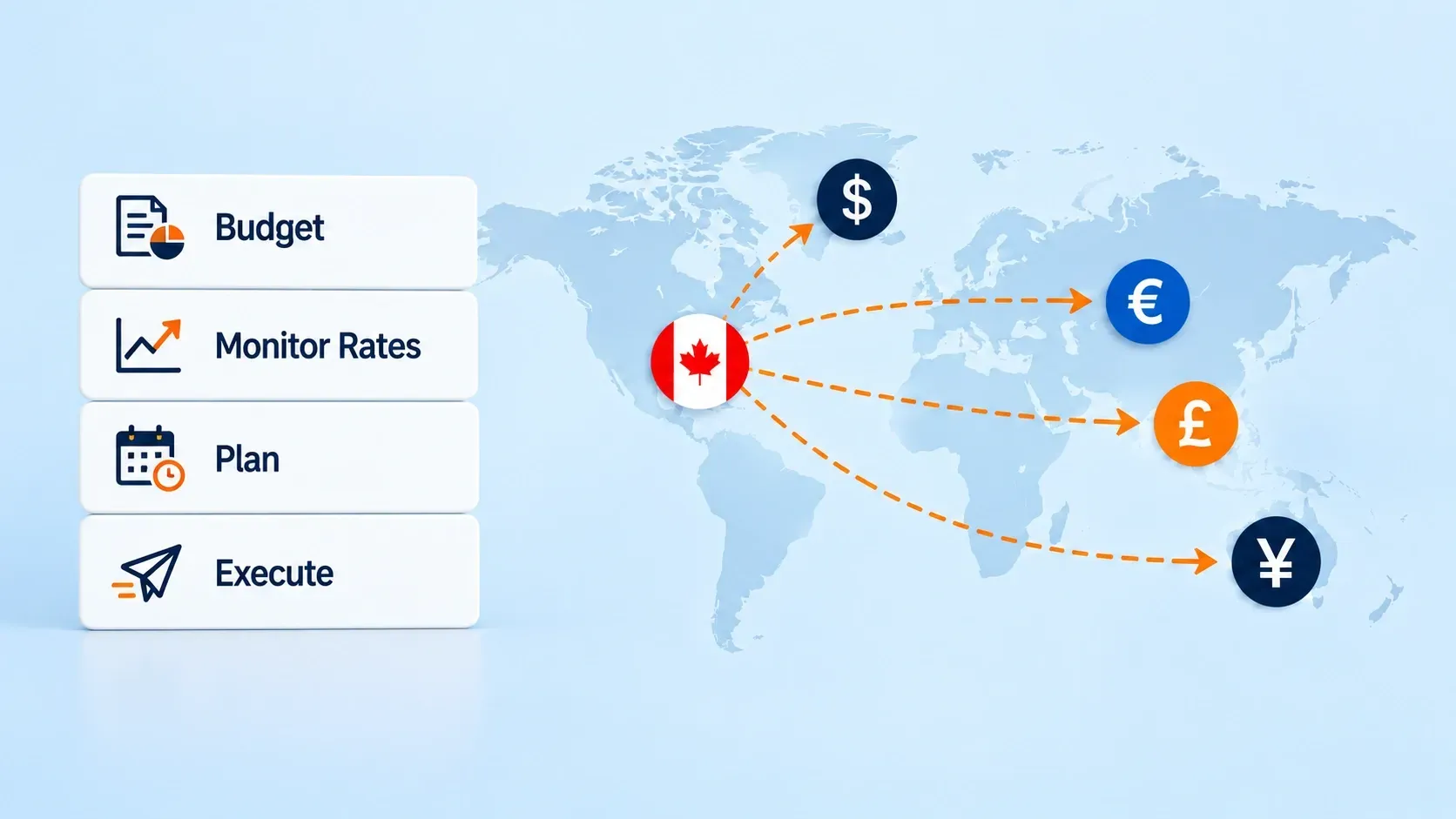
Currency budgeting helps finance teams plan, forecast, and control the real cost of international payments. When a business pays suppliers, contractors, employees, partners, or subsidiaries in foreign currencies, the final cost can change between the time a payment is budgeted and the time it is sent.
For Canadian businesses, this often means estimating how much CAD will be needed to pay invoices in USD, EUR, GBP, AUD, or other currencies. A strong currency budget looks beyond the invoice amount. It includes exchange rates, timing, transfer fees, payment methods, approval workflows, foreign exchange risk, and cash flow impact.
For finance teams making regular global payments, currency budgeting is not just an accounting exercise. It is a practical way to protect margins, reduce payment surprises, and make better decisions about when and how to convert money.
What is currency budgeting for global payments?
A currency budget usually includes the foreign currency amount owed, the expected payment date, the budgeted exchange rate, the estimated home currency cost, transfer fees, possible bank charges, a buffer for exchange rate movement, approval rules for high-value payments, and a plan for monitoring or managing FX risk.
For example, if a Canadian business needs to pay a US supplier USD 100,000 in 60 days, the finance team should not only record the invoice amount. It should estimate the CAD cost, monitor USD/CAD movement, add likely payment costs, and decide whether the payment should be converted now, closer to the due date, or managed with an FX tool such as a forward contract.
Businesses can use tools such as the MTFX live exchange rates tool and the MTFX currency exchange calculator to monitor market rates and estimate payment values before sending funds.
Why currency budgeting matters for finance teams
Currency budgeting helps finance teams forecast international payment costs more accurately, reduce unexpected FX budget variances, improve cash flow planning, protect supplier margins and project budgets, compare payment timing options, review provider rates and fees, track FX gains and losses more clearly, and build a repeatable process for global payments.
For example, a Canadian company approves a USD 100,000 supplier invoice when the budget rate is 1.35. The expected cost is CAD 135,000. If the rate moves to 1.39 by the payment date, the same invoice costs CAD 139,000 before transfer fees. That creates a CAD 4,000 budget variance even though the supplier did not change the invoice.
Export Development Canada explains that exchange rate fluctuations can affect a company’s profit margin, cash flow, and competitiveness. You can review EDC’s guidance on building a foreign exchange policy for more context.
For companies that send frequent cross-border payments, MTFX global payment solutions can support payments to suppliers, employees, and partners in different currencies and across international markets.
| Field | Value |
|---|---|
Amount Payable (USD) 20,000 | |
Bank Exchange Rate 1.4558 / 0.6869 | |
Total cost 29,115.08CAD |
| Field | Value |
|---|---|
Amount Payable (USD) 20,000 | |
MTFX Exchange Rate 1.4308 / 0.6989 | |
Total cost 28,615.56CAD |
You Save
CAD 499.52
with MTFX
12 October 2026
We use mid-market rates. This is for informational purposes only. Log in to view send rates.
Who needs a currency budget?
Any business that makes or receives payments in a foreign currency should have a currency budgeting process. The need becomes more important when payment values are large, payment dates are far in the future, or the business uses multiple currencies.
- Currency budgeting is especially useful for;
- Importers paying overseas suppliers
- Exporters managing foreign currency receivables
- Manufacturers buying international equipment or raw materials
- SaaS companies paying global contractors
- E-commerce businesses paying suppliers and logistics partners
- Professional services firms paying international consultants
- Education providers managing overseas payments
- Real estate businesses funding foreign property costs
- Non-profits sending funds abroad
- & companies with foreign subsidiaries handling intercompany payments.
Finance teams that regularly pay international vendors can also explore MTFX business international money transfer services for business payment support.
What should be included in a global payment currency budget?
A global payment currency budget should include the full expected cost of sending money internationally, not just the amount shown on the invoice. The real cost may include exchange rate movement, FX spread, transfer fees, intermediary bank charges, recipient bank fees, and payment timing risk.
Finance teams can use the Bank of Canada daily exchange rates as a reference point for planning and reporting support. However, reference rates should not be treated as guaranteed transaction rates.
Before sending funds, finance teams should compare actual provider quotes and total transfer value. And for that, use MTFX compare chart to review exchange rate differences before making a payment.
Confirmed vs forecast currency exposure
Finance teams should separate confirmed foreign currency exposure from forecast exposure. This helps the team decide how closely a payment should be monitored and whether additional FX planning is needed.
This distinction matters because a confirmed USD invoice due in 30 days may need closer monitoring than a possible USD purchase six months from now. Confirmed exposure may also justify more formal review by treasury, the controller, or the CFO.
How exchange rate changes affect payment budgets
Exchange rate changes affect payment budgets by changing how much home currency is needed to buy the foreign currency required for a payment.
The longer the gap between budgeting and payment, the greater the chance that exchange rate movement will affect the final cost. EDC notes that FX risk can begin before payment is received or made, including when a business quotes a price in a foreign currency. Businesses can learn more in EDC’s article on how to manage FX risk before it impacts profits.
This is why finance teams should treat currency budgeting as part of financial planning, not as a final administrative step before payment.
Manage currency risk and optimize global payments with MTFX.
How to build a currency budget for global payments
Finance teams can build a practical currency budget by following a structured process. The goal is to create a repeatable workflow that connects budgeting, cash flow, approvals, FX monitoring, and payment execution.
1. List all upcoming foreign currency payments
Start with a currency exposure register. This should include every known or expected foreign currency payment over the next month, quarter, or year.
Include supplier invoices, contractor payments, international payroll, software subscriptions, inventory purchases, equipment purchases, freight and logistics payments, tax or regulatory payments, intercompany transfers, overseas rent or property costs, loan repayments, and tuition or institutional payments.
For each payment, record the key details:
This register gives finance, treasury, and accounts payable one shared view of upcoming international payment needs.
2. Group payments by currency
After listing payments, group them by currency. This helps finance teams see where exposure is concentrated.
Grouping payments helps the business decide whether it needs spot conversions, rate alerts, multi-currency balances, forward contracts, or a broader FX risk management plan. For businesses with recurring multi-currency needs, MTFX treasury solutions can help support liquidity planning, currency exposure visibility, and global payment workflows.
3. Choose budget exchange rates
Finance teams need a consistent method for choosing exchange rates in the budget. The method should be documented so that budget owners, controllers, and leadership understand how foreign currency costs were estimated.
The chosen approach should be consistent. For example, a finance team may use Bank of Canada rates for internal reference, provider quotes for near-term payment planning, and forward quotes for large confirmed future payments.
4. Add fees and possible bank charges
International payments may involve more than the exchange rate. Finance teams should budget for payment-related fees so the total expected cost is not understated.
Potential costs include sending fees, receiving bank fees, intermediary bank fees, correspondent bank deductions, urgent payment fees, same-day wire costs, FX spread, and payment amendment or recall fees.
For supplier payments, finance teams should also confirm whether the sender or recipient is responsible for bank charges. This avoids disputes when the recipient receives less than the invoice amount. Businesses paying vendors overseas can review MTFX’s guide on paying overseas suppliers for more detail on payment methods, exchange rates, and supplier cost planning.
5. Add a currency variance buffer
A currency variance buffer is a planning allowance for exchange rate movement. It helps finance teams avoid cash shortfalls when rates move before payment.
The buffer should reflect the size, timing, and certainty of the payment.
A variance buffer is not a forecast. It is a control that gives the business room to manage uncertainty.
6. Decide when to convert currency
Payment timing can materially affect the final cost. Finance teams should decide whether to convert immediately, wait until closer to the due date, use a rate alert, hold foreign currency balances, or consider a forward contract.
The decision should consider payment certainty, current exchange rate, budget exchange rate, amount at risk, cash availability, supplier deadline, market volatility, internal approval limits, risk tolerance, and accounting treatment.
MTFX’s live exchange rates help businesses monitor currency pairs before converting funds. For businesses comparing payment values, the MTFX rate calculator can also help estimate conversion amounts before sending a payment.
7. Create approval thresholds
Currency decisions should not be handled informally, especially for high-value payments. Finance teams should create approval thresholds based on payment amount, timing, and currency risk.
Approval rules should also cover forward contracts, rate locks, payment date changes, supplier currency changes, urgent payments, payments above budget, payments to new beneficiaries, and large payments to higher-risk jurisdictions.
8. Track actual cost against budget
After each payment is completed, compare the final cost with the budgeted cost. This helps the finance team explain FX variance and improve future forecasts.
This reporting can be included in month-end finance reviews, treasury reports, or CFO dashboards.
Currency budgeting example for a finance team
Imagine a Canadian business expects to make four international payments next quarter.
The base converted cost is CAD 374,490 before fees and variance allowance.
This gives leadership a more realistic view of cash required for global payments. It also shows which payments need closer monitoring. In this example, the USD 150,000 inventory payment due in 90 days carries the highest exposure because it is both large and further from settlement.
How finance teams can reduce FX budget variance
Finance teams can reduce FX budget variance by improving forecasting, centralizing visibility, monitoring exchange rates, and using appropriate currency risk management tools.
1. Use a rolling currency forecast
A static annual budget may not be enough for businesses making regular global payments. A rolling forecast allows finance teams to update foreign currency needs monthly or quarterly based on new invoices, supplier contracts, payment dates, and exchange rate movement.
A rolling currency forecast should include the currency required, amount due, due date, budget rate, current estimated rate, expected variance, payment status, and recommended action. This helps finance teams identify potential cost increases before payment deadlines arrive.
2. Match foreign currency inflows and outflows
If a business receives and pays the same currency, it may be able to reduce conversion needs.
For example, a Canadian business that receives USD 200,000 from customers and pays USD 150,000 to suppliers may only need to convert the net USD 50,000, depending on timing, cash needs, and account structure.
This is sometimes called natural hedging. It does not eliminate risk, but it can reduce unnecessary conversions.
3. Review supplier currency terms
Finance and procurement teams should work together before agreeing to supplier currency terms. Some suppliers may offer invoices in more than one currency, but their built-in conversion rate may not always be favourable.
Before accepting supplier terms, compare the supplier invoice currency, supplier conversion rate, MTFX or provider exchange rate, transfer fees, payment timing, and total landed cost.
MTFX’s guide on negotiating better supplier pricing with FX in mind can support businesses reviewing supplier currency terms and payment strategy.
4. Set rate alerts
Rate alerts can help finance teams act when a target exchange rate becomes available. This is useful when a payment is confirmed but not yet due.
For example, if a USD supplier invoice is due in 45 days and the budget rate is 1.35, the finance team may monitor rates and set an internal action point if the rate reaches a preferred level or moves beyond a risk threshold.
5. Consider forward contracts for confirmed future payments
A forward contract allows a business to lock in an exchange rate for a future payment. This can help finance teams protect a budget when the payment amount and payment date are known.
Forward contracts can be useful when the payment is confirmed, the amount is significant, the payment date is in the future, currency movement could affect margins or cash flow, and leadership wants more cost certainty.
MTFX explains that forward contracts for importers and exporters can help businesses lock in an exchange rate for a future foreign-currency payment or receivable.
Forward contracts may not be suitable for every payment. Finance teams should consider cash flow, business certainty, accounting treatment, and the terms of the contract before using them.
6. Build a written FX policy
A written foreign exchange policy helps finance teams make consistent decisions. It should explain how the business identifies, measures, approves, and manages currency exposure.
EDC says the process of developing an FX policy can help companies identify when FX exposure arises and quantify its potential financial impact.
A basic FX policy should define who owns currency risk, which currencies are monitored, which exposures must be reported, which rates are used for budgeting, when approvals are required, when hedging can be considered, which tools are allowed, how FX variance is reported, and how exceptions are documented.
Businesses that need support managing currency risk can explore MTFX foreign exchange risk management solutions for tools that can support currency exposure planning and payment cost predictability.
Currency budgeting controls for accounts payable teams
Accounts payable teams are central to currency budgeting because they often manage invoices, beneficiary details, payment dates, and reconciliation.
A controlled AP process helps prevent late payments, duplicate payments, incorrect beneficiary details, and unexpected FX costs. Businesses making supplier payments can also read MTFX’s guide on business wire transfers for supplier payments.
Currency budgeting controls for CFOs and controllers
CFOs and controllers need visibility into material foreign currency exposure. They do not need to manually review every small payment, but they should have oversight of larger or higher-risk currency commitments.
This gives leadership a clearer view of how foreign exchange affects budgets, margins, and cash flow.
Currency budgeting and accounting considerations
Currency budgeting supports planning and control, but accounting treatment should follow applicable reporting standards and professional advice.
Under IAS 21, IFRS explains that foreign exchange accounting deals with which exchange rates to use and how to report the effects of exchange rate changes in financial statements. IFRS also defines functional currency as the currency of the primary economic environment in which an entity operates. Finance teams can review IAS 21 foreign exchange accounting guidance for more information.
Finance teams should work with their accounting advisors to align currency budgeting with month-end revaluation, FX gains and losses, functional currency assessment, foreign currency receivables and payables, intercompany balances, foreign currency loans, and financial statement reporting.
This is especially important for businesses with foreign subsidiaries, multi-currency accounts, or significant overseas payables and receivables.
Common currency budgeting mistakes to avoid
Currency budgeting mistakes usually happen when finance teams treat international payments as simple conversions instead of financial planning decisions.
- Budgeting only the invoice amount
- Using one annual exchange rate for every payment
- Ignoring payment timing
- Not comparing provider rates
- Waiting until the due date to think about FX
- Not tracking actual FX variance
- No approval rules for large payments
- Not coordinating with procurement
Currency budgeting checklist for finance teams
Use this checklist before approving major global payments:
- List all upcoming foreign currency payments.
- Confirm the payment currency and invoice currency.
- Separate confirmed, likely, and forecast payments.
- Record the expected payment date and invoice due date.
- Choose and document the budget exchange rate.
- Estimate transfer fees and possible intermediary charges.
- Add an FX variance buffer where needed.
- Compare provider rates and total payment cost.
- Review whether payment timing affects the budget.
- Check whether the payment needs higher-level approval.
- Confirm beneficiary details before sending funds.
- Track actual exchange rate and fees after payment.
- Compare final payment cost against budget.
- Record the reason for any material variance.
Example currency budget template
Finance teams can use a simple table like this to manage upcoming foreign currency payments:
This type of table gives finance teams a clear view of what is due, what was budgeted, what has changed, and what action may be needed.
How MTFX can support currency budgeting for global payments
MTFX helps Canadian businesses plan and manage international payments with tools and services designed for cross-border finance teams. Businesses can use MTFX to send global payments, compare exchange rates, monitor live currency movement, and manage foreign exchange risk.
Finance teams can use MTFX global payment solutions for supplier, employee, contractor, and partner payments. They can also use live exchange rates to monitor currency movements, the currency exchange calculator to estimate payment values, exchange rate comparison tools to review transfer value, treasury solutions for liquidity planning, and FX risk management solutions for businesses managing currency exposure.
For finance teams making regular global payments, working with a specialist provider can improve visibility, reduce manual work, and support better decision-making around currency conversion and payment timing.


Save More on Global Payments with MTFX
Currency budgeting gives finance teams better control over the cost of global payments. By mapping foreign currency exposure, using consistent budget rates, adding realistic buffers, monitoring exchange rates, and tracking actual payment costs, businesses can reduce surprises and improve cash flow planning.
For companies making regular international payments, currency budgeting should be part of the finance team’s normal planning process. It connects procurement, accounts payable, treasury, accounting, and leadership around one shared goal: making global payments with greater visibility, control, and confidence. Sign up with MTFX today and get your global payments transfer securely overseas.
FAQs
1. What is currency budgeting?
Currency budgeting is the process of estimating the home currency cost of future foreign currency payments. It helps finance teams plan for exchange rates, transfer fees, payment timing, and possible currency movement.
2. Why is currency budgeting important for global payments?
Currency budgeting is important because exchange rates can change before an international payment is completed. Without a currency budget, a business may underestimate supplier costs, experience cash flow gaps, or report unexpected FX variances.
3. How do finance teams calculate a currency budget?
Finance teams calculate a currency budget by multiplying the foreign currency amount by the budget exchange rate, then adding expected transfer fees, possible bank charges, and a variance buffer for exchange rate movement.
4. What is FX budget variance?
FX budget variance is the difference between the expected home currency cost of a foreign payment and the actual cost when the payment is completed. It can result from exchange rate movement, provider fees, payment delays, or changes in payment amount.
5. How often should finance teams update currency budgets?
Finance teams should update currency budgets at least monthly if they make recurring global payments. High-value or time-sensitive payments may need weekly or daily monitoring as the payment date approaches.
6. Should finance teams use spot rates or forward contracts?
Spot rates may work for immediate payments. Forward contracts may help with confirmed future payments where budget certainty is important. The right choice depends on payment timing, amount, certainty, cash flow needs, and the company’s FX policy.
7.Can currency budgeting eliminate exchange rate risk?
No. Currency budgeting cannot eliminate exchange rate risk, but it can help finance teams measure, monitor, and manage it. Businesses may also use tools such as natural hedging, rate alerts, forward contracts, and written FX policies to reduce uncertainty.
8. What tools help with currency budgeting?
Useful tools include live exchange rate trackers, currency calculators, payment calendars, exposure registers, approval workflows, variance reports, and FX risk management solutions. Finance teams can use MTFX tools such as the live exchange rates page, currency exchange calculator, and FX risk management solutions to support budgeting and payment planning.