Currency Forecasting for Business Payments: A Practical Guide
Currency forecasting for business payments is the process of estimating how future exchange-rate movements may affect international invoices, supplier payments, payroll, and other foreign-currency expenses. Businesses can use payment schedules, historical rates, economic indicators, and favourable, base, and adverse scenarios to estimate future costs.
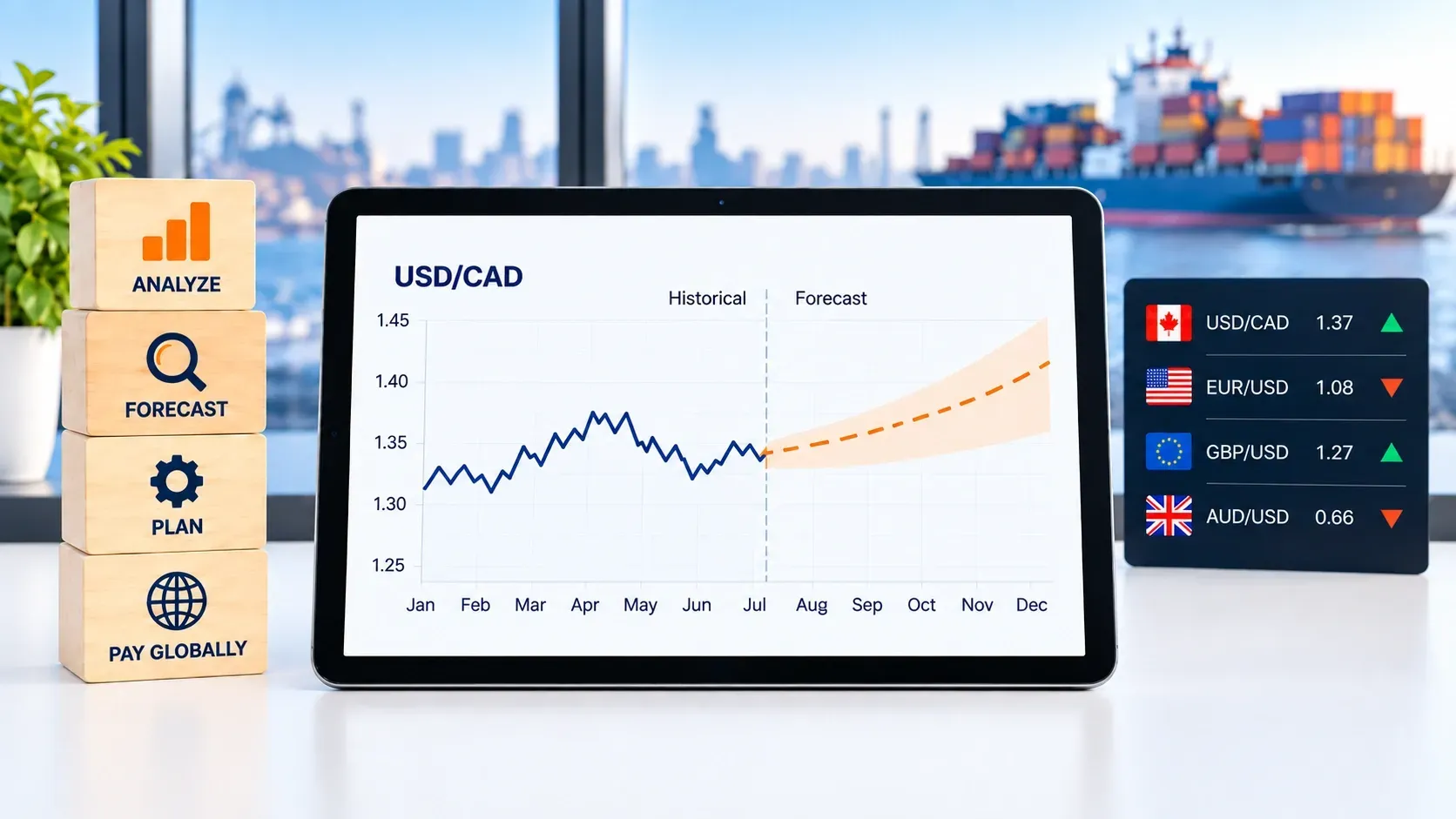
Canadian businesses can use currency forecasting to estimate how exchange-rate movements may affect upcoming supplier invoices, international payroll, inventory purchases, contractor payments, and other cross-border expenses. A forecast cannot guarantee a future exchange rate, but it can help finance teams prepare realistic budgets, identify vulnerable payments, and decide when greater cost certainty may be needed.
The most useful forecasting process starts with the company’s actual foreign-currency exposure. Finance teams should identify the currencies they need, expected payment amounts, settlement dates, and acceptable budget ranges before reviewing historical trends, economic events, and market forecasts. This turns a general currency-market prediction into a practical business-payment plan.
MTFX has been helping clients move money globally since 1996. Canadian businesses can use MTFX for secure global payments, competitive exchange rates, currency tools, rate alerts, and specialist support when planning international payments in multiple currencies.
What is currency forecasting for business payments?
Currency forecasting for business payments is the process of estimating how the value of one currency may change against another before a future payment or receipt is completed.
For example, a Canadian importer may know that it needs to pay USD 250,000 to a supplier in three months. The exact cost in Canadian dollars will remain uncertain until the currency is purchased, unless the business secures an exchange rate in advance through an appropriate FX risk management strategy.
A currency forecast helps the company estimate a possible range for that future Canadian-dollar cost. Finance teams can then use the estimate to:
- Build purchasing and operating budgets
- Forecast cash requirements
- Model gross margins
- Price products or services
- Plan supplier payment dates
- Measure potential downside
- Evaluate risk-management strategies
- Explain budget variances to management
The objective is not to identify the single perfect moment to exchange money. It is to make better financial decisions while exchange rates remain uncertain.
Why currency forecasting matters for international payments
Exchange rates can alter the final domestic-currency cost of an international invoice even when the supplier’s price does not change.
Suppose a Canadian business agrees to pay a European manufacturer EUR 150,000 in 90 days. If the euro strengthens against the Canadian dollar before the due date, the business will need more Canadian dollars to settle exactly the same invoice.
That difference can affect:
- Cost of goods sold
- Gross margins
- Project profitability
- Working-capital requirements
- Cash-flow forecasts
- Supplier-payment approvals
- Customer pricing
- Quarterly financial results
The impact becomes more significant when a company has large invoices, thin profit margins, several payment dates, or recurring exposure to multiple currencies.
Businesses making frequent international payments should connect their exchange-rate assumptions with their broader treasury planning instead of treating every currency conversion as an isolated transaction.
Compare CAD to USD exchange rates before planning your next international business payment. A more competitive rate can help reduce conversion costs and protect your payment budget.
| Field | Value |
|---|---|
Amount Payable (USD) 20,000 | |
Bank Exchange Rate 1.4522 / 0.6886 | |
Total cost 29,044.09CAD |
| Field | Value |
|---|---|
Amount Payable (USD) 20,000 | |
MTFX Exchange Rate 1.4273 / 0.7006 | |
Total cost 28,545.79CAD |
You Save
CAD 498.31
with MTFX
1 October 2026
We use mid-market rates. This is for informational purposes only. Log in to view send rates.
Currency forecasting does not mean predicting the market perfectly
No forecast can consistently predict an exact future exchange rate. Currency markets respond to economic data, central-bank decisions, commodity prices, capital flows, political developments, investor sentiment, and unexpected global events.
The Bank for International Settlements publishes foreign-exchange market data that demonstrates the scale and complexity of global currency trading. This complexity is one reason businesses should treat forecasts as planning assumptions rather than guaranteed outcomes.
A practical forecast is generally more useful when it provides:
- A central or expected scenario
- A favourable scenario
- An adverse scenario
- The financial impact of each outcome
- A clear date for reviewing the assumptions
- Actions the company may take if the market moves
This approach changes the question from “What will the exchange rate be?” to “What will happen to our payment cost under several reasonable exchange-rate outcomes?”
What factors influence exchange-rate forecasts?
Currency forecasts normally consider a combination of economic, financial, political, and payment-specific factors. No individual indicator should be used in isolation.
1. Interest rates and central-bank policy
Interest-rate decisions can affect demand for a currency because investors compare the returns available in different markets. Expectations about future rate changes can sometimes influence currencies before a central bank officially changes its policy rate.
Canadian finance teams may need to monitor announcements from the Bank of Canada, the US Federal Reserve, the European Central Bank, and the Bank of England, depending on the currencies used by the business.
MTFX’s economic calendar can help businesses monitor upcoming rate announcements and important economic data releases.
2. Inflation
Inflation affects purchasing power and can influence expectations about future interest rates. Persistent inflation differences between two countries may place pressure on their exchange rate over time.
Inflation data should not be treated as a standalone forecast, but it can help explain why one central bank may maintain a different interest-rate path from another.
3. Economic growth
Economic growth can affect investment flows, business confidence, government policy, and demand for a country’s assets.
Common indicators include:
- Gross domestic product
- Employment growth
- Retail sales
- Manufacturing activity
- Business investment
- Consumer confidence
Strong economic growth does not automatically guarantee a stronger currency. However, growth data can influence expectations about monetary policy and international investment.
4. Trade and commodity prices
Canada is a major commodity-producing economy, so changes in energy and commodity markets can influence the Canadian dollar. The relationship may be particularly relevant for businesses making CAD to USD, CAD to EUR, CAD to GBP, or other foreign-currency payments.
Businesses with significant US-dollar exposure can monitor the CAD to USD exchange rate, while companies paying European or British suppliers can review the CAD to EUR exchange rate or CAD to GBP exchange rate.
5. Political and geopolitical developments
Elections, trade disputes, tariffs, sanctions, wars, and political instability can rapidly change market sentiment. These developments are difficult to forecast precisely and may cause exchange rates to move before their full economic effect is understood.
Finance teams should account for political and event risk through scenario planning rather than relying entirely on a central market forecast.
6. Market sentiment
During periods of uncertainty, investors may move capital toward currencies and assets they consider more stable. This can cause exchange rates to move even when recent economic data has not materially changed.
Liquidity, investor positioning, and general risk appetite may be particularly influential over shorter forecasting periods.
7. Payment-specific factors
A useful business forecast must also include operational factors that are not directly related to the direction of the currency market.
These include:
- The final invoice amount
- The payment due date
- Supplier credit terms
- Deposit requirements
- Expected purchase-order changes
- Available cash flow
- Internal approval timelines
- Payment-processing time
- The provider’s exchange-rate margin
- Transfer and intermediary-bank charges
A market forecast may be directionally correct but still produce an inaccurate payment estimate when the underlying invoice or operating data is incomplete.
What are the main currency forecasting methods?
Businesses do not need to build complex trading models to improve international payment planning. Most finance teams can combine several practical forecasting methods.
1. Fundamental forecasting
Fundamental forecasting examines the economic forces that may affect supply and demand for a currency.
A Canadian business forecasting CAD to USD may review:
- Bank of Canada and Federal Reserve policy
- Canadian and US inflation
- Employment trends
- Economic growth
- Oil and commodity prices
- Trade developments
- Market risk sentiment
This method can help explain the broader direction of a currency pair, but shorter-term exchange-rate movements may still conflict with the economic outlook.
2. Technical forecasting
Technical forecasting studies historical market behaviour. It may use recent trading ranges, moving averages, trendlines, momentum indicators, and support or resistance levels.
Businesses should not treat technical signals as guaranteed payment instructions. Their main value is providing context around current momentum and volatility.
MTFX’s currency charts and historical currency exchange rates can help finance teams review how currency pairs have moved over different periods.
3. Scenario-based forecasting
Scenario analysis is often the most practical method for business payments because it does not depend on one exact market prediction.
A finance team can build three exchange-rate assumptions:
- Base case: the rate used for the main budget
- Favourable case: the currency moves in the company’s favour
- Adverse case: the currency moves against the company
The team then calculates the domestic-currency cost of its upcoming payments under each assumption. This makes the possible financial impact visible and helps management decide how much exchange-rate uncertainty the business can tolerate.
Forecast rate vs budget rate vs forward rate
Forecast rates, budget rates, spot rates, and forward rates are related, but they serve different purposes.
A forecast rate is an expectation. A budget rate is an internal planning assumption. A forward rate is a contractually agreed transaction rate, subject to the provider’s terms and the suitability of the solution for the business.
Forward rates are affected by the current spot rate and the interest-rate difference between the two currencies. They should not automatically be interpreted as the market’s exact prediction of the future spot rate.
How to forecast foreign-currency payment requirements
A useful currency forecasting process begins with the company’s payment data rather than general market commentary.
1. List all expected foreign-currency cash flows
Create a schedule of confirmed and probable payments and receipts.
Include:
- Supplier invoices
- Purchase orders
- International payroll
- Contractor payments
- Tax obligations
- Rent and lease payments
- Software subscriptions
- Freight and logistics costs
- Intercompany transfers
- Foreign-currency receivables
Record the currency, amount, due date, confidence level, and responsible department for every item.
2. Separate committed and uncertain exposure
Committed exposure includes payments the company is already contractually required to make. Forecast exposure includes likely future payments that have not yet been finalized.
Separating the two prevents the business from treating uncertain purchases, sales, or projects as guaranteed cash flows.
3. Group payments by currency and date
Combine payments that use the same currency and have similar settlement periods.
This provides a clearer view of the company’s total currency exposure than reviewing every invoice separately.
Businesses managing a large number of transfers may also benefit from international bulk payments that reduce manual work and improve payment visibility.
4. Establish a reference exchange rate
Use a clearly documented reference rate as the starting point for the forecast.
The business may review:
- Current live exchange rates
- Recent monthly averages
- Historical volatility
- Existing budget rates
- Published market forecasts
- Rates available through its FX provider
MTFX’s live exchange rates provide a current market reference, while its historical tools can help show how widely a currency pair has moved over time.
5. Build three exchange-rate scenarios
Create a base, favourable, and adverse rate for every material currency pair.
The ranges should reflect:
- Recent volatility
- The length of the forecast period
- Upcoming economic events
- Management’s risk tolerance
- The financial importance of the payment
- The possibility of unexpected market movements
Longer forecasting periods normally require wider scenario ranges because uncertainty increases over time.
6. Calculate the domestic-currency cost
Convert each foreign-currency exposure under all three scenarios.
For a Canadian business paying a US-dollar invoice, the simplified calculation is:
Estimated CAD cost = USD payment amount × CAD cost of one USD
For example, a USD 100,000 invoice at a rate of 1.38 Canadian dollars per US dollar would have an estimated cost of CAD 138,000 before any provider margin or payment charges.
Finance teams should use the same exchange-rate quotation format throughout their forecasting model to avoid calculation errors.
7. Compare the forecast with the budget
Measure the difference between:
- The original budgeted cost
- The base-case forecast
- The adverse-case forecast
- The current executable cost
- The final settled cost
This identifies possible margin pressure before the international invoice becomes due.
8. Decide whether action is required
A material adverse outcome may justify considering:
- Purchasing currency earlier
- Staging the currency purchases
- Using a forward contract
- Applying a natural hedge
- Negotiating the supplier’s invoice currency
- Adjusting customer prices
- Increasing the contingency reserve
- Changing payment timing where commercially possible
The right response depends on the company’s cash flow, exposure certainty, financial objectives, and risk tolerance. Businesses should discuss available risk-management approaches with a qualified specialist before entering into hedging arrangements.
9. Set monitoring triggers
Businesses should not depend on someone remembering to check the market every day.
Finance teams can set currency rate alerts for:
- A favourable target rate
- The approved budget rate
- An adverse threshold
- A management-review level
Each alert should be connected to a predefined action. For example, reaching the budget rate may trigger an internal review, while reaching a favourable target could trigger the purchase of part of the required currency.
10. Review forecast accuracy
After the payment is settled, compare the forecast with the actual result.
Review:
- The forecast rate
- The budget rate
- The actual exchange rate
- The provider’s exchange-rate margin
- Transfer charges
- The final payment date
- The domestic-currency cost
- The variance from budget
- The reason for the variance
This creates a feedback loop that can improve future forecasting and strengthen the company’s international payment process.
Compare FX rates and manage international business payments with MTFX.
A practical currency forecasting example
Consider a Canadian importer that must pay USD 500,000 in 90 days.
For a simplified illustration, assume the finance team models the following Canadian-dollar cost for one US dollar:
The difference between the favourable and adverse outcomes is CAD 45,000.
That amount may be significant enough to affect:
- Product margins
- Working capital
- Inventory pricing
- Credit-line use
- Quarterly financial results
The finance team now has a clearer decision framework. It can compare the possible CAD 45,000 cost difference with the terms, benefits, and obligations of available risk-management strategies.
The forecast has not predicted the final exchange rate. It has quantified the possible business impact.
How forecasts support better payment decisions
Currency forecasts become valuable when they are connected to specific payment, pricing, purchasing, and risk-management decisions.
1. Payment timing
A business with flexible payment terms may decide to convert currency earlier when the current exchange rate falls within its approved budget range.
However, delaying an unavoidable payment solely because the business expects a better rate can increase risk. The market may move in the opposite direction, leaving the company with a higher cost close to the payment deadline.
2. Staged currency purchases
Instead of purchasing the entire amount on one date, a business may divide a large requirement into several conversions.
This approach reduces dependence on a single exchange-rate level, although it does not guarantee a better average rate.
3. Forward contracts
A forward contract may allow an eligible business to agree on an exchange rate for a future payment date.
This can help protect margins and create budget certainty. However, it may also limit the business’s ability to benefit if the exchange rate later moves favourably. Contract terms, settlement obligations, credit requirements, and suitability should be reviewed carefully.
4. Natural hedging
Natural hedging involves matching foreign-currency receipts with expenses in the same currency.
For example, a Canadian company that receives US dollars from international customers and pays US-dollar suppliers may use part of those receipts to settle its supplier invoices. This can reduce unnecessary currency conversions.
An MTFX multi-currency account can help businesses receive, hold, and use supported currencies as part of their international cash-management process.
5. Supplier and customer pricing
Forecasts can also support commercial decisions.
A business may:
- Add currency-adjustment clauses to contracts
- Shorten the validity period of customer quotes
- Review foreign-currency price lists
- Negotiate the supplier’s invoice currency
- Build an FX buffer into customer pricing
- Reassess minimum margin requirements
Finance, sales, procurement, and operations teams should use consistent exchange-rate assumptions to avoid conflicting purchasing and pricing decisions.
How often should businesses update an FX forecast?
The appropriate review frequency depends on the size, timing, certainty, and volatility of the company’s foreign-currency exposure.
A quarterly forecast may be sufficient for broad financial planning, but it may not provide enough control for a large payment due within the next several days.
The forecast should also be updated when:
- The invoice amount changes
- The settlement date changes
- A purchase order becomes committed
- A central bank changes monetary policy
- The currency crosses an approved risk threshold
- Cash-flow assumptions change
- A significant geopolitical event occurs
Common currency forecasting mistakes
Currency forecasting becomes less useful when it is built around confidence rather than control. Businesses should avoid:
- Treating one forecast as a guaranteed outcome
- Waiting indefinitely for the perfect exchange rate
- Ignoring actual invoice amounts and payment dates
- Using the same forecast range for every currency
- Forgetting provider margins and payment charges
- Mixing different exchange-rate quotation formats
- Failing to separate committed and probable payments
- Using outdated forecasts after major economic events
- Forecasting gross exposure without considering foreign-currency receipts
- Hedging uncertain payments as though they were confirmed
- Allowing departments to use different budget rates
- Reviewing forecast accuracy only after a large loss
- Choosing a strategy without understanding its obligations
- Focusing only on market direction instead of cash-flow impact
A forecast should support disciplined financial decisions. It should not encourage speculative activity with funds required for business operations.
How MTFX supports business payment planning
MTFX helps Canadian businesses combine international payment execution with improved visibility over foreign-currency costs. Companies can use MTFX to:
- Make secure business money transfers
- Pay international supplier invoices in foreign currencies
- Monitor live and historical exchange-rate movements
- Set exchange-rate alerts for important market levels
- Discuss appropriate currency risk-management strategies
- Manage recurring and high-value international payments
- Send payments in multiple currencies
- Access specialist support for payment planning
- Improve visibility over international cash flows
Businesses can also use payment automation to reduce repetitive manual work and improve the consistency of recurring international payment processes.


Build a Smarter Global Payment Strategy with MTFX
Currency forecasting is most valuable when it helps a business prepare for several possible outcomes instead of chasing one predicted exchange rate. Finance teams should begin with confirmed foreign-currency cash flows, create realistic scenarios, calculate the possible effect on budgets and margins, and define what action will be taken at important market levels.
The process should connect accounts payable, procurement, cash-flow planning, customer pricing, and currency risk management. Forecasts should be reviewed regularly and compared with actual payment results so the company’s assumptions improve over time.
Businesses that regularly pay international suppliers, contractors, vendors, or global teams can sign up with MTFX to streamline cross-border payments, access competitive exchange rates, monitor currency movements, and receive specialist FX support.
Note - This information is provided for general informational purposes and does not constitute financial, investment, accounting, tax, or legal advice. Currency markets can move unpredictably, and risk-management products may not be suitable for every business.
FAQs
1. What is currency forecasting?
Currency forecasting is the process of estimating how one currency may move against another over a future period. Businesses use forecasts to prepare budgets, model international payment costs, and assess FX risk.
2. Can exchange rates be predicted accurately?
Exchange rates cannot be predicted with complete accuracy. Forecasts are estimates based on economic data, market trends, historical behaviour, and assumptions that may change.
3. Why do businesses forecast currencies?
Businesses forecast currencies to estimate the domestic-currency cost of foreign invoices, improve cash-flow planning, protect margins, and identify payments that may require risk management.
4. What is a budget exchange rate?
A budget exchange rate is the internal rate a business uses to prepare financial plans, product prices, cash-flow forecasts, and cost estimates. It is not necessarily the rate the business will receive when it makes the payment.
5. What is the difference between a forecast rate and a forward rate?
A forecast rate is an estimate of a future market rate. A forward rate is a rate agreed for exchanging currency on a specified future date, subject to the contract’s terms.
6. What data is used to forecast currencies?
Currency forecasts may use interest rates, inflation, employment, economic growth, trade balances, commodity prices, historical exchange rates, market sentiment, and political developments.
7. How far ahead should a business forecast currency needs?
Businesses should forecast according to their payment cycle. Many companies maintain detailed forecasts for the next 30 to 90 days and broader assumptions for six to twelve months.
8. How often should an exchange-rate forecast be updated?
Regular international payers may update forecasts weekly or monthly. Forecasts should also be reviewed after major market events or when invoice amounts and payment dates change.
9. Can rate alerts improve currency forecasting?
Rate alerts do not predict the market, but they help businesses monitor important exchange-rate levels. They are most useful when each alert is connected to a predefined review or payment action.
10. Should a business hedge every foreign-currency payment?
Not necessarily. The decision depends on the certainty, size, timing, and financial importance of the payment, as well as the company’s objectives and risk tolerance. Businesses should obtain specialist guidance before using hedging products.