Bulk Payments Explained: What They Are and Why Your Business Needs Them
Bulk payments let businesses send money to multiple recipients at once. They are commonly used for supplier payments, contractor payments, batch invoice payments, global payroll payments, marketplace payouts, and customer refunds.
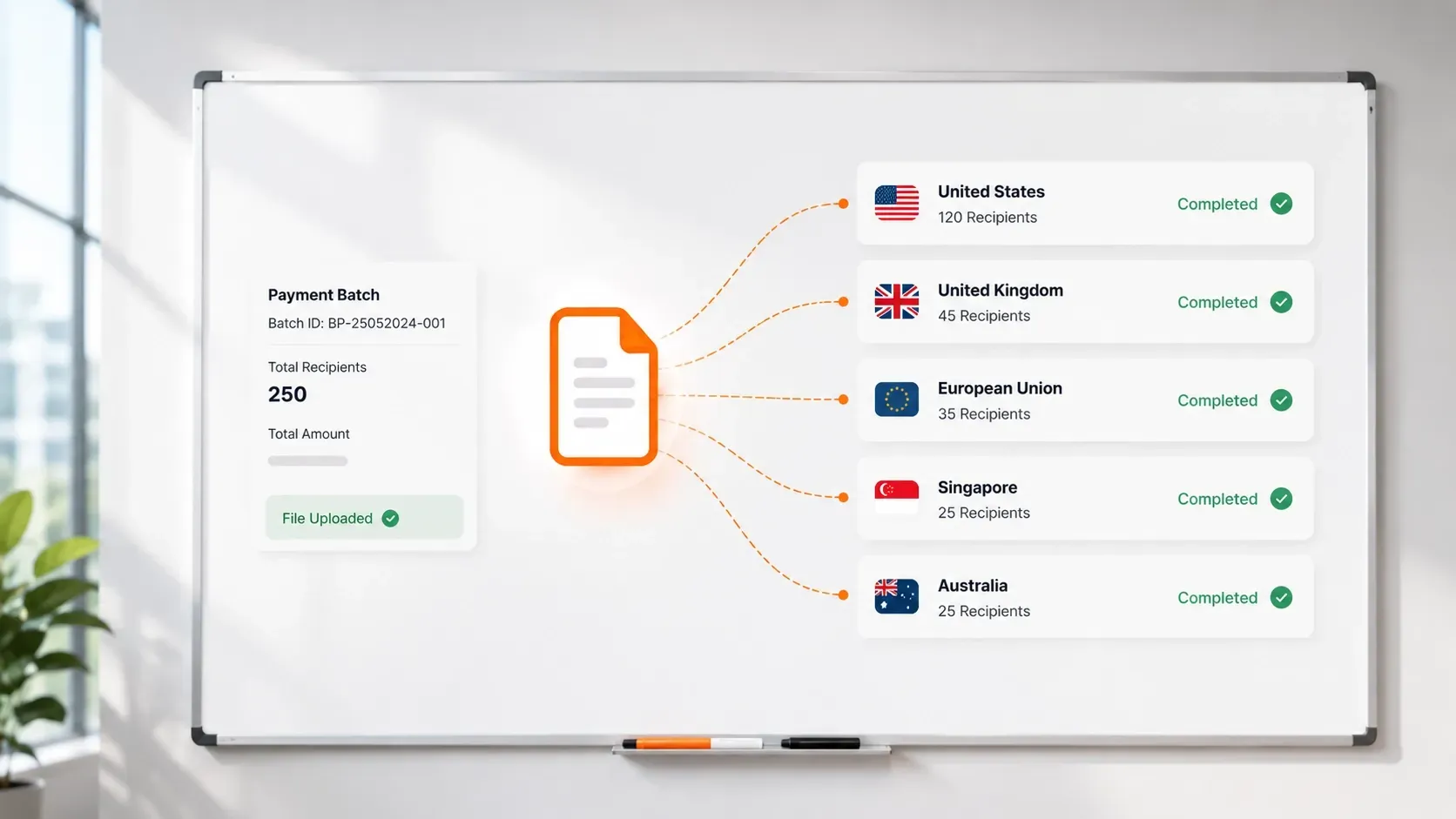
Bulk payments allow a business to send money to multiple recipients at once instead of processing every payment one by one. They are commonly used for supplier payments, contractor payments, global payroll payments, marketplace payouts, and recurring invoice payments.
Canadian businesses can use bulk payments to reduce manual payment work, improve payment accuracy, simplify reconciliation, and manage cross-border payments more efficiently.
Quick answer: Bulk payments are multiple payments sent together in one batch. Businesses use bulk payments to pay suppliers, contractors, employees, affiliates, vendors, or customers faster and with fewer manual steps. Canadian businesses that send international bulk payments can also save time, improve payment tracking, manage FX costs, and streamline approval and reconciliation workflows.
MTFX has been helping clients move money globally since 1996. Canadian businesses can use MTFX global payment solutions for secure international money transfers, competitive exchange rates, business FX payments, rate alerts, payment tracking, and specialist support when sending money to multiple countries and currencies.
What are bulk payments in business?
Bulk payments are grouped payments sent to several recipients at the same time. Instead of creating a separate transaction for every supplier, contractor, employee, or customer, a business prepares one payment batch and processes it through a bank, payment platform, or global payment provider.
Businesses commonly use bulk payments for:
- Supplier payments
- Vendor payments
- Contractor payments
- Freelancer payments
- Payroll-related payments
- Affiliate payouts
- Marketplace payouts
- Customer refunds
- Rebates and incentives
- Recurring invoice payments
Are bulk payments, mass payments, and batch payments different?
Bulk payments, mass payments, and batch payments are similar, but the terms are often used in different business contexts. In most cases, they all refer to sending multiple payments together instead of processing each payment separately.
The difference is usually based on how the bank, payment provider, or software platform describes the feature.
For example, a finance team may say “bulk payments,” an accounting system may call them “batch payments,” and a payment platform may describe them as “mass payments” or “bulk payouts.”
The purpose is the same: send multiple payments faster, reduce repetitive work, and create a more organized payment process.
| Field | Value |
|---|---|
Amount Payable (USD) 25,000 | |
Banks Exchange Rate 1.4425 / 0.6932 | |
Total cost 36,063.38CAD |
| Field | Value |
|---|---|
Amount Payable (USD) 25,000 | |
MTFX Exchange Rate 1.4178 / 0.7053 | |
Total cost 35,444.64CAD |
You Save
CAD 618.73
with MTFX
26 September 2026
We use mid-market rates. This is for informational purposes only. Log in to view send rates.
How do bulk payments work step by step?
Bulk payments work by grouping payment details into one file or workflow, reviewing the batch, approving the total payment, and sending funds to multiple recipients. For international bulk payments, the process also includes currency conversion and cross-border payment checks.
Here is the usual process:
- Collect payment details - Gather recipient names, bank details, invoice amounts, currencies, payment references, and due dates.
- Create the payment batch - Upload a spreadsheet, import a payment file from accounting software, or enter payment details into a payment platform.
- Review the payment batch - Check account numbers, recipient names, payment amounts, currencies, duplicate entries, and invoice references.
- Approve the payment - A business owner, finance manager, or authorized user approves the batch before funds are released.
- Fund the transfer - The business funds the payment from its bank account or payment account.
- Send and track payments -The payment provider processes the transfers and provides confirmations, tracking details, or reports.
For international bulk payments, businesses may also need to convert Canadian dollars into USD, EUR, GBP, JPY, AUD, INR, CNY, or another currency.
Before sending a large payment batch, businesses can check current exchange rates using the MTFX live currency converter, review live exchange rates, or monitor a specific currency pair, such as the CAD to USD exchange rate.
Businesses that want to review currency movements before scheduling payments can also use historical currency exchange rates and currency charts.
Why do businesses use bulk payments?
Businesses use bulk payments to save time, reduce manual errors, and manage high-volume payments more efficiently. As payment volume grows, one-by-one payment processing becomes harder to manage.
Bulk payments help businesses:
- Reduce repetitive data entry
- Pay multiple recipients faster
- Improve approval workflows
- Lower the risk of missed payments
- Reduce duplicate payments
- Improve payment visibility
- Simplify reconciliation
- Maintain cleaner records
- Support recurring payment schedules
- Manage international payments from one place
For payment planning, finance teams can also use MTFX resources such as the global payment checklist and the guide on common mistakes businesses make when sending international payments.
For business record-keeping, the Canada Revenue Agency’s record-keeping guidance explains that businesses should keep records that support income, expenses, and tax obligations.
Who needs a bulk payment solution?
A bulk payment solution is useful for any business that pays multiple people, companies, vendors, or accounts regularly. It becomes more important when payment volume, payment frequency, or currency complexity increases.
Do importers and exporters need bulk payments?
Yes, importers and exporters often benefit from bulk payments because they regularly pay overseas suppliers in foreign currencies. A Canadian importer may need to pay suppliers in USD, EUR, CNY, GBP, JPY, or other currencies.
Using a bulk payment solution helps the business organize supplier payments, reduce manual processing, and review exchange rates before sending funds.
Businesses paying vendors overseas can also use MTFX overseas invoice payment solutions to manage high-volume and recurring international invoices.
Do ecommerce businesses use bulk payouts?
Yes, ecommerce and marketplace businesses often use bulk payouts to pay sellers, affiliates, partners, and vendors. If a platform needs to send payments to many recipients every week or month, bulk payouts can make the process faster and easier to track.
This is useful for:
- Marketplace sellers
- Affiliate partners
- Referral partners
- Dropshipping suppliers
- Customer refunds
- Vendor settlements
Do agencies and service firms need batch payments?
Yes, agencies and professional service firms often use batch payments to pay freelancers, consultants, media partners, and contractors. A marketing agency, software company, creative studio, or consulting firm may work with remote teams in several countries.
Batch payments help these businesses pay multiple contractors while keeping payment records organized.
Can global teams use bulk payments?
Yes, businesses with global teams can use bulk payments to pay international employees, contractors, and remote workers. If payments are made across multiple countries, a provider with multi-currency payment support can make the process easier.
MTFX supports global workforce payments for businesses paying international employees, contractors, and freelancers.
Do accounts payable teams benefit from bulk payments?
Yes, accounts payable teams can use bulk payments to process approved invoices faster and improve reconciliation. Instead of paying every invoice separately, AP teams can group payments into batches and track them more clearly.
This helps with:
- Vendor payment scheduling
- Invoice payment runs
- Internal approvals
- Payment references
- Month-end close
- Audit trails
- Cash flow planning
How do bulk payments reduce business costs?
Bulk payments can reduce costs by saving admin time, reducing errors, improving payment planning, and helping businesses manage FX more effectively. The savings are not only about transfer fees. They also come from better payment workflows.
For international payments, the exchange rate often matters more than the visible transfer fee. A small difference in the FX rate can affect the total cost, especially when payment batches are large or frequent.
Canadian businesses sending recurring supplier payments can use the MTFX rate calculator, daily rate lookup, and live exchange rates to review currency values before converting funds.
Get USD Live Exchange Rates
| Currency | Rates | High | Low | Daily |
|---|---|---|---|---|
 CAD | 1.4143 | 1.4155 | 1.4125 | 0.06% |
 EUR | 1.1401 | 1.1401 | 1.1400 | 0.18% |
 INR | 95.82 | 95.82 | 95.82 | -0.13% |
 GBP | 1.3248 | 1.3264 | 1.3209 | 0.23% |
 CNY | 6.7037 | 6.7125 | 6.7037 | 0.00% |
 JPY | 157.19 | 157.19 | 157.19 | -1.00% |
 MXN | 17.68 | 17.78 | 17.64 | -0.25% |
Example: A Canadian business needs to pay 25 overseas suppliers at the end of each month. Instead of creating 25 separate transfers, the finance team uploads one payment batch with supplier names, invoice references, currencies, and payment amounts. The batch is reviewed, approved, funded, and then processed through one workflow. This reduces repeated data entry, makes reconciliation easier, and helps the business review FX costs before sending funds.
Why are international bulk payments more complex?
International bulk payments are more complex because they involve multiple currencies, banking networks, payment rules, and recipient details. A domestic payment may only need local bank details, but a cross-border payment often requires more information.
International bulk payments may involve:
- SWIFT/BIC codes
- IBANs
- Routing numbers
- Local bank codes
- Recipient addresses
- Intermediary banks
- Currency conversion
- FX margins
- Wire transfer fees
- Receiving bank charges
- Compliance checks
The SWIFT network supports international financial messaging between banks and financial institutions. Because cross-border payments rely on accurate banking details, businesses should check supplier information carefully before sending a batch.
Bulk payments vs manual payments: Which is better?
Bulk payments are better when a business pays multiple recipients regularly, while manual payments may be enough for occasional transfers. The right option depends on payment volume, payment frequency, payment complexity, and business growth.
If your business only pays one or two vendors occasionally, manual payments may be manageable. But if you pay several suppliers, contractors, or partners every month, a bulk payment solution can save time and improve control.
For businesses sending cross-border payments, manual transfers can become even more difficult because teams also need to manage FX rates, bank details, intermediary fees, and payment tracking.
What risks should businesses watch for with bulk payments?
Bulk payments are efficient, but they need strong controls because one payment batch may include many transactions. A single mistake can delay payments, create supplier issues, or increase admin work.
1. Can wrong bank details delay bulk payments?
Canadian businesses should verify payment instructions carefully, use approval controls for high-value transfers, and work with reputable payment providers. The Canadian Anti-Fraud Centre warns that businesses can be targeted by payment redirection and spear phishing fraud, where fraudsters impersonate legitimate contacts and provide fraudulent payment instructions.
2. Can duplicate payments happen in a payment batch?
Yes, duplicate payments can happen if the same invoice, supplier, or payee is included more than once. Finance teams should check batch files before approval and use clear invoice references.
3. Can FX costs be hidden in bulk payments?
Yes, international bulk payments may include FX margins, wire fees, intermediary charges, or receiving bank fees. A low transfer fee does not always mean the total cost is low.
Businesses should compare the full payment cost, not only the upfront fee.
4. Can poor approvals create payment risk?
Yes, weak approval controls can increase the risk of incorrect or unauthorized payments. Businesses should define who can create, review, approve, and release payment batches.
Businesses should also watch for payment redirection and business email compromise scams, where fraudsters impersonate trusted suppliers or executives and provide fraudulent payment instructions. The Canadian Anti-Fraud Centre provides guidance on fraud prevention for businesses.
The Financial Transactions and Reports Analysis Centre of Canada is Canada’s financial intelligence unit and AML/ATF regulator. Canadian businesses should work with reputable and regulated payment providers when sending high-value or international transfers. You can verify a Canadian money services business through FINTRAC’s Money Services Business Registry
What should you look for in a bulk payment provider?
A good bulk payment provider should offer security, multi-currency support, transparent costs, payment tracking, and business support. For international payments, the provider should also understand FX, cross-border settlement, and supplier payment workflows.
Use this checklist when comparing bulk payment providers:
A provider should also make it easy to compare rates before sending money. Businesses can use the MTFX currency converter to estimate conversion values, review currency charts to monitor market movement, and use historical exchange rates for planning.
For provider selection, businesses can also review MTFX’s blog on questions to ask before choosing a global payments provider.
How can MTFX help with bulk payments?
MTFX helps Canadian businesses send international business payments, manage FX rates, and streamline cross-border supplier, invoice, and contractor payments. With MTFX business global payments, businesses can send payments to 190+ countries in 50+ currencies.
MTFX can support businesses that need to:
- Pay overseas suppliers
- Send B2B money transfers
- Pay global contractors
- Manage international workforce payments
- Convert CAD into foreign currencies
- Track currency movements
- Set rate alerts
- Speak with FX specialists
- Improve payment visibility
- Manage invoice payments at scale
Join Canadians using MTFX for secure transfers, and fast online payments.


Better bulk payments start with better FX planning
Bulk payments are more than a faster way to send money. The main takeaway is simple: the more payments your business sends, the more important it becomes to have a structured process.
Bulk payments can help your business:
- Save finance team time
- Reduce manual payment errors
- Improve supplier payment reliability
- Simplify reconciliation
- Track international payments more clearly
- Manage currency conversion more effectively
- Support business growth across borders
If your business regularly pays overseas suppliers, global contractors, or international partners, MTFX can help you streamline cross-border business payments, compare exchange rates, and access specialist FX support.
Sign up with MTFX to streamline international bulk payments for your business with competitive exchange rates, secure cross-border transfers, multi-currency payment solutions, and specialist support for paying suppliers, contractors, vendors, and global teams.
FAQs
1. What is a bulk payment?
A bulk payment is a group of payments sent to multiple recipients at once. Businesses use bulk payments to pay suppliers, contractors, employees, affiliates, vendors, or customers more efficiently.
2. Are bulk payments and batch payments the same?
Bulk payments and batch payments are very similar. Both involve grouping multiple payments together for processing. The exact term may depend on the bank, payment provider, or accounting system.
3. Can bulk payments be used for international transfers?
Yes, bulk payments can be used for international transfers when the provider supports cross-border payments and multiple currencies. They are useful for paying overseas suppliers, contractors, and global teams.
4. What is the difference between bulk payments and mass payments?
Bulk payments usually refer to business payments grouped together, such as supplier or contractor payments. Mass payments often refer to larger-scale payouts, such as marketplace, affiliate, rebate, or customer payouts.
5. Are bulk payments safe?
Bulk payments can be safe when processed through a secure and regulated payment provider. Businesses should use approval controls, verify recipient details, review payment batches, and keep clear payment records.
6. How do bulk payments reduce costs?
Bulk payments reduce costs by saving admin time, reducing manual errors, improving reconciliation, and helping businesses plan recurring payments. For international payments, comparing exchange rates can also reduce FX-related costs.
7. What businesses benefit most from bulk payments?
Businesses that pay multiple recipients regularly benefit most. This includes importers, exporters, ecommerce companies, agencies, marketplaces, finance teams, and companies with international suppliers or contractors.
8. How can Canadian businesses send international bulk payments?
Canadian businesses can send international bulk payments through a global payment provider that supports multiple currencies, payment tracking, competitive exchange rates, and business payment support. MTFX supports international business payments to 190+ countries in 50+ currencies.
Get competitive exchange rates and quick international payments.