1 Euro Houses in Italy: A Canadian's Budget for Deposits, Fees and Renovations
For Canadians, the cost of a one-euro house goes well beyond its purchase price. A hypothetical project with a €90,000 renovation contract, purchase fees and contingency funds could require approximately €111,001 (CAD $177,601.60) at an illustrative exchange rate of CAD $1.60 per euro, excluding certain additional expenses.
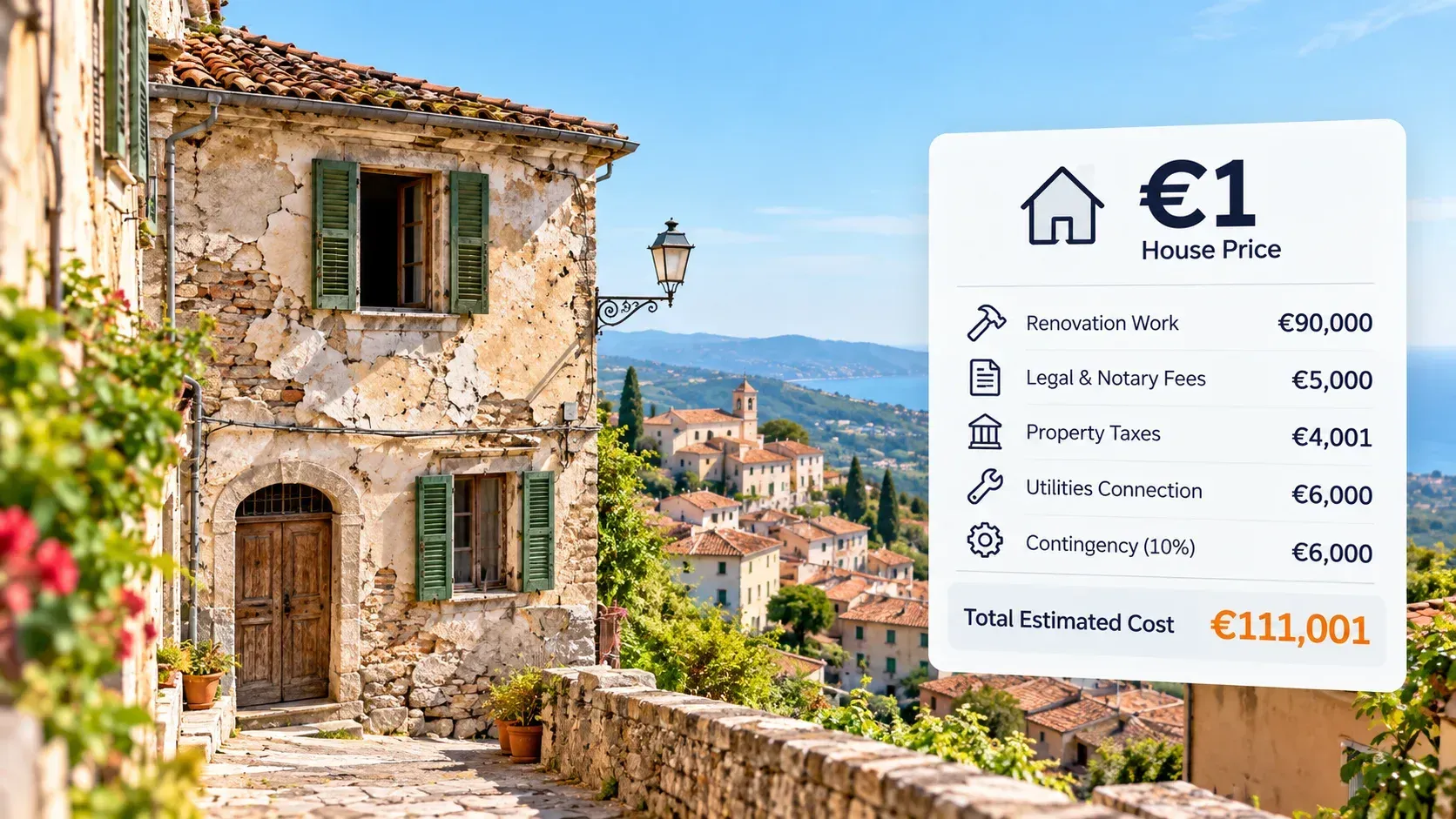
Buying a house in Italy for €1 sounds like an incredible deal, but the actual cost of owning and restoring the property can be much higher. While one-euro houses in Italy are genuine initiatives supported by certain municipalities, buyers must often cover property transfer fees, taxes, renovation expenses and financial guarantees. Depending on the building's condition, the total commitment can reach well over €100,000.
For Canadians considering a restoration project, there's another expense to manage: currency conversion. Your savings may be in Canadian dollars (CAD), but the purchase, professional services and renovation work will generally be paid in euros (EUR). Understanding these costs and when payments become due can help you build a realistic budget before committing.
This guide explains how Italy's €1 house schemes work, what buyers need to pay and how to plan CAD to EUR transfers throughout the renovation.
What are one-euro houses in Italy, and what's the catch?
One-euro houses in Italy are properties offered at a symbolic purchase price through local initiatives designed to restore abandoned or neglected buildings. The low price is intended to attract buyers willing to invest in properties that might otherwise remain vacant.
The catch is that purchasing the house is only the beginning. You may be required to complete substantial renovations, meet municipal deadlines and provide financial security to demonstrate your commitment.
Why are some Italian houses sold for €1?
Several smaller Italian municipalities have introduced these initiatives to encourage investment in historic properties and bring unused buildings back into use.
Instead of allowing deteriorating homes to remain empty, participating property owners make them available at a symbolic price, subject to the municipality's programme.
For the buyer, this creates an opportunity to acquire a property at a low initial price. However, the building may need extensive work before it can be safely occupied.
What obligations come with buying a €1 house?
Although requirements differ by municipality, buyers may need to:
- Submit a renovation or restoration plan.
- Arrange architectural or engineering assessments.
- Obtain the necessary building permits.
- Start and complete work within specified deadlines.
- Provide a cash deposit or financial guarantee, where required.
- Cover all expenses associated with transferring and restoring the property.
For example, the municipality of Casteldelci requires buyers participating in its scheme to undertake specific restoration commitments and provide a financial guarantee.
The important point is that Italy does not have one nationwide set of rules for €1 houses. Every participating municipality may apply different conditions.
| Field | Value |
|---|---|
Amount Payable (EUR) 150,000 | |
Bank Exchange Rate 1.6225 / 0.6163 | |
Total cost 243,380.16CAD |
| Field | Value |
|---|---|
Amount Payable (EUR) 150,000 | |
MTFX Exchange Rate 1.5947 / 0.6271 | |
Total cost 239,204.52CAD |
You Save
CAD 4,175.64
with MTFX
16 October 2026
We use mid-market rates. This is for informational purposes only. Log in to view send rates.
Can Canadians still buy one-euro houses in Italy?
Yes, Canadians may be eligible to buy one-euro houses in Italy, provided they meet the relevant municipal programme requirements and Italian property ownership rules.
However, the availability of these properties changes as municipalities announce new opportunities, receive applications and assign homes to successful buyers.
Where are one-euro house programmes available?
Several municipalities have continued running or developing property restoration initiatives.
Two examples illustrate how these schemes can differ.
According to the municipality of Penne, four properties were awarded in February 2026 for €100, €2,000 and €5,000, with two properties receiving the €5,000 price.
This is an important detail for buyers: participation in a €1 house initiative does not necessarily mean the final agreed purchase price will be exactly €1.
You should check the relevant municipality's official website for current listings, application deadlines and property-specific requirements. Previously announced programmes do not guarantee that homes remain available.
Do Canadians need to live in Italy to buy a property?
Canadians can generally purchase property in Italy without already living there, subject to applicable legal requirements.
For non-EU buyers, the Italian notary may need to verify the principle of reciprocity and other conditions relevant to the transaction.
The Italian National Council of Notaries explains how these checks apply to foreign nationals.
Owning property also does not automatically provide Italian residency rights.
If you're unfamiliar with the broader process, understanding the requirements for buying property in Italy as a Canadian can help you prepare the necessary documents before participating in a municipal scheme.
How much does a one-euro house in Italy really cost?
The true cost of a one-euro house includes much more than the purchase price. Buyers should budget for taxes, notary fees, property assessments, professional services, renovation work and unexpected expenses.
The largest financial commitment is often restoring the building to a usable condition.
Example: A Canadian buyer's restoration budget
Suppose you're purchasing a €1 property that needs substantial structural and interior work.
After reviewing the project, you prepare a hypothetical renovation contract budget of €90,000, with additional amounts for the purchase, professional services and contingency.
For this example, assume an illustrative exchange rate of €1 = CAD $1.60.
All professional, renovation and contingency amounts in this table are hypothetical planning assumptions, not quotations or national averages. The example assumes the €90,000 renovation contract covers the labour, materials and applicable taxes specified in that contract.
Actual costs could be considerably higher or lower depending on the building and the work required. The budget also excludes any applicable surety premium or collateral, travel, temporary accommodation, ongoing ownership costs and currency transfer charges.
A CAD to EUR currency calculator can help you estimate how much Canadian funding you'll need once you have actual quotations.
Why the advertised €1 price can be misleading
In the example above, the symbolic purchase price represents almost none of the total project budget. Even if the property itself costs only €1, the restoration and associated expenses could require more than €100,000.
The situation becomes more complicated when hidden structural problems, planning restrictions or additional professional work arise after the initial assessment. That's why the decision should be based on the total cost of acquiring and restoring the property, not simply the purchase price.
What deposits and financial guarantees do one-euro house buyers need?
Some municipalities require buyers to provide financial security as part of the purchase agreement. These requirements are intended to encourage buyers to complete the restoration work they have committed to undertaking.
However, a cash deposit and a bank or insurance guarantee are not the same thing.
What is the difference between a cash deposit and a financial guarantee?
A cash deposit involves paying an amount that is held under specific contractual conditions. Depending on the rules, it may be refundable once the buyer fulfils the required obligations.
A financial guarantee, such as a bank or insurance surety bond, is an undertaking that may be called upon if the buyer does not comply with the agreement.
The guarantee's face value is not necessarily the amount the buyer pays upfront. For example, a €4,000 guarantee might involve an issuer's premium or a collateral requirement rather than a direct €4,000 payment to the municipality.
Example: Casteldelci's €4,000 guarantee
Under Casteldelci's published one-euro house guidelines, participating buyers must arrange a €4,000 bank or insurance surety bond. The guarantee must remain valid for three years and six months, with renewal provisions if the municipality grants certain extensions.
If the buyer fails to meet their obligations, the municipality may call upon the guarantee under its terms. For a Canadian buyer, this creates another financial consideration. The bank or insurer may charge for issuing the guarantee, require supporting financial information or request collateral.
The €4,000 face value therefore should not automatically be added to the renovation budget as a non-refundable expense. However, the potential financial exposure and any collateral requirement still need to be considered.
Can you lose your deposit or guarantee?
Yes. Depending on the municipal agreement, failing to meet restoration deadlines or other contractual obligations may lead to financial consequences.
Before committing, confirm the conditions for releasing any security, the circumstances that may trigger forfeiture or a guarantee claim, and whether extensions are permitted. These details matter just as much as the property's purchase price.
What taxes and professional fees apply to a €1 property in Italy?
Buying a house for a symbolic amount does not remove the normal legal and administrative costs associated with transferring Italian property.
The final amount depends on the seller, property classification, cadastral value and whether the buyer qualifies for any tax relief.
Property registration and transfer taxes
According to the Italian Revenue Agency, the ordinary tax framework for buying residential property from a private seller without first-home relief generally includes:
Where the relevant conditions are met, registration tax can be calculated using the property's cadastral value rather than the symbolic purchase price. This means buying a home for €1 does not automatically result in negligible purchase taxes.
Different rules may apply to qualifying first-home purchases, VAT-taxable transactions and other circumstances. An Italian notary should calculate the tax liability for the specific property.
Notary and legal costs
The Italian notary plays a central role in transferring ownership and registering the transaction. Notary fees vary depending on the property and complexity of the purchase. Older buildings may also involve ownership-history or cadastral issues that require additional work.
Before signing, request a written breakdown of the notary's fees, applicable taxes and any other expenses necessary to complete the transfer.
Survey, architectural and permit expenses
A €1 property may have been vacant for years. Before committing to a restoration budget, you may need a technical assessment of the building's structure and compliance status.
A local geometra, architect or engineer can help assess the property's condition, review relevant documents and identify the approvals needed for renovation. These professional costs should be included in the budget even if the purchase price is minimal.
For Canadians funding the acquisition from abroad, property purchase payments also need to be planned around the notary's settlement instructions and required deadlines.
How much should you budget to renovate a one-euro house?
There is no reliable single renovation cost for every one-euro house in Italy. The amount depends on the building's size, age, structural condition, location and the work necessary to meet local regulations.
A house requiring cosmetic improvements will have a very different budget from one that needs extensive structural repairs.
What renovation work may be required?
A restoration project might involve repairing or replacing several major building components.
- Structural repairs: Older properties may require work on walls, floors, foundations or other load-bearing elements.
- Roofing and weatherproofing: Damaged roofs and water ingress may need attention before interior work can begin.
- Electrical and plumbing systems: Existing installations may require replacement or upgrading to meet applicable standards.
- Heating and insulation: Energy efficiency improvements may form part of the renovation plan.
- Windows, doors and interiors: Finishing work may include flooring, kitchens, bathrooms and other essential fixtures.
Not every property will require all these improvements. A qualified inspection is necessary to establish the scope of work.
How should you estimate renovation costs?
Start with a professional assessment and obtain written quotations from qualified local contractors. A useful quotation should identify the work being performed, materials, labour, applicable VAT, expected completion dates and any exclusions.
For example, a contractor offering a €90,000 renovation should explain whether the price includes electrical work, plumbing, structural repairs, finishes and waste removal. If the quote excludes major items, the final project cost could be significantly higher.
How much contingency should you include?
Renovation projects can change once work begins, especially when older buildings have concealed damage.
Using the hypothetical €90,000 renovation contract, a 15% contingency would be:
€90,000 × 15% = €13,500
This creates a combined renovation and contingency allowance of:
€90,000 + €13,500 = €103,500
The 15% figure is an illustrative budgeting assumption, not a standard requirement or a guarantee of sufficient reserves.
If the property requires extensive structural restoration, a larger contingency may be appropriate. The amount should reflect the risks identified during the professional assessment.
When are payments due during the purchase and renovation process?
One-euro house purchases can involve several financial deadlines. You may need funds for the property transfer first, followed by design work, permits, contractor deposits and progress payments.
For Canadians, planning these obligations in advance is particularly important because each EUR payment may require a separate conversion from CAD.
What deadlines can municipalities impose?
Casteldelci's published guidelines provide a practical example of how restoration obligations may be scheduled.
These deadlines apply to Casteldelci's programme and should not be treated as universal rules across Italy. For instance, the municipality of Penne stated that buyers awarded properties in February 2026 needed to submit renovation designs and begin restoration work during 2026.
Before buying, review the exact dates and consequences of missing them.
How do contractor progress payments work?
Rather than paying the full renovation contract upfront, buyers may negotiate payments linked to specific stages of completed work.
For example, consider a hypothetical €90,000 renovation agreement with the following schedule.
This is an illustrative payment schedule, not a standard Italian contractual requirement. Each payment should correspond to agreed work, verified documentation and the conditions of the signed agreement.
For example, before transferring the €31,500 structural milestone, ask your contractor to confirm the work completed and provide the supporting invoice. The payment reference should identify the project and relevant invoice so both parties can reconcile the amount.
Why does payment timing matter?
Suppose a €31,500 contractor invoice becomes due while your money is still held in Canadian dollars.
At an illustrative exchange rate of €1 = CAD $1.60, you would need CAD $50,400 before transfer costs.
If the rate moves to CAD $1.65 per euro, the same invoice would require CAD $51,975.
That's an additional $1,575 for one payment, even though the contractor's EUR invoice hasn't changed.
When you have several milestones over a longer renovation period, these differences can affect your remaining budget.
If a payment deadline is approaching, arranging the correct amount on time should take priority over waiting for a potentially better exchange rate.
How do CAD to EUR exchange rates affect a one-euro house renovation budget?
CAD to EUR exchange rates determine how many Canadian dollars you need to purchase the euros required for your project.
Although your contractor may agree to a fixed EUR amount, your cost in CAD can rise or fall between signing the agreement and making the payment.
Example: Funding a €90,000 renovation
Suppose your renovation contract is fixed at €90,000. Here's how two hypothetical exchange rates affect the Canadian-dollar requirement.
Difference: CAD $4,500.
Nothing has changed in the contractor's quotation. The additional cost comes entirely from the exchange rate movement.
These figures exclude transfer fees and provider exchange rate margins. For a project involving multiple EUR payments, it can be helpful to calculate the CAD requirement for each milestone rather than converting the full budget using one assumed future rate.
Understanding how to convert Canadian dollars into euros can also help you assess how exchange rates and transfer pricing affect larger payments.
How can you plan your CAD to EUR transfers?
If your renovation is expected to run over several months, you can use currency tools to understand potential changes in your Canadian-dollar funding requirements.
Review historical exchange rates
Checking historical CAD to EUR exchange rates can help you understand how the currency pair has moved over previous weeks and months. Past movements don't predict future rates, but they can provide context when preparing a longer-term renovation budget.
Compare FX rates and save big on CAD to EUR conversions.
Monitor daily currency developments
The daily EUR exchange rate outlook provides information about recent currency movements and the factors influencing the euro. This can be useful when an upcoming contractor payment is approaching.
Consider the broader currency outlook
For longer-term planning, the monthly Canadian dollar forecast and bank exchange rate forecasts provide perspectives on possible currency movements. Forecasts are uncertain and shouldn't replace a payment plan based on actual contractual deadlines.
Set exchange rate alerts
If your next payment is still several weeks away, exchange rate alerts can notify you when the currency pair reaches a preferred level. An alert helps you monitor rates but doesn't reserve or guarantee the quoted rate.
How can Canadians pay for property and renovation costs in Italy?
Canadians can use banks or eligible international money transfer providers to make EUR payments to Italian recipients.
The appropriate route depends on who is receiving the funds, the amount required and any payment instructions specified in the property or renovation agreement.
Paying the property seller or notary
The property purchase may require a payment to the seller or through an arrangement specified by the Italian notary. Before transferring funds, confirm the recipient's identity, banking details, payment reference and settlement deadline directly with the relevant professional.
Don't assume that every one-euro house programme uses a municipal bank account to collect the purchase price.
Paying renovation contractors in EUR
Contractors will generally provide payment instructions for their invoices. For each invoice, verify the contractor's legal name, Italian IBAN and any required BIC/SWIFT information, along with the payment amount and reference.
If someone requests a change to banking details, confirm the change independently using previously verified contact information.
For example, if your contractor emails an updated account number shortly before a €31,500 payment is due, contact the contractor through an established telephone number rather than relying solely on the message. This helps protect against payment redirection fraud.
Banks versus international money transfer providers
When comparing payment options, consider the full cost of delivering the required EUR amount.
For example, two providers might advertise different transfer fees, but the provider with the lower fee won't necessarily be less expensive if its exchange rate is less favourable.
The most useful comparison is how many Canadian dollars you must pay for the required EUR amount to reach your recipient. You can compare CAD to EUR exchange rates before arranging a large payment.
For eligible property and renovation payments, MTFX also provides a way to send money to Italy from Canada through its online international transfer service. Confirm the final rate, applicable charges, recipient eligibility and expected delivery time before completing your transfer.
How can you avoid renovation cost overruns and payment mistakes?
A €1 house renovation can involve several contractors, unexpected repairs and payments spread over a long period. Keeping your financial records organized and checking invoices carefully can help you control the project's costs.
Before making a major payment, focus on a few practical checks.
- Confirm the scope of work: Make sure the invoice matches the signed quotation and the work agreed with the contractor.
- Review completed milestones: If payment depends on a particular construction stage, obtain the appropriate confirmation that it has been completed.
- Check additional charges: Determine whether new expenses involve work outside the original agreement.
- Verify the recipient: Independently confirm the banking information before sending funds.
- Update your budget: Record payments already made, remaining contractual obligations and the contingency still available.
- Keep supporting documents: Save invoices, receipts, contracts, bank confirmations and currency conversion records.
For example, suppose a contractor discovers additional structural problems and requests €8,000 for work not included in the original quotation.
Before paying, ask for a written explanation of the repairs, an updated cost estimate and confirmation of how the change affects the project schedule. At an illustrative rate of CAD $1.60 per euro, that additional €8,000 would require CAD $12,800, before transfer costs.
The expense would also reduce the €13,500 contingency in the earlier example to €5,500 if the entire amount were paid from that reserve. That's why maintaining a current renovation budget is just as important as preparing the initial estimate.


Beyond the €1 price: Make every euro count
The appeal of a one-euro house in Italy is easy to understand. But the real commitment begins after the purchase, when you need to turn an aging property into a usable home while meeting the municipality's requirements.
For Canadian buyers, a realistic plan starts with the property's condition, not its advertised price. Understand the taxes and professional costs, review any financial guarantees, obtain detailed renovation quotations and prepare for contractor payments throughout the project.
It's equally important to consider what those EUR expenses mean for your Canadian savings. Exchange rate movements, transfer charges and unexpected work can all affect the final CAD cost. A well-planned renovation isn't necessarily the one with the lowest purchase price. It's the one you have the financial resources to complete.
Ready to fund your Italian property project?
MTFX has helped Canadians manage international payments since 1996. Whether you're arranging an eligible property payment or funding renovation invoices, you can access CAD to EUR exchange rates, online transfers and support for larger international payments.
Check your CAD to EUR rate and plan your next payment before your deadline approaches.
FAQs
1. Can Canadians buy one-euro houses in Italy?
Yes, Canadians may be eligible to buy one-euro houses in Italy, provided they satisfy the relevant municipal scheme and Italian legal requirements. An Italian notary should verify the applicable foreign-buyer conditions before the transaction is completed.
2. Are €1 houses still available in Italy in 2026?
Municipal one-euro house initiatives continued in 2026, including activity in Penne and Casteldelci. However, individual properties are assigned or withdrawn over time. Check the participating municipality's official notices for current availability and application deadlines.
3. What is the real cost of buying a €1 house in Italy?
The total cost includes the property price, applicable taxes, notary fees, professional assessments, renovation work and contingency funds. A hypothetical project with a €90,000 renovation contract and a 15% renovation contingency could require approximately €111,001 overall, before certain additional expenses.
4. What is the catch with one-euro houses in Italy?
Buyers may be required to restore neglected buildings, submit renovation plans, provide financial guarantees and complete work within municipal deadlines. The property's condition and the cost of meeting these obligations can make the total investment much higher than €1.
5. Are deposits for one-euro houses in Italy refundable?
It depends on the municipality and the type of security required. Some schemes may involve refundable cash deposits, while others require bank or insurance guarantees. Casteldelci, for example, specifies a €4,000 surety bond rather than an ordinary €4,000 cash deposit.
6. How long do you have to renovate a €1 house in Italy?
Renovation deadlines vary by municipality. Under Casteldelci's published guidelines, buyers generally must submit a renovation project within six months of the deed, begin work within 12 months of building permission and complete it within three years of the deed, subject to authorized extensions.
7. What taxes do you pay when buying a one-euro house in Italy?
Applicable property purchase taxes depend on the seller, cadastral value, property classification and buyer's eligibility for relief. For certain private residential sales without first-home relief, ordinary registration tax is 9%, subject to a €1,000 minimum, plus applicable mortgage and cadastral taxes.
8. Can I pay an Italian renovation contractor from Canada?
Yes, eligible international bank transfers can be used to pay Italian renovation contractors from Canada. Confirm the contractor's banking details, invoice amount, payment reference and contractual milestone before transferring funds. Compare the full CAD cost of delivering the required EUR amount.
9. How do CAD to EUR exchange rates affect renovation costs?
Exchange rate movements change the Canadian-dollar amount required for fixed EUR expenses. For example, a €90,000 renovation costs CAD $144,000 at $1.60 per euro but CAD $148,500 at $1.65 per euro, a difference of $4,500 before transfer charges.
Disclaimer: This article is for general informational purposes only and does not constitute financial, legal, tax or real estate advice. One-euro house programme requirements, property taxes, deposits, financial guarantees, renovation costs and completion deadlines vary by municipality and individual property. All budget figures, renovation estimates and currency conversion examples are illustrative and do not represent guaranteed costs or exchange rates. Before purchasing a property or making payments, verify current requirements with the relevant Italian municipality, a qualified notary, local professionals and your financial service provider.