Business Wire Transfers for Overseas Supplier Payments
Canadian businesses can use wire transfers to pay overseas suppliers securely, but the real cost depends on FX rates, bank fees, payment routing, and timing. Learn what details you need, how wires work, and how to reduce supplier payment risks.
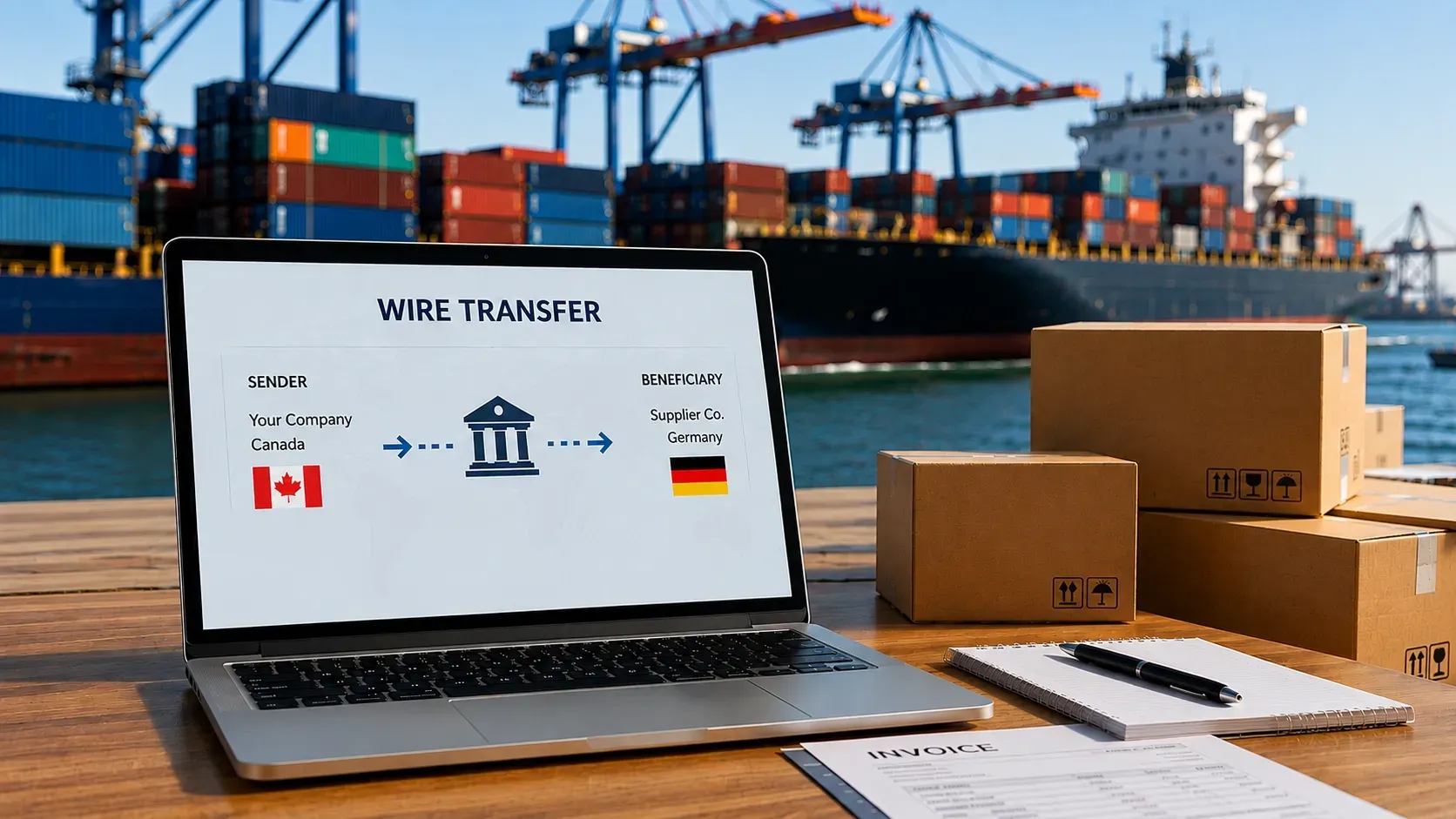
Business wire transfers are one of the most common ways Canadian companies pay overseas suppliers, especially for high-value invoices, time-sensitive payments, and direct bank-to-bank supplier payments.
They can be reliable and widely accepted, but they can also involve transfer fees, intermediary bank charges, exchange rate markups, compliance checks, and processing delays.
Quick overview: A business wire transfer lets Canadian companies send funds directly to an overseas supplier’s bank account. It is useful for large or time-sensitive invoices, but businesses should compare exchange rates, check transfer and intermediary fees, verify supplier bank details, and track the payment to avoid delays or unexpected costs.
This guide is for Canadian business owners, CFOs, finance teams, AP teams, importers, exporters, and procurement teams that need to send international supplier payments securely while keeping costs, timelines, and cash flow under control.
What is a business wire transfer?
A business wire transfer is an electronic payment sent from one business account to another. For overseas supplier payments, a business wire transfer usually moves funds through international banking networks and may involve currency conversion, SWIFT/BIC details, intermediary banks, and compliance screening.
Businesses often use wire transfers when they need to pay international invoices directly into a supplier’s bank account. This is common for manufacturers, distributors, contractors, freight providers, raw material suppliers, and global service vendors.
A business wire transfer may be used for:
- Paying overseas manufacturers
- Sending deposits for international orders
- Settling large supplier invoices
- Paying vendors in USD, EUR, GBP, or another foreign currency
- Managing recurring B2B supplier payments
- Sending urgent global business payments
For many Canadian companies, the wire itself is only one part of the decision. The bigger question is how much the payment will cost after exchange rates, fees, timing, and supplier-bank deductions are considered.
How do business wire transfers work for overseas supplier payments?
To pay an overseas supplier by wire transfer, a business collects the supplier’s banking details, confirms the invoice amount and currency, submits the payment through a bank or international payment provider, completes any required compliance checks, and tracks the transfer until the supplier receives the funds.
Here is the typical process.
1. Confirm the supplier invoice and payment currency
Start by checking the supplier invoice carefully. Confirm:
- Supplier name
- Invoice number
- Invoice amount
- Payment due date
- Required currency
- Payment reference
- Whether the supplier expects the full invoice amount after bank fees
This step matters because international supplier payments can become more expensive if the wrong currency is used or if the supplier’s bank converts the payment again after it arrives.
For example, if a Canadian company receives a USD invoice from a supplier in the United States, sending CAD may create an extra conversion at the receiving end. Paying in the supplier’s preferred currency can make reconciliation easier and reduce confusion.
If your business regularly handles international invoices, MTFX’s pay overseas invoices solution can help simplify currency conversion and supplier payment execution.
2. Collect the supplier’s bank details
For an international business wire transfer, you usually need more than an account number. Depending on the destination country, the supplier may provide a SWIFT/BIC code, IBAN, routing number, branch code, intermediary bank details, or other local banking information.
SWIFT explains that BICs are standardized identifiers used to identify parties in financial messages, which is why businesses should confirm the correct SWIFT/BIC code before sending supplier payments.
MTFX also provides tools to help businesses check payment details, including a SWIFT/BIC code lookup and an IBAN checker.
3. Compare the exchange rate and transfer fees
Before sending the wire, compare the full payment cost. A low wire fee does not always mean a low total cost.
For international supplier payments, the total cost can include:
- Sending fee
- Receiving fee
- Intermediary bank fee
- Exchange rate markup
- Trace or amendment fee if details are incorrect
The exchange rate can have a major impact on the final CAD cost, especially for large or recurring supplier invoices. Before booking a payment, finance teams can check live exchange rates or use the MTFX currency converter to estimate the currency impact.
| Field | Value |
|---|---|
25,000 | |
Banks Exchange Rate 1.4212 / 0.7036 | |
Total cost 35,529.15CAD |
| Field | Value |
|---|---|
Invoice Amount (USD) 25,000 | |
MTFX Exchange Rate 1.3968 / 0.7159 | |
Total cost 34,919.58CAD |
You Save
CAD 609.57
with MTFX
7 August 2026
We use mid-market rates. This is for informational purposes only. Log in to view send rates.
For a broader market context, the Bank of Canada exchange rate page can also be useful for reference rates and historical context.
4. Submit the payment through a bank or international payment provider
Businesses can send international wire transfers through traditional banks, online banking platforms, or specialist international payment providers.
Banks may be convenient if the supplier payment is occasional. However, companies with recurring supplier invoices, multiple currencies, or larger payment values may benefit from using a provider built for B2B international money transfers.
MTFX supports global payment solutions for businesses, including supplier payments, dedicated FX support, and payments to more than 190 countries in 50+ currencies.
5. Complete compliance and verification checks
International business payments may be reviewed for compliance purposes. This can include identity verification, beneficiary screening, source-of-funds checks, payment-purpose review, or additional documentation for larger or unusual transactions.
In Canada, FINTRAC requires money services businesses to register if they provide covered services such as foreign exchange dealing or money transferring. MTFX is a Canadian-based, FINTRAC-regulated provider, which supports trust and compliance for business clients.
Businesses can verify registered money services businesses through FINTRAC’s public MSB registry.
6. Track the payment and confirm receipt
Once the payment is sent, save the confirmation details and follow up with the supplier. This helps your finance team reconcile the invoice and identify any delays, deductions, or missing payment references.
For high-value supplier payments, it is also useful to keep a record of:
- Exchange rate booked
- Total CAD cost
- Payment date
- Supplier confirmation
- Wire reference number
- Supporting invoice
For finance leaders managing larger payment workflows, MTFX’s guide on scaling international business payments provides additional context on payment controls, FX risk, supplier payments, and operational efficiency.
What bank details are needed to wire money to an overseas supplier?
To wire money to an overseas supplier, you typically need the supplier’s legal business name, business address, bank name, bank address, account number or IBAN, SWIFT/BIC code, payment currency, and invoice reference.
Important: Always verify supplier bank details using a trusted contact method before sending a wire transfer. If a supplier emails new banking details or says their account has changed, confirm the change by phone or another verified communication channel before releasing funds.
The Canadian Anti-Fraud Centre warns businesses about fraud attempts involving spoofed emails, false payment instructions, and invoice-related scams.
How long do international business wire transfers take?
International business wire transfers commonly take 1–5 business days. Timing depends on the destination country, currency, banking network, cut-off time, compliance checks, intermediary banks, and the receiving bank’s processing requirements.
For international supplier payments, the payment may involve more than one bank or payment network. That is why even a payment released quickly by your provider can still take time to reach the final supplier account.
What fees affect international wire transfers for businesses?
The total cost of an international business wire transfer can include a sending fee, receiving fee, intermediary bank fee, exchange rate markup, and sometimes a trace or amendment fee. For Canadian businesses paying overseas suppliers, the exchange rate can often have a bigger impact than the flat wire fee.
Example: why the exchange rate matters
Suppose a Canadian business needs to pay a USD 50,000 supplier invoice.
If the exchange rate changes by even a small amount, the CAD cost can shift meaningfully. A difference of just 0.01 in the CAD/USD rate could affect the payment by hundreds of dollars, depending on how the rate is quoted and applied.
For one invoice, that may be manageable. For recurring supplier payments, those differences can affect margins, cash flow, and product pricing over time.
Businesses can monitor market movement using MTFX’s daily FX updates and forecasts, historical exchange rates, and daily exchange rate lookup.
Key takeaway: Do not compare business wire transfer services on wire fees alone. Compare the full delivered cost, including the exchange rate, transfer fee, intermediary-fee risk, and the amount the supplier is expected to receive.
Are wire transfers the best way to pay overseas suppliers?
Wire transfers can be a good option for large, direct, or time-sensitive overseas supplier payments, but they are not always the most efficient choice for recurring, high-volume, or multi-currency supplier payments.
For many Canadian companies, the best approach is not simply “bank wire or no wire.” It is choosing the right payment process for the supplier, invoice value, currency, and business risk.
A one-off large supplier invoice may be well-suited to a wire transfer. A finance team sending dozens of international supplier payments every month may need a broader international business payment platform with FX tools, approvals, tracking, and dedicated support.
For a broader supplier-payment view, see MTFX’s guide on how to pay overseas suppliers without losing margins to your bank.
Business wire transfers vs. international payment platforms
Banks can send international wire transfers, but specialist international payment platforms may offer more visibility, dedicated support, competitive exchange rates, and tools for managing recurring supplier payments.
MTFX is designed for businesses that move money across borders. Its business foreign exchange and international payments services include dedicated account managers, live FX tools, global payment solutions, same-day wires, and FINTRAC-regulated service positioning.
Open a free MTFX business account, compare live exchange rates, or speak with an FX specialist before your next supplier payment.
How can Canadian businesses reduce the cost of overseas supplier wire transfers?
Canadian businesses can reduce supplier payment costs by comparing exchange rates, checking all fees, avoiding unnecessary currency conversions, planning payment timing, and using a provider that supports business-focused international payments.
Compare the exchange rate, not just the wire fee
A low transfer fee does not always mean a low-cost payment. If the exchange rate includes a wide markup, the total CAD cost can still be higher than expected.
For larger invoices, ask:
- What exchange rate am I getting?
- How does it compare with the market rate?
- Is the rate locked in?
- Are there any additional payment fees?
- How much will the supplier receive?
MTFX’s live exchange rate tool and currency converter can help businesses estimate the cost of converting CAD into USD, EUR, GBP, or another supplier currency.
Ask whether intermediary fees may apply
Some international wires pass through correspondent or intermediary banks before reaching the supplier. These banks may deduct fees from the payment.
If your supplier must receive an exact invoice amount, ask your provider how fees are handled before sending the wire.
Pay in the supplier’s preferred currency
Paying in the currency shown on the invoice can make reconciliation easier for both sides. It may also reduce the risk of the supplier’s bank applying an unexpected conversion after the payment arrives.
Businesses that regularly hold, send, and receive different currencies may also benefit from a multi-currency business account.
Use rate alerts for planned supplier invoices
If your company knows payment dates in advance, currency rate alerts can help you monitor currency movements before the invoice is due.
This is useful for businesses that:
- Pay suppliers monthly or quarterly
- Import inventory on a schedule
- Buy goods in USD, EUR, GBP, or another foreign currency
- Need to protect margins from currency movement
MTFX rate alerts let users choose a currency pair, set a target rate, and receive a notification when the selected rate is reached.
Consider forward contracts for larger future invoices
For future supplier invoices, forward contracts may help businesses plan around exchange rate uncertainty. This can be useful when you know a supplier payment is coming but want more control over the future CAD cost.
Forward contracts are not suitable for every situation, so businesses should speak with an FX specialist before using them. MTFX’s foreign exchange risk management services can help companies assess FX exposure and payment timing.
Review broader treasury needs
If supplier payments are part of a larger global finance workflow, companies may need more than a single wire transfer. MTFX’s treasury solutions can support businesses managing multi-currency balances, global payments, collections, and FX planning.
What risks should businesses watch for when wiring money overseas?
The main risks of overseas business wire transfers include incorrect bank details, invoice fraud, unexpected intermediary fees, FX movement, payment delays, and supplier reconciliation issues.
The Canadian Anti-Fraud Centre highlights fraud risks affecting businesses, including scams involving suppliers, spoofed communication, and false payment instructions.
For finance and AP teams, the safest way to pay overseas suppliers is to combine a secure payment provider with strong internal controls.
How to send a business wire transfer to an overseas supplier safely
To send a business wire transfer to an overseas supplier safely, verify the supplier, confirm the invoice and bank details, check the exchange rate and fees, submit the payment before the cut-off time, save the confirmation, and confirm receipt.
1. Verify the supplier and invoice
Confirm the supplier’s legal name, invoice number, payment amount, due date, and currency.
Do not rely only on an email thread if the payment is large or the supplier is new.
2. Confirm banking details through a trusted channel
If the supplier sends new or changed bank details, verify them by phone or another trusted contact method already on file.
This is especially important if:
- The payment is urgent
- The supplier changed their bank details
- The email tone seems unusual
- The sender asks you to bypass normal approval steps
- The invoice amount is large
3. Check the exchange rate and total payment cost
Review the full CAD cost before sending the wire. Include the exchange rate, transfer fee, and any known charges.
You can compare current market conditions through MTFX live exchange rates and review broader currency context through MTFX daily FX updates.
4. Review payment purpose and compliance information
Be ready to provide supporting details, such as the invoice, supplier information, payment purpose, or business relationship.
5. Send the payment before the cut-off time
Wire transfers submitted after a provider’s cut-off time may not be processed until the next business day.
If the supplier has a strict payment deadline, send the wire early enough to allow for processing, time zone differences, and possible review.
6. Save the confirmation and payment record
Keep a copy of:
- Wire confirmation
- Exchange rate
- CAD amount paid
- Foreign currency amount sent
- Supplier invoice
- Payment reference
- Approval record
This helps with accounting, audit trails, and supplier reconciliation.
7. Confirm receipt with the supplier
Ask the supplier to confirm when funds arrive. If the payment is delayed or the received amount is short, contact your provider quickly.


When should Canadian businesses use MTFX for supplier wire payments?
Canadian businesses may consider MTFX when they need to send large, recurring, or multi-currency supplier payments and want support with exchange rates, payment timing, and international transfer execution.
MTFX is Canadian-based, trusted since 1996, FINTRAC-regulated, and provides dedicated account management for business clients. Its business payment services support importers, exporters, supplier payments, vendor payments, and multi-currency global operations.
MTFX may be useful for:
- Importers paying overseas manufacturers
- Finance teams managing recurring supplier invoices
- Companies paying vendors in USD, EUR, GBP, or other currencies
- Businesses trying to reduce the FX impact on margins
- AP teams that want more support than a standard bank wire process
- Companies that need global payment reach and dedicated FX guidance
For businesses that pay overseas suppliers regularly, MTFX can help simplify the process by combining currency exchange, international money transfers for business, and business-focused payment tools.
Choose a better way to pay your overseas suppliers
Business wire transfers remain an important way for Canadian companies to pay overseas suppliers, especially for large invoices, direct bank payments, and time-sensitive transactions. The key is to look beyond the basic wire fee and understand the full payment cost, including exchange rates, intermediary fees, timing, compliance checks, and supplier verification.
For businesses that send supplier payments regularly, a specialist international payment provider can offer more support than a standard bank wire process. MTFX helps Canadian businesses manage overseas supplier payments with dedicated FX support, secure global transfers, and tools designed to support better cash flow and margin control.
Ready to streamline international supplier payments? Open a free MTFX business account or speak with an FX specialist before your next overseas wire transfer.
FAQs
1. What is a business wire transfer?
A business wire transfer is an electronic payment sent from one business account to another. International supplier payments often involve SWIFT routing, currency conversion, and compliance checks.
2. Can I use a wire transfer to pay an overseas supplier?
Yes, Canadian businesses can use international wire transfers to pay overseas suppliers. You will usually need the supplier’s bank details, SWIFT/BIC code, account number or IBAN, payment currency, and invoice reference.
3. How long does an international business wire transfer take?
International business wire transfers commonly take 1–5 business days. The timeline depends on the destination country, currency, cut-off time, intermediary banks, receiving bank, and compliance checks.
4. What information do I need to wire money to an overseas supplier?
You typically need the supplier’s legal name, business address, bank name, bank address, account number or IBAN, SWIFT/BIC code, payment currency, and invoice reference. You can use MTFX’s SWIFT/BIC code lookup and IBAN checker to help review payment details.
5. What fees apply to international wire transfers for businesses?
International wire transfer fees may include sending fees, receiving fees, intermediary bank fees, amendment fees, trace fees, and exchange rate markups. The FX rate can have a major impact on the total CAD cost of a supplier payment.
6. Are business wire transfers safe for overseas supplier payments?
Business wire transfers can be secure when supplier details are verified, approvals are controlled, and payments are sent through a regulated provider. Businesses should always confirm new or changed bank details before sending funds.
7. What is the difference between a wire transfer and a SWIFT payment?
A wire transfer is the payment method, while SWIFT is a financial messaging network used by banks and financial institutions to send payment instructions. Not every wire uses SWIFT, but many international wires do.
8. Is a bank the best option for international supplier wire transfers?
A bank can send international wire transfers, but it may not always provide the most competitive exchange rate, strongest visibility on total payment costs, or dedicated supplier-payment support. Businesses should compare banks with specialist international payment providers.
9. How can businesses reduce the cost of overseas supplier payments?
Businesses can reduce costs by comparing exchange rates, checking all transfer fees, planning payment timing, using currency rate alerts, reviewing daily FX updates, and working with a provider experienced in international business payments.
10. Can MTFX help with overseas supplier payments?
Yes, MTFX helps Canadian businesses send international supplier payments, manage currency exchange, and access business-focused support for global payments. MTFX supports payments to more than 190 countries in 50+ currencies through its global payments for business solution.
Disclaimer: This article is for general information only and does not constitute financial, legal, tax, or compliance advice. Exchange rates, fees, timelines, and payment requirements may vary by provider, currency, destination, and business circumstances.
Avoid unnecessary fees and keep more of your money with MTFX.