How to Manage Purpose of Payment Codes for INR Business Payments From Canada
Paying an Indian supplier involves more than entering the correct bank details. Learn how purpose of payment codes work, who should confirm them and how Canadian businesses can prevent avoidable INR payment delays.
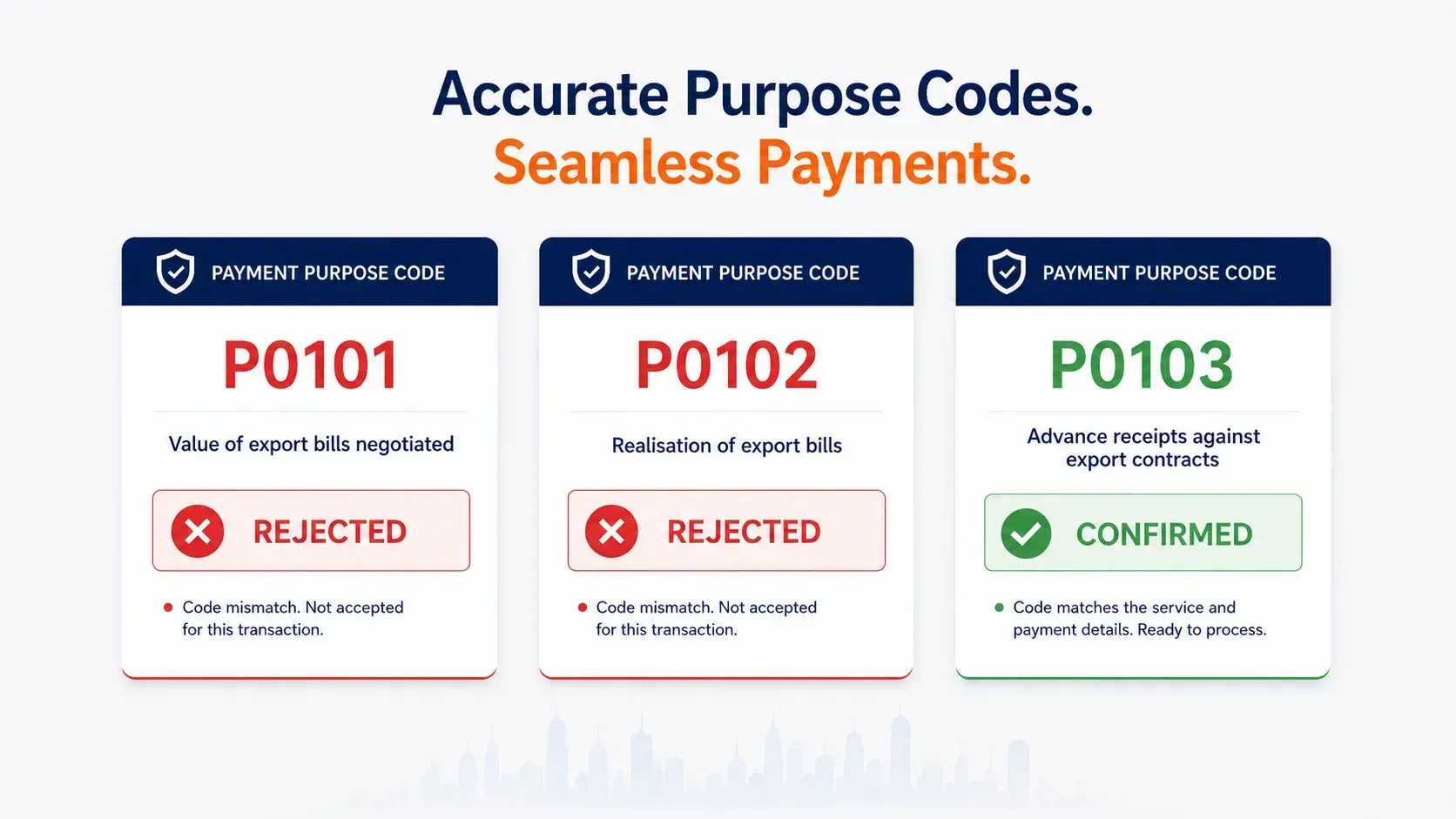
When a Canadian business pays a supplier or service provider in India, correct bank details are only part of the payment instruction. You may also be asked for a purpose of payment code that explains the commercial reason for the transaction.
The code should match what your business is actually paying for, such as exported goods, software implementation, consulting or licensing. It should not be guessed from a list. Your Indian supplier should confirm the appropriate code with its bank before you release the funds, particularly when the invoice contains multiple products or services.
Quick overview: Canadian businesses sending INR payments to India may need a purpose code that identifies the goods or services being paid for. The code should match the invoice and be confirmed by the Indian supplier and its beneficiary bank before the payment is released.
This guide explains how purpose codes work, which codes may apply to common business transactions and how Canadian finance teams can prevent avoidable payment delays.
What is the purpose of payment code for an INR business payment?
A purpose of payment code is a classification that tells Indian banks and regulators why money is entering the country. It connects the incoming payment to its underlying commercial activity, such as the export of goods or the delivery of professional services.
The Reserve Bank of India’s official list of receipt purpose codes organizes inward payments into categories including goods, computer services, licensing, consulting, engineering and other business services. Inward-remittance codes generally begin with P, followed by four digits.
A purpose code is not a routing code. It does not identify the bank or account receiving the payment.
For example, entering the correct IFSC helps route the payment to the right bank branch. Entering the correct purpose code helps the receiving bank understand why the funds have arrived.
Why may Canadian businesses need a purpose code when paying India?
A payment sent from Canada to an Indian business is an international receipt from the Indian recipient’s perspective. The recipient’s bank may therefore need to classify it under India’s foreign-exchange reporting framework before or while crediting the funds.
The Reserve Bank of India’s foreign-exchange reporting directions place reporting responsibilities on authorized financial institutions and stress the importance of accurate and timely transaction reporting.
Purpose codes may be relevant when a Canadian business is:
- Importing manufactured goods, raw materials or inventory from India.
- Paying an Indian software development company.
- Outsourcing accounting, data processing or customer support.
- Engaging an engineering, legal or management consulting firm.
- Paying commissions, licensing fees or distribution charges.
- Making deposits or staged payments against an Indian supplier contract.
Paying the invoice in Indian rupees does not necessarily remove the requirement. The classification relates to the underlying cross-border transaction, not simply the currency delivered to the recipient.
| Field | Value |
|---|---|
Amount Payable (INR) 5,000,000 | |
Bank Exchange Rate 0.0148 / 67.6599 | |
Total cost 73,899CAD |
| Field | Value |
|---|---|
Amount Payable (INR) 5,000,000 | |
MTFX Exchange Rate 0.0145 / 68.8410 | |
Total cost 72,631.13CAD |
You Save
CAD 1,267.88
with MTFX
16 September 2026
We use mid-market rates. This is for informational purposes only. Log in to view send rates.
Should a Canadian business use a P code or an S code?
A payment sent by a Canadian company to an Indian supplier is outgoing from the Canadian business’s perspective. However, it is generally treated as an incoming receipt from the Indian recipient’s perspective.
This distinction matters because Indian receipt-purpose codes commonly begin with P, while codes beginning with S generally relate to payments or remittances leaving India.
Canadian businesses should not select an S code simply because their payment platform describes the transfer as an outgoing payment. The purpose code should reflect how the transaction is classified in India, and the Indian supplier should
Who should select and confirm the purpose code?
The Indian supplier should normally confirm the purpose code because the code affects how the incoming payment is classified by its bank.
The Canadian payer is still responsible for describing the transaction accurately. Your accounts-payable team should make sure that the invoice, contract, payment description and purpose code all tell the same story.
Consider a Canadian company paying an Indian firm for a new inventory-management system. The invoice says “technology services,” but that phrase could cover software implementation, data processing, maintenance or licensing. Rather than choosing the first computer-related code it sees, the Canadian business should ask the supplier to confirm the exact service category with its bank.
That extra check can be much quicker than trying to correct a payment after it has been sent.
Which purpose codes are commonly used for business payments to India?
The correct code depends on what the Indian recipient supplied. The following are common examples from the RBI’s receipt-purpose categories, but they are not a substitute for confirmation from the supplier and its bank.
Important: These examples are for general guidance. The Indian recipient and its bank should confirm the final code before the payment is sent.
What should Canadian importers consider when paying for physical goods?
Payments for physical goods should generally use an export-of-goods classification rather than a professional-services code. The Indian supplier may also need to connect the incoming payment with its commercial invoice, shipping documentation, export declaration and outstanding export receivable.
Canadian importers should clearly identify whether the payment is an advance, a payment against shipped goods or the final balance on an order. That distinction may affect the purpose code and the supporting information requested by the beneficiary bank.
For example, a deposit paid before production begins may be classified differently from the final payment made after the goods have been shipped. The supplier should confirm the correct treatment for each stage of the transaction.
Example: advance payment for goods
A Canadian furniture retailer orders custom products from an Indian manufacturer. The supplier requires a 30% deposit before production begins.
Because the payment is an advance against an export contract for goods, the supplier may identify P0103 as the relevant code. When the final balance is paid after shipment, the classification may differ depending on the invoice and export-document status.
The retailer should not assume that the deposit code applies to every later payment.
How are software services different from licensing payments?
Paying an Indian company to develop, configure or maintain software may be classified differently from paying for the right to use software or other intellectual property.
For example, a project involving software configuration and implementation may fall within a computer-services category. A separate charge for the right to use proprietary software may be treated as a licensing payment.
The contract and invoice should clearly distinguish between implementation, maintenance, subscriptions and licensing fees. This helps the Indian supplier confirm the correct purpose code with its bank.
Example: software implementation
A Canadian logistics company hires an Indian technology company to configure and implement a warehouse-management system.
If the invoice is specifically for software implementation and consultancy, the supplier may confirm P0802. If the later monthly invoice is only for database processing or system maintenance, a different code may be more appropriate.
Example: management consulting
A Canadian manufacturer hires an Indian advisory firm to redesign its procurement processes.
The invoice describes a management consulting engagement rather than software development or engineering. The supplier may therefore confirm P1006, which covers business and management consultancy and public relations services.
How do you choose the correct purpose code?
The easiest way to manage purpose codes is to treat them as part of invoice approval, not as a detail to resolve when the payment is already being entered.
Step 1: Review what the invoice actually covers
Start with the invoice description. Determine whether the payment is for:
- Goods.
- An advance against goods.
- Software implementation.
- Maintenance or technical support.
- Data processing.
- Professional consulting.
- Licensing.
- Commission.
- Engineering or another specialized service.
Avoid relying on broad phrases such as “professional services” or “project costs” when a more precise description is available.
Step 2: Compare the invoice with the contract
The purpose code should make sense alongside the purchase order, statement of work or supplier agreement.
For example, an invoice labelled “consulting” may actually relate to software configuration under the contract. Resolving that difference before payment can prevent the recipient’s bank from requesting clarification later.
Step 3: Ask the supplier to confirm the code
Add a purpose-code field to your supplier-onboarding or invoice-approval process.
Please confirm the RBI inward-remittance purpose code that your bank requires for this invoice.
The supplier should confirm the answer with its beneficiary bank when necessary.
Step 4: Clarify mixed invoices
An invoice may contain more than one commercial activity.
For example, an Indian technology company might invoice a Canadian business for:
- Software implementation.
- Annual licensing.
- Ongoing maintenance.
Those items could fall under different categories. Ask whether the supplier wants the invoice separated or whether its bank has approved one classification for the complete transaction.
Step 5: Keep the wording consistent
Use the same clear description across:
- The invoice.
- Purchase order.
- Contract.
- Payment instruction.
- Supporting documents.
- Internal accounting record.
A useful payment description should clearly identify what is being purchased and connect the transfer with the relevant invoice or contract.
For example, a description such as “Vendor payment for services” is too broad. A clearer alternative would be:
Payment for software implementation services under Invoice 4582 dated June 30, 2026.
Similarly, “Consulting invoice” provides limited information. A stronger description would be:
Payment for engineering design services under Contract ENG-104 and Invoice 7815.
Clear wording helps the payment provider and beneficiary bank understand the transaction without having to request immediate clarification.
Step 6: Save the confirmed details
Once the transaction has been completed successfully, store the confirmed code in the supplier record.
Do not make it permanent without review. Reconfirm the code when the supplier, contract or type of service changes.
What purpose code mistakes should Canadian businesses avoid?
Most purpose-code problems happen when payment information is copied from an earlier transaction, described too broadly or selected without checking the underlying invoice.
- Choosing “other services” too quickly: A general category may seem convenient, but it should not replace a more specific code that accurately reflects the transaction.
- Copying a code from another supplier: Two Indian suppliers may require different codes, even when they are paid by the same Canadian company. The correct classification depends on the goods or services covered by each invoice.
- Confusing inward and outward codes: A payment entering India will generally require a receipt-purpose code rather than an Indian outward-remittance code.
- Using one code for goods and services: Physical goods, software development, consulting, licensing and expense reimbursements are different types of transactions and may require separate classifications.
- Entering a vague payment reference: Descriptions such as “vendor payment,” “services” or “invoice settlement” may not give the receiving bank enough information to connect the payment with the invoice.
- Reusing an outdated payment template: A saved code may no longer be appropriate if the supplier’s contract, services or invoicing arrangement has changed.
What documents and payment details may be required?
A purpose code is only one part of an INR business-payment instruction. Your provider or the Indian beneficiary bank may request supporting information to verify the recipient and underlying invoice.
Prepare the following before initiating the transfer:
- Supplier’s complete legal name and registered address.
- Beneficiary bank name and branch.
- Bank account number.
- IFSC.
- SWIFT/BIC, where required.
- Confirmed purpose code.
- Invoice number and amount.
- Purchase order or contract.
- Clear payment description.
- Supplier contact details.
- Shipping or export documents for goods, where applicable.
The precise requirements can vary by transaction, bank, payment route and type of business activity. Larger, unusual or time-sensitive payments may receive additional review.
Your team can apply these checks alongside the process for paying suppliers in India and its own supplier-onboarding and invoice-approval controls.
What is the best way to make an INR business payment from Canada?
Canadian companies commonly use either a traditional bank or a specialist international payment provider. The appropriate route depends on your payment volume, deadlines, support requirements and tolerance for manual work.
A Canadian company paying one small invoice may prioritize simplicity. A business making regular or high-value INR payments may place more weight on exchange-rate pricing, beneficiary management, reconciliation and dedicated support.
You can make global business payments to international suppliers, while overseas invoice payments can be used for one-off, recurring and higher-volume vendor invoices.
How do CAD/INR exchange rates affect the total invoice cost?
The purpose code does not determine your exchange rate. However, the rate used to convert Canadian dollars into Indian rupees can materially change how much the invoice costs your business.
Suppose your company needs to deliver INR 5,000,000 to a supplier:
- At CAD/INR 68.00, the cost is approximately CAD 73,529.
- At CAD/INR 67.00, the cost is approximately CAD 74,627.
- The one-rupee movement increases the Canadian-dollar cost by roughly CAD 1,098, before transfer fees.
This is why exchange-rate planning matters even when the supplier’s INR invoice does not change.
Businesses can check the latest indicative level using the CAD to INR currency converter and review recent movement on the CAD to INR currency chart.
Finance teams with flexible deadlines can also set a CAD to INR rate alert rather than monitoring the market manually.
Compare FX rates and save more on global business payments.
Keep your payment timing connected to the market
Purpose-code accuracy and exchange-rate planning solve different problems. The code helps the payment move through the correct compliance and reporting process, while FX planning helps control the Canadian-dollar cost.
Before a large payment cycle, your team can review:
- The daily Canadian dollar update for short-term market developments.
- The monthly Canadian dollar forecast for upcoming events and a broader CAD outlook.
- The MTFX five-bank FX forecast for major-bank currency projections.
Forecasts cannot guarantee where the market will move, but they can help finance teams identify relevant economic events before choosing a conversion date.
What happens if the wrong purpose code is used?
An incorrect or inconsistent purpose code can lead to questions from the beneficiary bank. The funds may be held while the bank requests an invoice, contract or updated payment explanation.
Possible consequences include:
- Delayed credit to the supplier.
- Requests for additional documents.
- Payment cancellation or return.
- Reconciliation problems.
- Incorrect supplier export records.
- Additional compliance review.
- Delayed production or shipment.
- Strain on supplier payment terms.
Published purpose-code guidance from Xflow also notes that mismatched codes can result in holds, clarification requests, reclassification or cancellation.
For a Canadian importer, the commercial effect can be larger than the payment itself. A supplier waiting for a deposit may not release materials or begin production, even though the Canadian company believed the funds had already been sent.
How can a business correct a purpose-code error?
Act as soon as the issue is identified. The options available may depend on whether the payment is pending, already credited or being returned.
Step 1: Contact your payment provider
Ask for the current payment status and explain that the purpose code or description may be incorrect.
Step 2: Notify the Indian supplier
The supplier may need to contact its beneficiary bank and provide clarification from the recipient side.
Step 3: Gather supporting documents
Have the following ready:
- Invoice.
- Contract or purchase order.
- Original payment instruction.
- Correct purpose code.
- Clear explanation of the goods or services.
- Any correspondence from the beneficiary bank.
Step 4: Follow the amendment process
The payment provider and beneficiary bank will determine whether the transaction can be amended, reclassified or must be returned and resent.
Step 5: Do not send a duplicate payment too quickly
Wait until the status of the original transfer is confirmed. Otherwise, your business could accidentally pay the same invoice twice.
Step 6: Update the supplier record
Record the correct classification, supporting-document requirements and contact history so the same issue does not happen during the next payment cycle.
How should recurring INR supplier payments be managed?
Recurring payments are easier to control when purpose codes are built into the supplier master record and invoice workflow.
A practical accounts-payable process should include:
- Verifying beneficiary details during onboarding.
- Collecting the supplier’s confirmed purpose code.
- Matching each invoice to the approved contract.
- Checking whether the commercial activity has changed.
- Recording the invoice number in the payment reference.
- Reviewing the CAD/INR rate before conversion.
- Keeping payment confirmation and supporting documents.
- Reconciling the amount received with the supplier.
For example, a Canadian retailer may make monthly payments to the same Indian manufacturer. The same code may continue to apply while every invoice covers the same exported goods. If the supplier later charges a separate design-consulting fee, the finance team should not automatically reuse the goods code for that service invoice.
Businesses with predictable future payables can also explore FX risk management tools, including forward contracts and market orders, to help manage the Canadian-dollar cost of upcoming invoices.
What should accounts payable teams check before releasing an INR payment?
Before approving a payment to an Indian supplier, the accounts-payable team should confirm that the purpose code, supporting documents and beneficiary details are consistent.
Check that:
- The beneficiary’s legal name matches the invoice and bank account.
- The invoice clearly describes the goods or services being purchased.
- The purpose code has been confirmed by the Indian recipient.
- The code reflects an inward receipt into India.
- The payment reference matches the invoice and stated purpose.
- Required contracts, shipping records or export information are available.
- Unrelated goods, services or licensing charges have not been combined incorrectly.
- The code has not been copied from an unrelated supplier.
- The classification has been reviewed if the commercial arrangement has changed.
This final review can help catch inconsistencies before the payment is released and reduce the risk of follow-up questions from the receiving bank.
How can MTFX support business payments to India?
MTFX is Canadian-based, has operated since 1996, and is FINTRAC regulated. Its business solutions support supplier and invoice payments across more than 190 countries and over 50 currencies.
We help Canadian businesses manage currency conversion and international payments to overseas suppliers. Businesses can arrange INR payments, manage beneficiary information, track transfers and access dedicated foreign-exchange support.
MTFX can help your business collect and submit the payment information needed to process a transfer. The Indian supplier and its beneficiary bank should still confirm the appropriate purpose code and any local reporting or documentation requirements.


Turn the right code into a smoother payment
Purpose codes may look like a small administrative detail, but they connect the payment to the invoice behind it. Confirming the correct code before sending the funds can reduce clarification requests, support cleaner reconciliation and help your Indian supplier receive the payment without avoidable disruption.
The strongest process combines accurate supplier information with clear documents, well-planned payment timing and appropriate FX management. With those controls in place, Canadian finance teams can manage INR invoices more efficiently while keeping supplier relationships and cash-flow forecasts on track.
Set up your MTFX business account today and ensure seamless money transfers to India.
FAQs
1. Does every business payment to India require a purpose code?
A purpose code may be required when an Indian bank needs to classify an incoming international payment. The precise requirement can depend on the payment route, bank and underlying transaction, so the Indian supplier should confirm the details before payment.
2. Who provides the purpose code: the Canadian payer or the Indian supplier?
The Indian supplier should normally confirm the purpose code because its bank uses the code to classify the incoming funds. The Canadian payer should provide an accurate description that matches the invoice and contract.
3. Is the purpose code based on the currency being sent?
No. The code is based on the reason for the transaction, such as exported goods, software services or consulting. A payment delivered in INR can still require a code that reflects the underlying cross-border activity.
4. What purpose code applies when paying an Indian software company?
The code depends on the specific service. Software implementation or consultancy may use P0802, data processing may use P0803, and computer or software maintenance may use P0804. The supplier should confirm the final classification with its bank.
5. Can the same purpose code be used for every payment to a supplier?
Only when the underlying commercial activity remains the same and the code has been confirmed. A supplier providing both goods and services may require different codes for different invoices.
6. What happens when an invoice includes both goods and services?
Ask the supplier whether the items should be separated into different invoices or payment instructions. The beneficiary bank should confirm how it wants the transaction classified rather than having the Canadian payer choose one broad code.
7. Can the wrong purpose code delay an INR payment?
Yes. The beneficiary bank may hold the payment, ask for supporting documents, request reclassification or return the funds if the code does not match the transaction.
8. Is a purpose code the same as an IFSC or SWIFT code?
No. A purpose code identifies why the payment is being made. An IFSC identifies an Indian bank branch, while a SWIFT/BIC identifies a financial institution within the international banking network.
9. Is an invoice enough to support the purpose code?
An invoice may be enough for a straightforward transaction, but additional documents can still be requested. These may include a contract, purchase order, statement of work, shipping document, export reference or explanation of the commercial relationship.
10. Can MTFX choose the purpose code for my business?
MTFX can help explain the payment information required to process the transfer, but the code must accurately represent the underlying transaction. The Indian beneficiary and its bank should confirm the final classification when the payment is unusual or unclear.
11. Does the purpose code affect the exchange rate?
No. The purpose code does not normally determine the exchange rate used for the transfer. However, missing or incorrect payment information may delay processing and affect when the currency conversion or payment is completed.
Disclaimer: The information in this article is provided for general informational purposes only and should not be considered legal, tax, regulatory or financial advice. RBI purpose codes, banking requirements and supporting-document rules may vary by transaction and can change over time. Canadian businesses should confirm the appropriate purpose code and payment requirements with the Indian supplier, the beneficiary bank and their payment provider before sending funds