How to Pay Suppliers in the UK from Canada
Before paying a UK supplier, confirm that the invoice is issued in the correct currency and that the beneficiary name matches the recipient’s bank account. Verify the account number, IBAN, SWIFT/BIC code, payment reference, applicable transfer fees, and expected delivery time to help prevent delays and rejected payments.
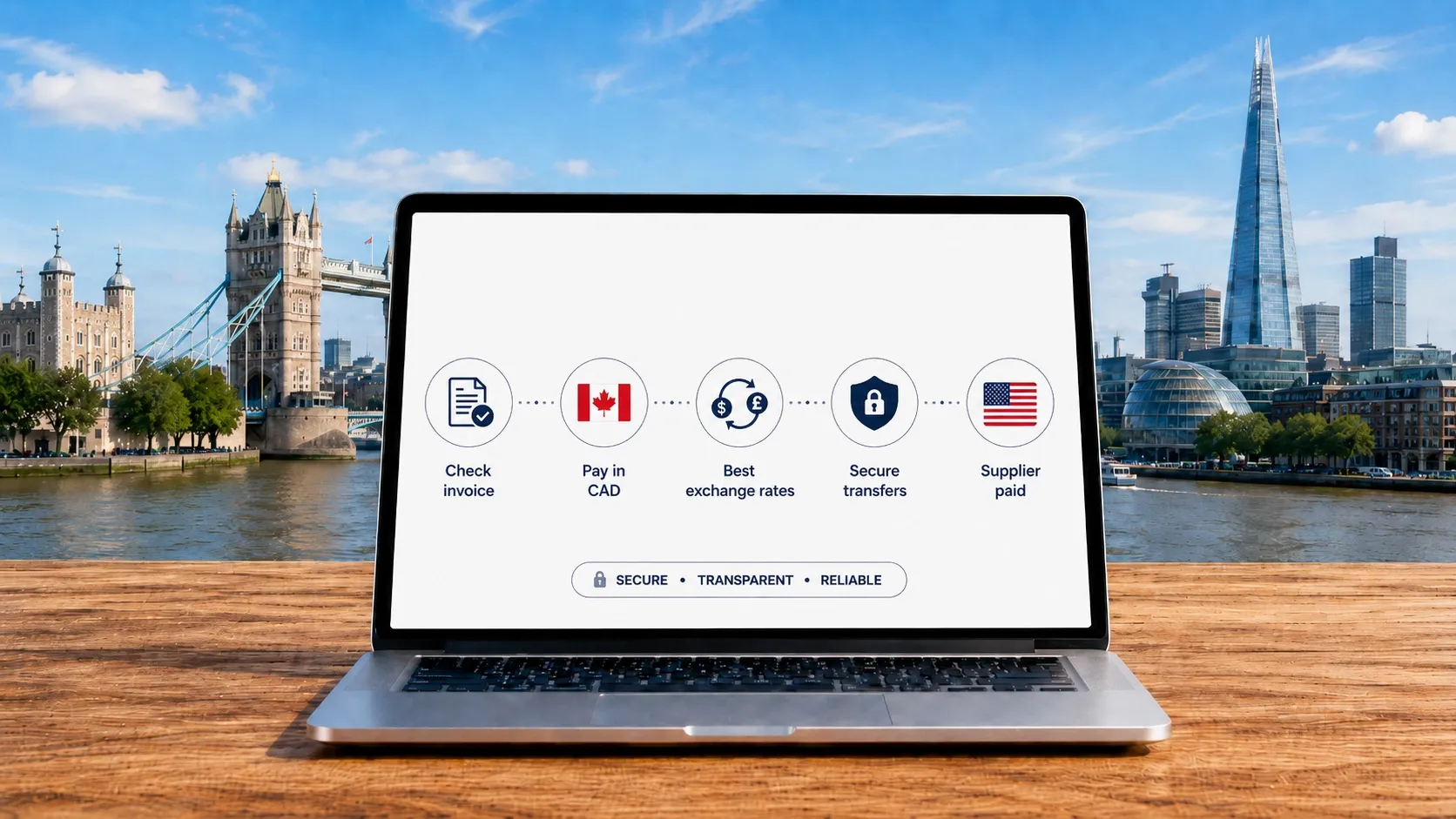
Canadian businesses can pay suppliers in the UK by converting Canadian dollars into British pounds and sending the payment directly to the supplier’s UK bank account. The process is straightforward, but the final cost depends on the CAD to GBP exchange rate, the provider’s FX markup, transfer charges, payment timing, and any deductions made before the money reaches the supplier.
For businesses importing products, equipment, raw materials, or professional services from the UK, small exchange-rate differences can have a noticeable effect on margins. A supplier invoice may be fixed in GBP, but the amount your company pays in Canadian dollars can change before the due date. That makes the payment method and currency strategy just as important as the invoice value itself.
MTFX has been helping clients move money internationally since 1996. Canadian companies can use MTFX for secure global business payments, CAD to GBP currency conversion, recurring transfers, exchange-rate monitoring, and specialist guidance when paying suppliers, vendors, and other commercial partners in the UK.
What is the best way to pay a UK supplier from Canada?
The best way to pay a UK supplier is to send the exact invoice amount in British pounds through a provider that offers transparent pricing, competitive exchange rates, and payment tracking. Before transferring funds, compare the total Canadian-dollar cost, verify the supplier’s banking details, and confirm how much GBP will arrive after all charges.
A bank wire may be suitable for an occasional invoice, while a specialist provider offering international business money transfers can be more practical for regular, high-value, or time-sensitive supplier payments. Businesses with recurring UK expenses may also benefit from scheduled transfers, saved payment templates, batch payments, or a multi-currency account.
How do payments to UK suppliers work?
Most UK supplier payments begin with an invoice issued in British pounds. The Canadian buyer then converts CAD into GBP and sends the funds to the supplier’s nominated bank account.
- The supplier issues an invoice stating the amount, currency, due date, and payment instructions.
- The Canadian business checks the invoice and verifies the beneficiary information.
- The business selects a bank or international payment provider.
- Canadian dollars are converted into British pounds.
- The GBP payment is delivered to the supplier’s UK bank account.
- The supplier uses the payment reference to match the funds with the outstanding invoice.
The Canadian sender does not always choose the domestic UK payment system used at the final stage. Depending on the provider and transaction, the GBP payment may be delivered through Faster Payments, Bacs, CHAPS, or another banking route.
What matters most is that the correct amount reaches the correct supplier account by the agreed deadline. Businesses can also use dedicated international invoice payment solutions to improve tracking and reconciliation.
What details do you need to pay a UK supplier?
Collect the complete payment information before initiating the transfer. Missing or incorrect details can delay the payment, trigger additional checks, or cause the funds to be returned.
You can use an IBAN checker to review the format of an international account number and a BIC/SWIFT code checker to verify the structure of the receiving bank’s identifier. These tools can help identify formatting problems, but they do not confirm that an account belongs to the intended supplier.
Treat any unexpected change to supplier banking details as a warning sign. If an invoice suddenly lists a different account, confirm the new information using a trusted phone number or contact method already held by your business. Do not rely only on the email requesting the change.
Should you pay UK suppliers in CAD or GBP?
Paying in GBP can offer several advantages:
- The supplier receives the invoice currency.
- The buyer can compare CAD to GBP exchange rates before sending.
- The invoice is easier to reconcile.
- The supplier faces less currency uncertainty.
- Payment disputes caused by conversion shortfalls are less likely.
- The Canadian business can plan the conversion around its own budget and due date.
Paying in CAD may still make sense when the supplier explicitly invoices in Canadian dollars, maintains a CAD account, or agrees to absorb the currency risk.
The key is to confirm the payment terms before accepting the invoice. Also, compare current CAD to GBP exchange rates for automated and secure transactions.
| Field | Value |
|---|---|
Supplier Payment (GBP) 50,000 | |
Bank Exchange Rate 0.5199 / 1.9234 | |
Total cost 96,172.23CAD |
| Field | Value |
|---|---|
Supplier Payment (GBP) 50,000 | |
MTFX Exchange Rate 0.5290 / 1.8904 | |
Total cost 94,522.22CAD |
You Save
CAD 1,650.01
with MTFX
16 October 2026
We use mid-market rates. This is for informational purposes only. Log in to view send rates.
What is the cheapest way to pay a UK supplier?
The cheapest option is not always the provider with the lowest transfer fee. For larger invoices, the exchange rate often has a much greater effect on the total cost.
Total invoice cost in CAD = GBP invoice amount × effective exchange rate + transfer charges + possible bank deductions
A complete comparison should include:
- The live market rate
- The rate offered by the provider
- The FX spread or markup
- The transfer fee
- Possible intermediary bank charges
- Receiving-bank deductions
- The final GBP amount delivered
- The expected transfer time
Businesses should therefore look beyond headline fees and review the hidden costs of cross-border payments before approving a supplier transfer.
Example: Paying a £25,000 supplier invoice
The following example is illustrative and does not represent a live quote.
Provider B charges a higher transfer fee but results in a lower total cost because of the stronger exchange rate. This is why businesses should compare the complete transaction rather than focusing only on the upfront charge.
Before making a transfer, check current pricing with a CAD to GBP rate calculator. The rate available to a business may depend on the transfer amount, market conditions, payment timing, and account arrangement.
Compare ways to pay suppliers in the UK
The right payment method depends on the invoice amount, urgency, payment frequency, and relationship with the supplier.
For most established supplier relationships, a direct GBP transfer is the simplest option. Letters of credit and similar trade-finance tools are generally more relevant when both parties require greater protection over delivery, documentation, and payment.
Businesses comparing payment rails should consider how each option supports approval controls, delivery tracking, and reconciliation. A broader guide to choosing payment methods is available in How to Choose the Best Payment Methods for International Trade.
How do Bacs, Faster Payments, CHAPS, and SWIFT differ?
These systems serve different purposes and should not be treated as interchangeable payment methods.
Faster Payments is a UK domestic system designed to move sterling between participating accounts more quickly. Bacs supports scheduled and batch-based UK payments and is commonly used for direct credits and recurring transactions.
CHAPS is operated by the Bank of England and is used for same-day sterling payments, including high-value and time-sensitive corporate transactions. SWIFT, by contrast, is a secure financial messaging network used by institutions to communicate payment instructions.
A Canadian business may send funds internationally through a bank or payment provider, while the provider’s UK banking partner delivers the pounds through a domestic system such as Faster Payments. This is why a supplier may see a local GBP credit even though the original payment began in Canada.
The sender should focus on the factors it can control: the exchange rate, total cost, delivery estimate, beneficiary verification, payment tracking, and confirmation.
How long does it take to pay a supplier in the UK?
A payment from Canada to a UK supplier commonly takes between one and several business days. The exact timeline depends on the provider, payment route, funding method, cut-off time, and compliance requirements.
The transfer may take longer when:
- The beneficiary information is incomplete.
- The account name does not match the banking records.
- The payment is funded after the provider’s daily cut-off.
- A Canadian or UK bank holiday affects processing.
- The transaction requires an additional compliance review.
- The invoice or payment purpose is unclear.
- An intermediary bank is involved.
- It is the first payment to a new beneficiary.
- The recipient bank holds the payment for verification.
Businesses should initiate important supplier payments before the invoice due date rather than treating the due date as the day to begin the transfer. For urgent shipments or production orders, confirm the expected delivery window before releasing the payment.
For more detail on the process behind bank-to-bank transfers, review how international wire transfers work.
How to pay a UK supplier in six steps
Step 1: Confirm the invoice and payment terms
Review the supplier invoice before arranging the transfer.
- Invoice amount
- Invoice currency
- Payment deadline
- Purchase order number
- Supplier legal name
- Payment reference
- Charge arrangement
- Goods or services covered
Clarify whether the supplier must receive the full invoice amount after all deductions. The contract or purchase order should also state which party is responsible for payment charges.
Step 2: Verify the supplier’s bank details
Compare the banking information with previous invoices, contracts, or approved supplier records.
Any change to the beneficiary name, account number, sort code, IBAN, or SWIFT code should be independently confirmed. A brief verification call can prevent a costly payment error.
Step 3: Compare the full payment cost
Ask each provider for the amount of CAD required to deliver the necessary GBP amount. Do not compare only the advertised transfer fee. Check the exchange rate, markup, possible deductions, and expected amount received.
Businesses that rely only on their bank may also benefit from reviewing the differences between banks and specialist providers for B2B transfers.
Step 4: Choose a payment and FX strategy
The appropriate strategy will depend on when the invoice is due and how much certainty the business needs.
- A spot transfer for an immediate invoice
- A forward contract for a known future payment
- A market order for a target exchange rate
- A scheduled transfer for a recurring supplier
- A batch payment for multiple invoices
- A multi-currency balance for ongoing GBP expenses
Step 5: Fund and authorize the payment
Fund the transaction using the approved method and complete your internal authorization process.
For larger invoices, consider dual approval so that one employee prepares the payment and another verifies the beneficiary, invoice, currency, and transfer amount.
Step 6: Track and reconcile the transfer
Save the payment confirmation and send remittance information to the supplier where appropriate.
Once the payment is complete:
- Confirm that the supplier received it.
- Match the transfer to the invoice.
- Record the exchange rate and fees.
- Retain the payment confirmation.
- Update the supplier account in your accounting system.
A consistent reconciliation process helps finance teams identify duplicate, missing, underpaid, or incorrectly referenced invoices.
How can businesses manage CAD to GBP exchange-rate risk?
A UK supplier invoice creates a future cost in Canadian dollars. Even when the GBP amount remains unchanged, the CAD amount may rise before the payment date.
A structured FX risk management approach can help a business protect budgets and reduce uncertainty around future supplier costs.
1. Spot contracts
A spot contract converts currency at the current available rate. It is generally used when an invoice is due soon or the business is comfortable paying at the present market level.
2. Forward contracts
A forward contract allows a business to secure an exchange rate for a payment scheduled in the future, subject to the provider’s terms and suitability requirements.
It may be useful when:
- The invoice value is known.
- The payment date is predictable.
- The business needs budget certainty.
- A weaker Canadian dollar would reduce the expected margin.
A forward contract can protect a budget from adverse currency movement, but it may also prevent the business from benefiting fully if the market later moves in its favour. Businesses considering this strategy can review how forward contracts add certainty for importers and exporters.
3. Market orders
A market order can be used to target a preferred exchange rate. The conversion takes place if the market reaches the selected level.
Because the target may never be reached, a market order should not be the only plan for an invoice with a fixed due date.
4. Rate alerts
CAD to GBP rate alerts notify the business when the currency pair reaches a selected level. They can help finance teams monitor the market without checking currency movements throughout the day.
5. Staggered conversions
A business can convert parts of a large requirement at different times instead of committing the entire amount on one date.
This can reduce the risk of making the full conversion at an unfavourable moment, although it cannot guarantee the lowest possible cost.
Reduce FX costs on CAD to GBP business payments with MTFX.
How can recurring UK supplier payments be streamlined?
Businesses that pay the same UK suppliers every month should avoid rebuilding each payment from the beginning.
A more efficient process may include:
- Saving approved beneficiary templates
- Scheduling recurring transfers
- Uploading batch-payment files
- Establishing payment approval limits
- Separating payment creation from authorization
- Holding GBP for future invoices
- Using reference fields consistently
- Exporting payment data for reconciliation
- Tracking payment status centrally
- Reviewing supplier costs by currency and country
Companies paying multiple suppliers may use bulk payment solutions to consolidate transactions and reduce repetitive manual work. Businesses with predictable monthly invoices may also consider payment automation to strengthen approval and processing workflows.
A multi-currency account may also be useful when a company receives GBP revenue or maintains a regular sterling balance. Instead of converting every payment separately, the business may be able to use existing GBP funds for supplier expenses.
Common mistakes when paying UK suppliers
Supplier payments can become more expensive or delayed when the process is rushed or treated like a standard domestic transfer.
- Paying without confirming the invoice currency
- Comparing only the transfer fee
- Allowing the supplier’s bank to manage the conversion without reviewing the rate
- Sending an incomplete or incorrect invoice reference
- Using outdated beneficiary details
- Failing to verify a change in banking instructions
- Initiating the transfer on the invoice due date
- Ignoring Canadian and UK bank holidays
- Paying every invoice separately when batching would be more efficient
- Leaving recurring GBP exposure unmanaged
- Using a personal payment account for a business invoice
- Failing to retain payment records and remittance confirmations
A written supplier-payment policy can reduce these risks by defining who may add beneficiaries, approve invoices, authorize transfers, and verify account changes. Businesses can also review the most common payment pitfalls that damage supplier relationships.
How MTFX helps Canadian businesses pay UK suppliers
MTFX helps Canadian businesses manage UK supplier invoices through international payment and foreign exchange solutions designed for recurring and higher-value commercial transfers. Businesses can also use MTFX treasury solutions to support more complex currency and payment requirements.
- Convert Canadian dollars into British pounds
- Send trackable payments to UK suppliers
- Arrange recurring or multiple business transfers
- Monitor CAD to GBP exchange rates
- Access currency risk-management solutions where appropriate
- Work with foreign exchange specialists on payment planning.


Make every GBP supplier payment count with MTFX
Paying a UK supplier should not be reduced to entering bank details and accepting the first exchange rate offered. The full result depends on the currency, provider, payment timing, fee structure, and amount that ultimately reaches the supplier.
Canadian businesses can improve the process by verifying every beneficiary, comparing the complete CAD cost, paying in the correct invoice currency, and using an appropriate FX strategy for future GBP obligations.
Businesses that regularly pay UK suppliers can sign up with MTFX to manage international invoice payments with competitive exchange rates, secure transfers, payment tracking, and specialist support.
FAQs
1. What is the best way to pay a supplier in the UK from Canada?
The best method is usually to send the exact invoice amount in GBP through a bank or international business payment provider. Compare the full CAD cost, exchange rate, fees, delivery time, and amount the supplier will receive before confirming the payment.
2. What bank details do I need to pay a UK supplier?
You may need the supplier’s legal name, bank name, account number, sort code, IBAN, SWIFT/BIC code, business address, and invoice reference. Requirements vary by provider and receiving bank.
3. Should I pay my UK supplier in CAD or GBP?
Paying in GBP generally gives the Canadian business more control over the exchange rate and final amount received. Paying in CAD may be suitable when the supplier invoices in Canadian dollars or maintains a CAD account.
4. How long does a supplier payment to the UK take?
A Canadian-to-UK supplier payment commonly takes between one and several business days. Processing time depends on the provider, funding method, cut-off time, compliance checks, payment route, and receiving bank.
5. How much does it cost to pay a UK supplier?
The cost may include an exchange-rate markup, transfer fee, intermediary bank charge, and receiving-bank deduction. Compare the total Canadian-dollar amount required to deliver the full GBP invoice value.
6. Do I need an IBAN to pay a UK supplier?
Many UK bank accounts have an IBAN for international payments. Your provider may also request the supplier’s account number, sort code, and SWIFT/BIC code.
7. Can a Canadian business use Faster Payments?
A Canadian business does not usually access Faster Payments directly. Its payment provider or banking partner may use the system to deliver GBP to the supplier’s UK bank account.
8. Can I automate monthly supplier payments to the UK?
Yes. Depending on the provider, businesses may use recurring transfers, saved beneficiary templates, scheduled payments, batch files, and approval workflows for regular UK supplier invoices.
9. How can I protect my business from CAD to GBP volatility?
Businesses may use forward contracts, market orders, rate alerts, staggered conversions, or a combination of strategies. The appropriate approach depends on the invoice amount, payment date, budget, and risk tolerance.
10. How can I verify that a UK supplier payment is secure?
Confirm supplier bank details through a trusted channel, use role-based access, require payment approvals, match the transfer to an approved invoice, and retain payment confirmations for reconciliation.