How to Choose a Treasury Management Provider for Your International Business
Choosing the right treasury management provider can help your business manage international payments, reduce FX costs and improve financial control. This guide covers key evaluation criteria, provider comparisons and a practical checklist to help you make an informed decision.
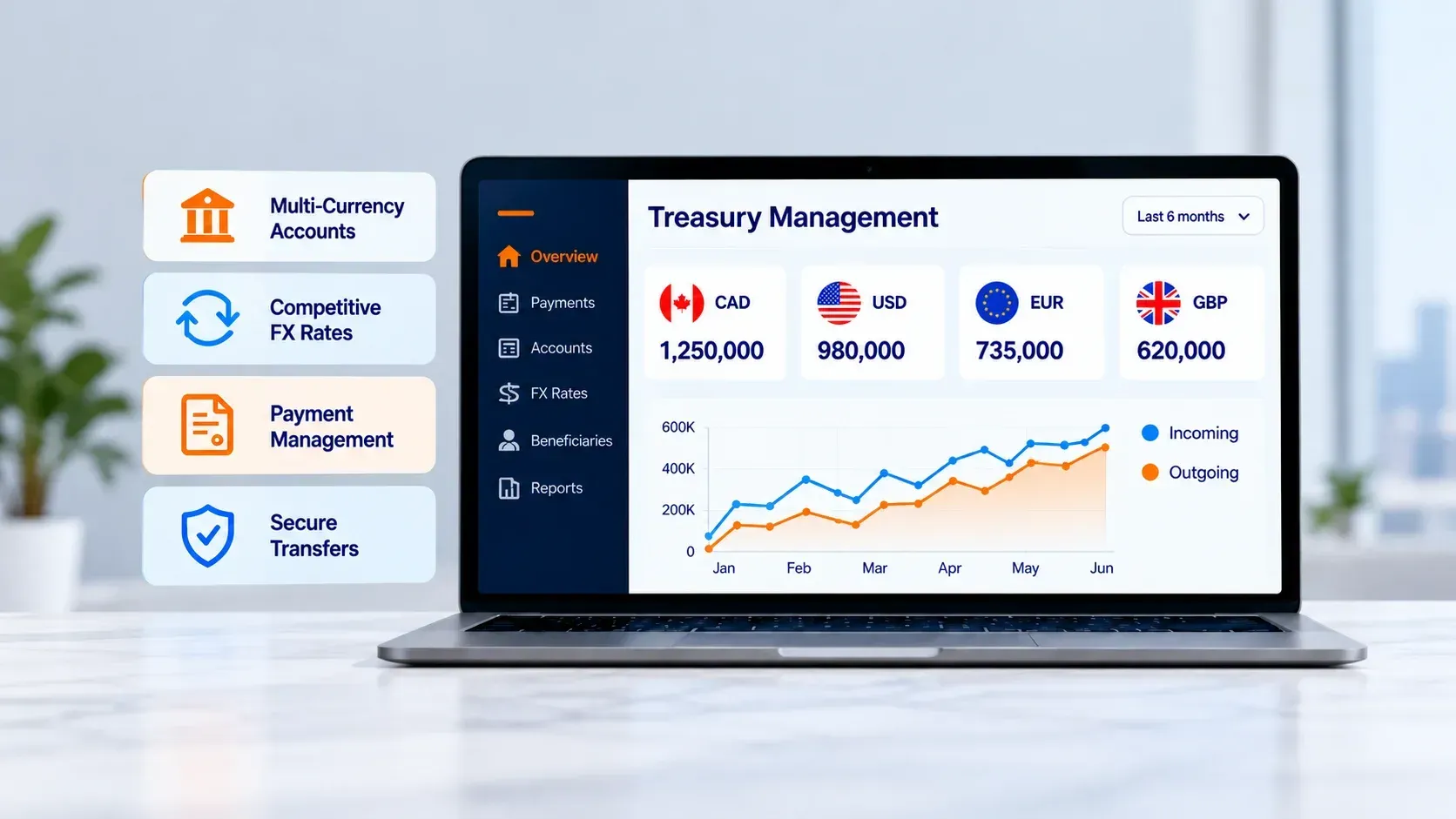
Managing overseas supplier payments, collecting foreign currency revenue and dealing with exchange rate fluctuations can make international financial operations increasingly complex.
As transaction volumes grow, businesses often recognize the need for dedicated treasury support to improve payment efficiency, financial visibility and control over currency costs.
Choosing the right treasury management provider means comparing currency coverage, international payments, FX pricing, risk management, reporting and customer support. This guide explains how to evaluate providers and find a solution that fits your international business requirements.
Understand your business treasury requirements first
Before comparing treasury management providers, identify which financial activities your business needs help managing.
A Canadian importer paying US manufacturers may prioritize competitive exchange rates and reliable supplier payments. An exporter collecting payments from European customers may instead need multi-currency accounts and greater flexibility over foreign currency conversions.
Start by reviewing these requirements:
- Currency coverage: Which currencies do you regularly send, receive or hold?
- Payment volumes: How frequently do you make international transfers?
- FX exposure: How do exchange rate movements affect your costs and revenue?
- Payment operations: Do you need bulk payments or approval workflows?
- Financial systems: What reporting and accounting integrations are required?
- Future growth: Will you need additional currencies or payment destinations?
For businesses managing international payments at scale, documenting these requirements can help identify operational gaps before selecting a provider.
| Field | Value |
|---|---|
Amount Payable (USD) 20,000 | |
Bank Exchange Rate 1.4302 / 0.6992 | |
Total cost 28,603.86CAD |
| Field | Value |
|---|---|
Amount Payable (USD) 20,000 | |
MTFX Exchange Rate 1.4057 / 0.7114 | |
Total cost 28,113.11CAD |
You Save
CAD 490.75
CAD
22 October 2026
We use mid-market rates. This is for informational purposes only. Log in to view send rates.
Compare currency and payment capabilities
International businesses should prioritize providers that support their everyday currency transactions, payment requirements and foreign exchange exposure.
1. Currency coverage and multi-currency accounts
Check whether the provider supports your main trading currencies and allows you to receive, hold and convert foreign currency balances.
For example, a Canadian exporter receiving USD payments and paying US suppliers may benefit from holding USD rather than converting the same funds twice.
This is one reason multi-currency accounts can help CFOs manage FX exposure, particularly when foreign currency inflows and outflows occur regularly.
MTFX's multi-currency business accounts support holding, receiving and sending funds in multiple currencies.
What to check: Supported currencies, local receiving details, balance capabilities and conversion restrictions.
2. International payments and collections
A suitable provider should support how your business pays overseas suppliers and collects payments from international customers.
If your finance team processes dozens of supplier invoices monthly, bulk payments and beneficiary management can reduce repetitive administrative work.
For companies handling regular supplier obligations, automating recurring international invoices can improve payment preparation and consistency. The provider's actual scheduling and automation capabilities should be confirmed.
On the collection side, businesses may benefit from receiving international customer payments through local account details, rather than requiring every customer to arrange an international wire.
What to check: Bulk payments, collection methods, settlement times, transaction tracking and beneficiary management.
3. FX pricing and risk management
Exchange rate movements can affect supplier costs, revenue and profitability.
Consider a Canadian importer with a USD 250,000 invoice. At USD/CAD 1.35, the payment costs CAD 337,500. If the rate increases to 1.40, the cost rises to CAD 350,000.
That's an additional CAD 12,500 for the same invoice.
A provider offering appropriate FX risk management tools may help businesses manage this uncertainty.
Compare the availability of:
- Spot transactions for immediate currency needs.
- Forward contracts for future payment obligations.
- Market orders for targeting preferred rates.
- Rate alerts and currency market information.
For businesses with confirmed future expenses, forward contracts can improve FX cost certainty, although they involve contractual commitments and may limit the benefit of favourable subsequent rate movements.
MTFX offers FX risk management solutions, including forward contracts and market orders for eligible business requirements.
What to check: Available FX tools, exchange rate transparency, contract conditions and specialist support.
4. Transparent pricing and transaction costs
A low transfer fee doesn't always mean a provider offers better value.
International payment costs may include exchange rate margins, transfer fees, intermediary charges and ongoing account or service costs.
For example, converting CAD 100,000 at an illustrative rate of 0.7250 USD per CAD delivers USD 72,500. At 0.7200, it delivers USD 72,000 before fees.
That USD 500 difference shows why the exchange rate matters when comparing providers.
Businesses evaluating international supplier payment costs should consider the total amount delivered, not just the advertised transfer fee.
Currency exchange charts can provide market context, but executable provider quotes should form the basis of pricing comparisons.
What to check: FX margins, transfer charges, ongoing fees and final recipient amounts.
You can leverage the currency chart below to check your desired currency pair.
Leverage MTFX treasury management solution and save on currency exchange.
Evaluate operational efficiency and financial controls
Beyond payment capabilities, treasury management providers should support the reporting, security and operational processes your finance team relies on.
5. Reporting and payment visibility
Accurate financial records are essential when managing payments across multiple currencies.
Your provider should make it easy to monitor transactions, identify outstanding payments and reconcile transfers against invoices.
Look for centralized transaction histories, downloadable reports, payment references and approval records.
For finance teams handling regular overseas supplier payments, accounts payable automation can support more organized invoice and payment workflows.
What to check: Reporting formats, transaction histories, audit trails and reconciliation capabilities.
6. Integration with existing financial systems
A treasury provider should work with your accounting or enterprise resource planning (ERP) systems.
Depending on the provider, integration may involve APIs, file uploads or downloadable reporting data.
For example, a business may want approved supplier payment instructions transferred from its accounting system without re-entering each transaction.
MTFX's payment automation capabilities include integration options and bulk processing for international business payments.
What to check: System compatibility, integration methods, setup requirements and technical support.
7. Security and compliance
Security should be a non-negotiable requirement when selecting a treasury management provider.
Verify relevant regulatory registrations, secure account access procedures and controls over payment activity.
For Canadian businesses, this may include confirming a money services business's registration with FINTRAC, where applicable. Registration alone does not guarantee the safety of a provider.
Also check whether the platform supports separate permissions for employees preparing and approving payments.
What to check: Regulatory suitability, authentication, user permissions, beneficiary verification and approval controls.
8. Customer support and service reliability
Access to experienced support becomes particularly important when handling large or time-sensitive international payments.
A delayed supplier transfer can affect purchasing schedules and commercial relationships.
Ask whether the provider offers dedicated account management, payment investigation support and access to foreign exchange specialists.
What to check: Support availability, escalation procedures, onboarding assistance and FX expertise.
Which type of treasury management provider suits your business?
Different providers serve different financial requirements. Understanding these differences can help you avoid selecting an unnecessarily complex or limited solution.
These services can complement one another.
For example, a Canadian manufacturer may use its bank for domestic accounts and financing while relying on a specialist provider for international supplier payments.
When comparing banks and fintech providers for international business payments, businesses should focus on transaction costs, operational requirements, currency coverage and service quality.
Treasury management provider comparison checklist
Once you've shortlisted potential providers, use a consistent scoring framework to evaluate their capabilities.
Questions to ask before choosing a treasury management provider
Before signing an agreement, request a demonstration or consultation based on your actual transaction requirements.
Currency and payment questions
- Which currencies can we send, receive and hold?
- Do you support bulk supplier payments and international collections?
- What payment processing times and transaction limits apply?
Pricing and FX questions
- How are exchange rates, margins and transaction fees calculated?
- What FX risk management tools are available?
- Are there account, implementation or ongoing service charges?
Operational and support questions
- Can your platform connect with our accounting systems?
- What reporting and approval controls are included?
- Who handles delayed payments or transaction investigations?
Request sample quotes, service documentation and demonstrations before making your final decision.
How MTFX supports international treasury requirements
For Canadian businesses managing overseas suppliers, international customers and foreign currency exposure, MTFX offers specialized international payment and FX services.
International payments and multi-currency management
MTFX supports business payments, foreign currency collections and multi-currency balances, helping companies manage transactions across international markets.
Its services are particularly relevant to businesses that regularly send funds to overseas suppliers or receive revenue from international customers.
FX risk management and payment automation
Businesses can access foreign exchange tools, bulk payment capabilities and payment controls to support recurring international financial operations.
MTFX also offers specialist FX support for companies evaluating currency exposure and future payment requirements.
Financial visibility and global collections
For businesses collecting revenue internationally, MTFX's accounts receivable automation solutions can support collection workflows and visibility over incoming payments.
Companies requiring extensive enterprise-wide liquidity forecasting, investment management or complex cash pooling may need additional treasury systems alongside specialist payment services.


Choose a provider that keeps pace with your business
The right treasury management provider should make international financial operations easier to manage while giving your business greater control over payments, currency costs and financial reporting.
Focus on capabilities that support your actual requirements rather than selecting a provider based on the number of features offered.
For Canadian businesses managing overseas payments, international collections and FX exposure, MTFX treasury solutions provide specialized services for managing cross-border financial activity.
Create your account today and discuss your business treasury requirements with MTFX to identify the payment and foreign exchange capabilities that fit your operations.
FAQs
1. What does a treasury management provider do?
A treasury management provider helps businesses manage financial activities such as payments, currency exposure, cash visibility and reporting. Services vary depending on whether the provider specializes in enterprise treasury management or international payments.
2. How do I choose a treasury management provider for my business?
Compare providers based on currency coverage, international payment capabilities, FX pricing, reporting, security, integration options and customer support. Prioritize the features that match your business's financial requirements.
3. What is the difference between a bank and a treasury management provider?
Banks offer broad financial services, including accounts, lending and payments. Treasury providers may specialize in payment automation, FX management, liquidity reporting or other financial functions.
4. How much do treasury management services cost?
Costs depend on the provider and services selected. Common charges include FX margins, transaction fees, subscriptions and implementation costs. Businesses should compare total expenses rather than individual fees.
5. What features should a treasury management provider offer?
Important features include international payments, multi-currency management, FX risk tools, financial reporting, payment controls and accounting integration. The ideal combination depends on your business's transaction activity.
6. Can treasury management providers handle international payments?
Yes. Many providers support international payments, although available currencies, settlement methods and automation capabilities vary. Specialist providers such as MTFX focus on cross-border payments and foreign exchange services.
7. Can treasury providers help manage foreign exchange risk?
Some providers offer forward contracts, market orders and other FX risk management tools. These services can help businesses manage uncertainty around future currency payments, subject to eligibility and contractual terms.
8. Do treasury management providers integrate with accounting software?
Many providers offer integration options through APIs, file transfers or reporting exports. Businesses should confirm compatibility with their existing financial systems before selecting a solution.
9. What security features should a treasury management provider have?
Look for secure authentication, user permissions, payment approvals, beneficiary verification and transaction monitoring. Relevant regulatory status and compliance procedures should also be verified.
10. What questions should I ask during a treasury provider demonstration?
Ask about currency coverage, FX pricing, payment automation, reporting, integrations, security controls and customer support. Request examples using your business's typical international transactions.