What Is FX Risk? Types, Examples and Business Impact
A USD invoice, a US subsidiary and future export sales can all be affected differently when CAD moves. This guide explains transaction risk, translation risk and economic exposure through simple Canadian business examples.
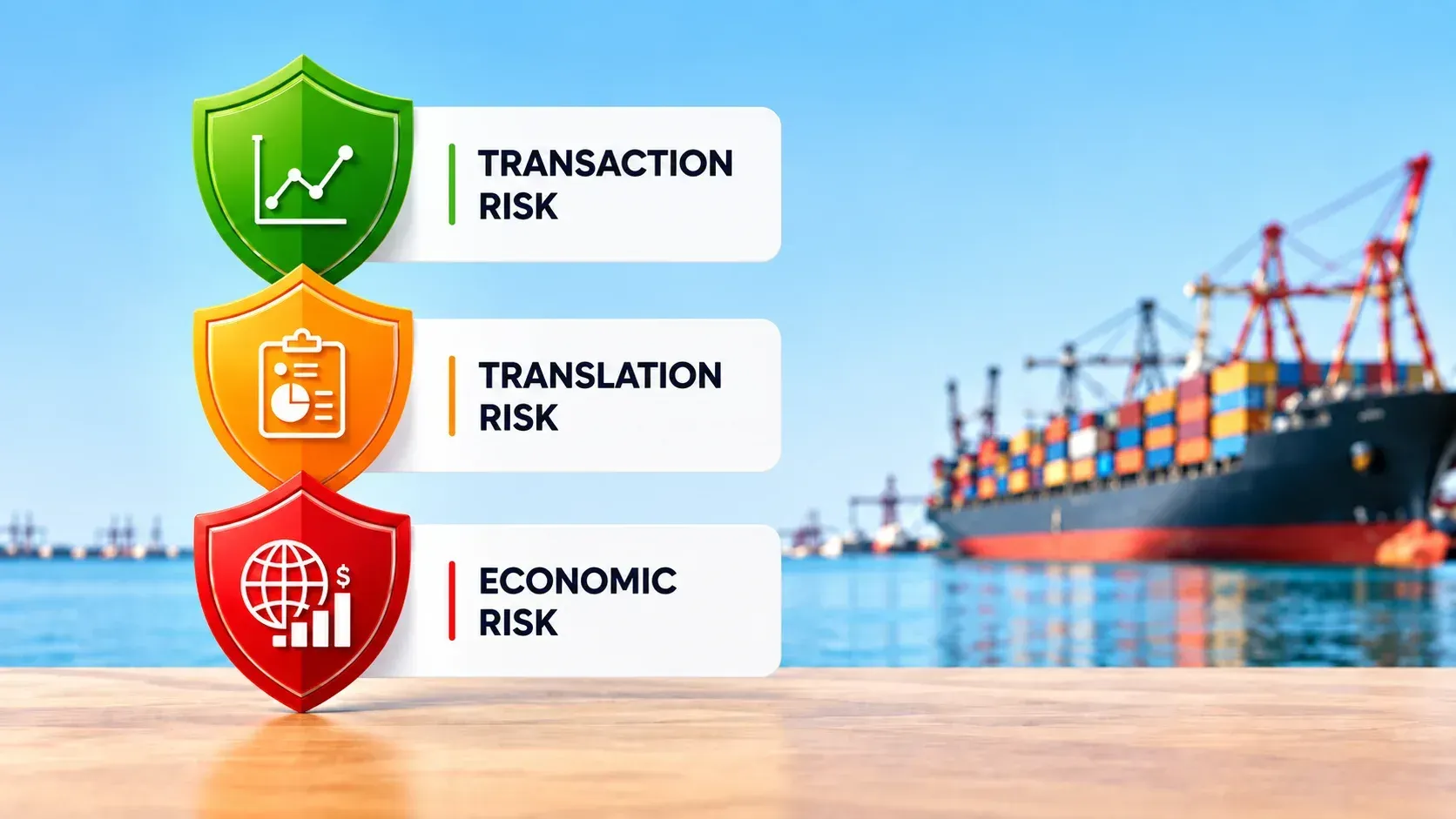
FX risk is the possibility that an exchange rate change will alter what a foreign currency payment, receipt or business activity is worth to you. For a Canadian business, that could mean paying more CAD for a US supplier invoice, receiving less CAD from an overseas sale or seeing the reported value of a foreign operation change.
This guide explains what FX risk means, the three main types of foreign exchange risk and where each can show up in a business. The examples use simple, hypothetical rates so you can see the effect without needing to follow the currency market.
What is FX risk?
Foreign exchange risk, also called currency risk, is uncertainty about the financial effect of exchange rate movements. A business has foreign currency exposure when its payments, receipts, assets or future performance are sensitive to a currency other than its usual operating currency. FX risk is the possibility that a rate change will affect the value of that exposure.
Consider a Canadian importer that agrees to pay a supplier USD 100,000 in two months. It knows the number of US dollars it owes, but the CAD cost may change before payment is due. A Canadian exporter awaiting a USD payment faces the opposite concern: the CAD value of the incoming money could fall.
Currency movements can also work in a business’s favour. The uncertainty exists because the final CAD cost or value is not yet known, even when the foreign currency amount is fixed.
What are the three main types of foreign exchange risk?
The types of foreign exchange risk are transaction risk, translation risk and economic exposure. The difference is where the exchange rate change shows up: in a specific transaction, in financial reporting or in future business performance.
Transaction risk: an invoice changes in CAD value
Transaction risk arises when a business agrees to pay or receive an amount in a foreign currency and the rate changes before settlement. Supplier invoices, customer payments and foreign currency loans can all create this exposure.
Say a Canadian company receives a USD 100,000 supplier invoice, payable in 60 days. At an illustrative USD/CAD rate of 1.35, that invoice represents CAD 135,000. If the rate reaches 1.40 before the company buys the USD, the same invoice costs CAD 140,000, a difference of CAD 5,000 before any conversion costs.
| Field | Value |
|---|---|
Amount Payable (USD) 20,000 | |
Bank Exchange Rate 1.4533 / 0.6881 | |
Total cost 29,066.12CAD |
| Field | Value |
|---|---|
Amount Payable (USD) 20,000 | |
MTFX Exchange Rate 1.4284 / 0.7001 | |
Total cost 28,567.44CAD |
You Save
CAD 498.68
with MTFX
8 October 2026
We use mid-market rates. This is for informational purposes only. Log in to view send rates.
The supplier has not changed its price. What changed is the amount of CAD needed to meet the USD obligation. A business receiving USD would see the effect in the other direction: a stronger CAD could reduce the Canadian dollar value of its receipt. You can use a currency converter to translate an invoice amount at a current rate, then compare it with the rate used in your budget.
Translation risk: financial statements change in CAD value
Translation risk arises when a business presents foreign currency results or the financial position of an overseas operation in CAD. The reported numbers can change as exchange rates move, even if the underlying business has not sold an asset or made a payment.
Imagine a Canadian parent company with a US subsidiary whose net assets are worth USD 1 million. At an illustrative USD/CAD rate of 1.40, that is CAD 1.4 million. At 1.35, it is CAD 1.35 million. The CAD reporting value has fallen by CAD 50,000, although the subsidiary still has USD 1 million in net assets.
That example illustrates the exposure, not a complete accounting calculation. The treatment of foreign currency transactions and the translation of foreign operations is set out in IAS 21, The Effects of Changes in Foreign Exchange Rates. Translation risk is especially relevant when a business presents the results of an overseas operation in CAD.
Economic exposure: future sales or costs change
Economic exposure is the longer-term effect of currency movements on a business’s competitiveness and future cash flows. Unlike transaction risk, it does not require an invoice to have been issued.
Suppose a Canadian manufacturer sells a product for CAD 100,000 to US buyers. If one Canadian dollar is worth USD 0.72, the buyer’s approximate cost is USD 72,000. If CAD strengthens so that one Canadian dollar is worth USD 0.76, that same CAD price becomes USD 76,000. The manufacturer has not changed its price, but US buyers may find the product less competitive.
Economic exposure can also appear when a company’s future supplier costs change or when competitors gain a pricing advantage. It is often less obvious than an invoice waiting to be paid, which is why a business can have currency risk before a transaction is confirmed.
Once a business has identified its exposure, FX risk management services for businesses can help connect that picture to its payment and planning needs.
When does a business become exposed to FX risk?
FX exposure can begin before a payment is due or even before a sale is confirmed. The key moment is when a business sets a foreign currency price while the CAD value of that price can still change.
While a foreign currency quote is open
Suppose a Canadian architecture firm proposes a EUR 80,000 fee for a European project. It expects to pay most of its staff and operating costs in CAD, so it estimates the project’s margin using the exchange rate available when it prepares the quote.
If CAD strengthens while the client considers the proposal, EUR 80,000 would be worth fewer Canadian dollars. The firm has not won the project or lost money on a transaction. Its expected CAD revenue has changed. Export Development Canada describes this stage as unconfirmed FX exposure.
After the client accepts the price
Once the client accepts the proposal, the EUR fee is agreed, but its final CAD value may remain uncertain. The firm could complete several months of work before issuing its invoice, then wait longer for payment. An exchange rate movement during that period can change the CAD revenue from the project without changing the fee the client owes.
The amount of exposure is now easier to identify because the sale is confirmed. Its duration depends on the project schedule and payment terms, not just the date printed on the invoice.
After payment arrives in the foreign currency
Receiving the EUR payment does not necessarily end the exposure. If the firm keeps the funds in EUR, their CAD value can continue to change. The amount owed by the client has been settled, but the business still holds a foreign currency balance.
This is why the date of the sale, the date of payment and the date of conversion can each matter when a business describes its FX exposure.
How can FX risk affect a Canadian business?
The business impact depends on what the company pays for, earns and reports in each currency. Export Development Canada notes in its foreign exchange guide that exchange rate volatility can affect cash flow, profitability and competitiveness.
- Supplier costs and margins: If CAD weakens before a USD or EUR invoice is paid, the same foreign currency purchase requires more CAD. A company may have to absorb that extra cost if its customer prices are already set.
- Revenue and cash flow: If CAD strengthens before a USD customer payment arrives, the receipt converts into fewer Canadian dollars than expected. That gap may affect money available for payroll, inventory or other expenses.
- Reported results: A change in the CAD value of a foreign operation or foreign currency balance can affect financial reporting, even when it does not create an immediate cash payment.
- Future sales: Currency shifts can make a Canadian product more or less affordable in an overseas market, changing demand over time.
These effects are easiest to understand against a rate the business actually used for a quote, budget or forecast. Historical currency charts can show how much a relevant exchange rate has moved, although past movements cannot establish what it will do next. Having a well-defined FX risk policy can help alleviate these issues.
Why can FX risk affect financial reports without changing cash flow?
Financial statements capture values at reporting dates, while customers may pay and businesses may convert currency at different times. An exchange rate movement can therefore appear in reported CAD figures before it affects the cash a business receives or pays.
An unpaid foreign currency balance can change in reported value
Imagine a Canadian company has invoiced a UK client GBP 40,000, with payment due after its reporting date. At a GBP/CAD rate of 1.70, the amount is worth CAD 68,000. If the rate is 1.75 at the reporting date, its CAD value is CAD 70,000. The client still owes GBP 40,000, and no cash has arrived, but the reported CAD value has changed by CAD 2,000.
This remains transaction exposure because it relates to a specific amount the company expects to receive. Under IAS 21, foreign currency monetary items are translated using the closing rate at the end of a reporting period.
CAD results can move while local operations remain steady
A foreign operation creates a different reporting effect. Suppose a European branch earns the same amount of revenue in EUR in two reporting periods. If the exchange rate changes, that revenue can appear higher or lower when presented in CAD, even though the branch’s euro sales have not changed.
Looking at both the local currency result and its CAD equivalent helps explain whether a reported change reflects business activity, currency movement or a combination of the two.
A reported change may differ from the eventual cash effect
The GBP invoice’s reported CAD value may change again before the customer pays. Its final cash effect depends on the rate relevant when the funds are received and converted. By contrast, translating a foreign operation’s results into CAD does not itself require the operation to transfer money to Canada.
That timing difference is why a change in reported value does not automatically mean the same amount has been gained or lost in cash.
What causes exchange rates to change?
Exchange rates respond to many influences, including economic growth, inflation, interest rates and demand for a country’s goods and financial assets. The Bank of Canada’s explanation of exchange rates describes how these forces can affect the value of the Canadian dollar.
The key distinction for a business is that market news moves the rate, while the business’s exposure determines the impact. The same rise in USD/CAD can increase a Canadian importer’s USD costs and increase the CAD value of an exporter’s USD receipts. The daily FX update gives context for current moves.
A Canadian dollar forecast offers a longer-term view, but it cannot tell a business exactly what rate it will receive on a future transaction.
How can you tell which type of FX risk your business faces?
Start with the part of the business whose CAD value could change:
- A known amount to pay or collect? If a foreign currency invoice, loan or receivable has a settlement date, look first at transaction risk.
- A foreign operation to include in financial statements? If its results and financial position must be presented in CAD, consider translation risk and the applicable accounting treatment.
- Future business that has not become an invoice? If currency movements could change demand, pricing or expected operating costs, consider economic exposure.
One business can face all three. A Canadian exporter might have a USD invoice outstanding today, a US subsidiary whose results are reported in CAD, and future US sales that depend partly on how competitive its prices remain. Naming each exposure makes the effect of a currency move easier to understand.


The risk starts before the rate moves
An exchange rate change matters because it meets an existing business exposure. A signed USD invoice makes the effect easy to calculate; a foreign operation can change reported CAD figures; and future sales can become less certain before anyone issues an invoice.
That is the useful starting point: know where currency affects your business and when the CAD value could change. From there, the question of which FX risk management strategy fits becomes much clearer.
Set up your business account today and talk to an FX risk specialist to manage your business exposure.
FAQs
1. Is FX risk the same as currency risk?
Yes. FX risk, foreign exchange risk and currency risk all describe uncertainty caused by changes in the value of one currency relative to another. For a Canadian business, the concern is often how that movement changes a CAD cost, receipt or reported value.
2. What is the difference between foreign currency exposure and FX risk?
Foreign currency exposure is the payment, receipt, asset, liability or business activity sensitive to an exchange rate. FX risk is the possibility that a rate change will alter its value or financial effect. A USD supplier invoice is an exposure; the uncertain CAD cost before it is paid is the risk.
3. What is the difference between transaction and translation risk?
Transaction risk concerns the value of a specific amount that will be paid or received in a foreign currency. Translation risk concerns how foreign currency results or an overseas operation appear in the reporting currency. A translation change does not, by itself, mean cash has changed hands.
4. Can FX risk arise before a business issues an invoice?
Yes. A business may commit to a foreign currency price before invoicing, and exchange rates can affect the expected CAD margin during that period. Economic exposure can arise even earlier if currency movements affect future demand or costs.
5. Can a business without an overseas office face FX risk?
Yes. A Canadian company can face transaction risk by paying foreign suppliers or receiving foreign currency from customers. It can also face economic exposure if exchange rates affect its competitive position, even when all its operations are based in Canada.
6. What happens to a USD supplier invoice if CAD weakens?
It generally takes more CAD to buy the same amount of USD. For example, a USD 100,000 invoice costs CAD 135,000 at USD/CAD 1.35 and CAD 140,000 at 1.40, excluding conversion costs.
7. Can an exchange rate movement benefit a business?
Yes. A weaker CAD can increase the CAD value of a USD receipt, while a stronger CAD can reduce the cost of a USD payment. The direction that helps depends on whether the business needs to buy or receive the foreign currency.
8. Is economic exposure the same as transaction risk?
No. Transaction risk relates to a particular foreign currency payment or receipt. Economic exposure is broader: it concerns how currency movements could affect future sales, costs or competitiveness, including before any invoice exists.
Disclaimer: The exchange rates and business examples in this article are hypothetical and for illustration only. Actual effects depend on transaction terms, timing and market rates. This article provides general information, not financial or accounting advice.
Talk to an FX specialist and reduce FX risk on global business payments.