How to Choose a Business Account for International Payments in Canada
The best business account for international payments in Canada is one that combines reliable domestic banking with competitive global payment support. A regular bank account may work for occasional wires, but businesses with frequent international payments should compare FX rates, transfer fees, multi-currency support, payment tracking, and FX risk tools. Many companies use a bank for local banking and MTFX for global transfers.
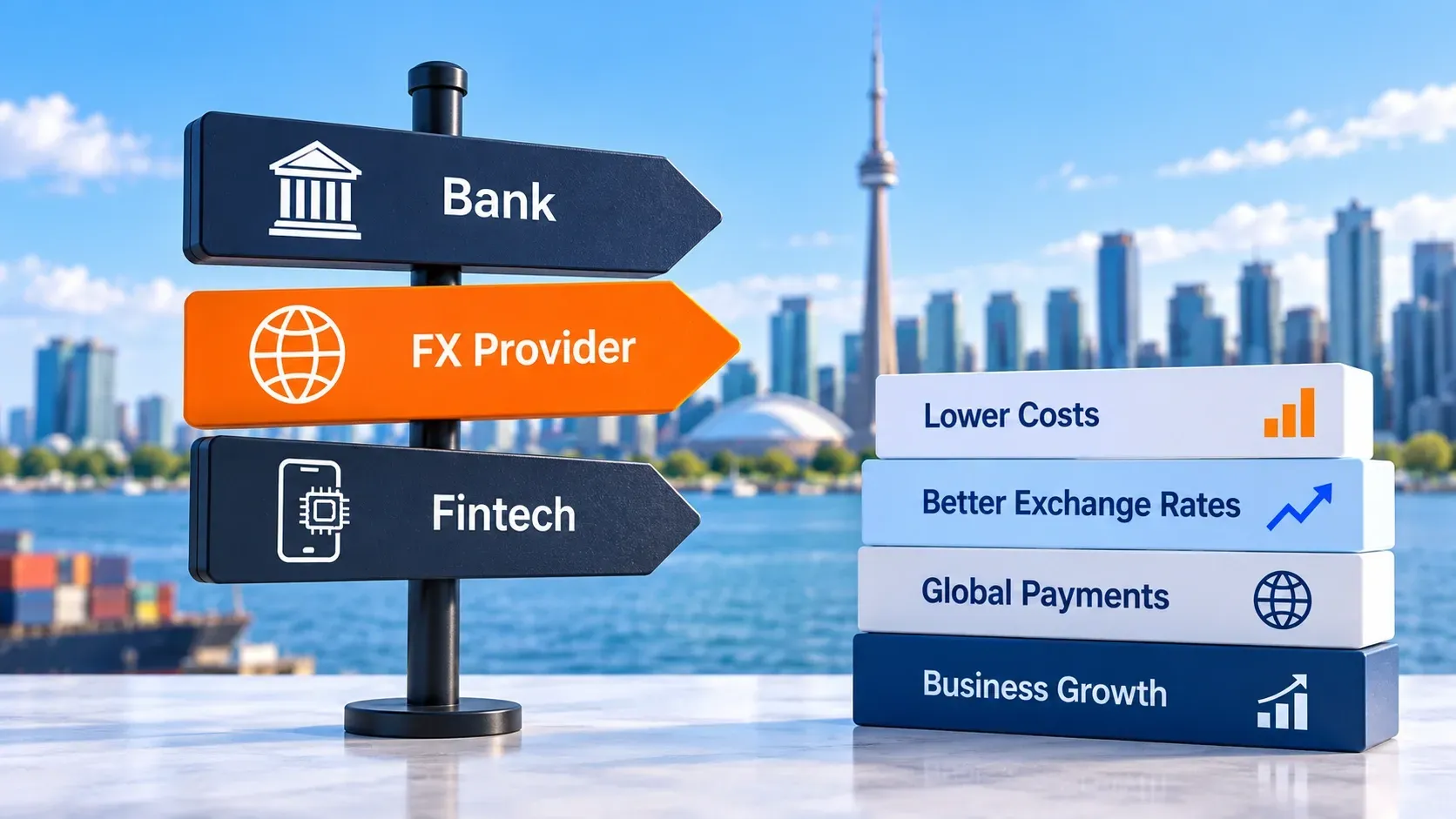
The best business account for international payments in Canada is the one that gives your company strong domestic banking plus cost-effective global payment support.
A regular business bank account may be enough for occasional international wires, but companies with frequent cross-border payments should compare exchange rates, transfer fees, multi-currency support, payment tracking, & FX risk tools.
Quick Answer - For most Canadian businesses, the best setup is a regular business bank account for domestic banking plus a specialist FX provider for international payments, currency conversion, supplier payments, and FX risk management.
Many Canadian businesses use a traditional bank account for everyday banking and a specialist provider like MTFX global payments for international transfers, supplier payments, business international money transfers and foreign currency conversion.
This guide explains how to choose the right business account for international payments in Canada, when to consider a specialist FX provider, and how to build a global payment setup that supports growth.
What is an international business account?
An international business account helps a company send, receive, hold, or convert money across currencies. For a Canadian business, that usually means managing payments in CAD, USD, EUR, GBP, or other currencies depending on where clients, suppliers, contractors, or marketplaces are located.
Some international business accounts are offered by major banks. Others are provided by fintech platforms or foreign exchange specialists. The best option depends on what your company needs to do with international money.
A local business that sends one overseas wire a year may only need basic international transfer access through its bank. An importer paying USD suppliers every week needs something stronger. A consulting firm billing clients in Europe may need foreign currency collection options. An e-commerce seller receiving marketplace funds may need a way to collect, convert, and repatriate money efficiently.
Why a regular business bank account may not be enough
Most Canadian business bank accounts are designed for domestic operations first. They are useful for deposits, payroll, bill payments, local transfers, cheques, tax payments, business cards, and everyday cash flow management.
That can create problems when global transactions become part of your regular operations. A bank may be able to send an international wire, but that does not always mean it is the most efficient or cost-effective option.
Businesses may face wider exchange rate spreads, fixed wire fees, intermediary bank deductions, limited delivery visibility, or delays caused by missing beneficiary details. The Financial Consumer Agency of Canada notes that international transfers may involve fees, exchange rates, and delivery differences that customers should understand before sending money.
The bigger issue is predictability. If your supplier invoice is in USD but your revenue is mostly in CAD, the exchange rate can change your real cost between the day you receive the invoice and the day you pay it. If your business works on tight margins, that difference matters.
This is where a specialist FX and payment provider can add value. Instead of treating foreign exchange as a side feature, platforms like MTFX focus on business international money transfers, supplier payments, global collections, live exchange rates, and currency risk planning.
| Field | Value |
|---|---|
Amount Payable (USD) 20,000 | |
Bank Exchange Rate 1.4533 / 0.6881 | |
Total cost 29,065.72CAD |
| Field | Value |
|---|---|
Amount Payable (USD) 20,000 | |
MTFX Exchange Rate 1.4284 / 0.7001 | |
Total cost 28,567.04CAD |
You Save
CAD 498.68
with MTFX
8 October 2026
We use mid-market rates. This is for informational purposes only. Log in to view send rates.
Business bank account vs FX provider: what is the difference?
A business bank account and an FX provider are not always competing products. In many cases, they work best together.
A bank gives your business a financial base. It helps with domestic deposits, payroll, cards, credit products, local transfers, taxes, and everyday account management. A specialist FX provider helps optimize the international side of your business, especially where currency conversion and cross-border payments affect your margins.
For example, if your company sends CAD 100,000 to overseas suppliers every month, a small difference in the exchange rate can matter more than the monthly fee on your business chequing account. This is why businesses should compare the total cost of sending money internationally, not just the account fee.
The right structure is often simple: keep your regular business bank account for domestic banking and use a specialist provider like MTFX for global business payments, supplier invoices, foreign exchange, and currency planning.
When should a business stop relying only on bank wires?
Your business may need a specialist FX and payment provider if you:
- pay overseas suppliers every month
- send high-value international transfers
- convert large amounts between CAD, USD, EUR, GBP, or other currencies
- receive payments from international clients or marketplaces
- need clearer payment tracking
- want better visibility before confirming a transfer
- are exposed to exchange rate movement
- need batch payments or recurring supplier payments
- want support from currency and payment specialists
- need to plan future currency purchases
A specialist provider can help your company compare exchange rates, reduce avoidable FX costs, save beneficiary details, schedule recurring payments, process multiple payments, and plan for future currency needs. For related guidance, see MTFX’s resources on cutting international supplier payment costs, paying remote employees and contractors overseas, and intercompany transfers between global subsidiaries.
Key features to compare before choosing an account
The best business account for international payments is not always the one with the lowest monthly fee. It is the one that gives you the best balance of cost, control, currency support, payment speed, and reliability.
Here are the most important features to compare.
1. Competitive exchange rates
The exchange rate is often the biggest cost in an international payment. Many businesses focus on transfer fees because they are visible, but the FX markup can be more expensive.
Before choosing a provider, compare the rate you are offered against the mid-market rate. A slightly better rate can make a meaningful difference when you are sending large supplier payments, paying overseas tuition, funding global payroll, purchasing inventory, or transferring recurring invoices.
MTFX provides live exchange rates so businesses can monitor market movement and make more informed payment decisions.
2. Transparent transfer fees
A low monthly account fee does not automatically mean low international payment costs. You should check the full cost of sending and receiving funds.
Common fees include:
- outgoing wire fees
- incoming wire fees
- intermediary bank fees
- receiving bank charges
- payment investigation fees
- account maintenance fees
- platform fees
- currency conversion margins
The best provider should show the cost before you confirm the transfer. You should know what you are paying, what currency is being sent, and what amount the recipient is expected to receive.
For wire-specific requirements, Payments Canada’s wire payments guide explains that complete and accurate information helps avoid delays, returns, and fees.
3. Multi-currency support
If your business regularly works in USD, EUR, GBP, or other foreign currencies, multi-currency support can reduce unnecessary conversions.
Multi-currency support is useful for:
- importers
- exporters
- e-commerce sellers
- SaaS companies
- agencies with overseas clients
- manufacturers with global suppliers
- companies paying international contractors
- firms managing foreign currency invoices
The goal is not just to hold multiple currencies. The goal is to reduce unnecessary conversion, improve timing, and keep cash flow more predictable.
This is especially important for companies managing global collections, marketplace revenue, or cross-border receivables.
4. Payment speed and reliability
Speed matters when you are paying suppliers, contractors, freight partners, tuition providers, overseas offices, or service vendors. Late payments can delay shipments, strain relationships, or trigger penalties.
Traditional bank wires can work well, but they may involve extra steps, especially when intermediary banks are involved. A provider built for global transactions can often offer a smoother process, clearer tracking, and faster support when something needs attention.
Payment reliability is especially important when sending funds to new beneficiaries, unfamiliar markets, or time-sensitive suppliers. A delayed payment may not just be inconvenient; it can affect your ability to receive goods, complete projects, or maintain trust with vendors.
For planning support, MTFX’s guide to developing a seamless international payment process can help finance teams build cleaner workflows.
5. Supplier and invoice payment tools
If your team pays one invoice occasionally, manual entry may be fine. But if you pay dozens or hundreds of invoices, manual processing becomes risky. It increases the chance of duplicate payments, incorrect beneficiary details, missed deadlines, and reconciliation headaches.
For businesses with frequent vendor payments, look for:
- saved beneficiaries
- recurring transfers
- batch payments
- approval workflows
- payment confirmations
- transaction records
- invoice references
- easy reconciliation
MTFX offers dedicated solutions for paying overseas invoices and paying suppliers internationally, helping businesses manage high-volume and recurring cross-border payments more efficiently.
6. Global collections
A good global payment setup should make receivables easier to manage. That means receiving funds in multiple currencies, converting when it makes sense, and keeping everything visible in one platform.
This is useful for:
- exporters receiving payments from foreign buyers
- agencies billing clients overseas
- marketplaces paying sellers in different currencies
- SaaS companies with international subscriptions
- service firms working with global customers
- manufacturers receiving deposits from foreign distributors
MTFX’s global collections solution helps businesses receive international payments and manage cross-border receivables with better visibility.
For online sellers, MTFX’s guide to e-commerce payment processing also explains how digital businesses can think about payment flows.
7. FX risk management
If your company makes international payments regularly, exchange rate movement is not just a finance detail. It affects pricing, margins, budgeting, and cash flow.
Export Development Canada also notes that foreign exchange risk can affect cash flow, profitability, and competitiveness, which is why businesses should understand and manage currency exposure.
That is why some businesses need tools such as:
- rate alerts
- market orders
- forward contracts
- multi-currency planning
- scheduled payment strategies
- expert FX guidance
MTFX provides FX risk management services to help businesses manage exposure and plan ahead.
Example: Why the exchange rate matters more than the transfer fee
Suppose a Canadian business needs to send the equivalent of CAD 50,000 to a USD supplier. One provider offers a low transfer fee, but the exchange rate includes a wider markup. Another provider charges a clear transfer fee but offers a stronger exchange rate.
At first glance, the lower transfer fee may look better. But once you calculate the final USD amount received by the supplier, the provider with the better exchange rate may deliver more value.
This is why businesses should compare the full payment cost before sending funds internationally. The visible wire fee is only one part of the transaction. The exchange rate often has the bigger impact, especially on high-value or recurring payments.
A business sending one small transfer may not notice a major difference. But a company sending frequent supplier payments, inventory deposits, tuition payments, or offshore contractor payments can lose significant value over time if it ignores the exchange rate.
The lesson is simple: do not choose an international payment provider based only on the stated transfer fee. Compare the rate, the fees, the delivery amount, and the level of support before confirming the payment.
To estimate currency exposure before booking, use the MTFX rate calculator or review the CAD to USD converter, CAD to EUR converter, or CAD to GBP converter.
Which option is best for your business?
The best account depends on how often you transact internationally and how much control you need.
For many Canadian companies, the smartest option is not replacing the bank. It is using the bank for domestic banking and using a specialist provider for the international payment layer.
This approach gives the business more flexibility. The bank supports everyday operations, while the FX provider helps manage cross-border payments, currency conversion, global collections, and payment timing.
Comparing Canadian banks for global business transactions
Canada’s major banks, including RBC, TD, Scotiabank, CIBC, and BMO, all offer business banking products and some level of international payment support. They can be useful for everyday business accounts, credit products, branch access, merchant services, and domestic cash management.
But when comparing them for global transactions, avoid choosing based only on brand familiarity. Review the details that affect real payment cost and performance.
A major bank can be a strong domestic banking partner. But if your business is making frequent foreign currency payments, you should compare the total cost against a specialist FX provider before sending large or recurring transfers.
The best setup depends on your business model. A company that mainly operates in Canada may prioritize monthly account fees and local transaction limits. A business that imports inventory, pays international suppliers, or receives overseas revenue should look more closely at FX rates, payment speed, and global support.
For more business payment planning, see MTFX’s guides on sending business payments from Canada to Europe, sending business payments from Canada to the UK, and sending business payments from Canada to China.
Reduce FX costs and streamline global payments with MTFX.
Hidden costs to watch for
International payment costs are not always obvious. A transfer that looks affordable at first can become expensive once you include the full chain of charges.
The most common hidden costs include:
- FX spread
- Wire fee
- Intermediary bank fee
- Receiving bank fee
- Payment delay
- Manual admin
- Currency movement
- Investigation fees
For global businesses, the cheapest option is not always the account with the lowest monthly fee. It is the setup with the lowest total cost, clearest pricing, and strongest control over currency timing.
A business should always ask: “What will the recipient actually receive, and what will this payment really cost us?”
How to choose the right business account for international payments
Use this process before opening an account or choosing a payment provider.
Step 1: List your main currencies
Start with the currencies your business uses most often. For many Canadian companies, this includes CAD and USD. Others may need EUR, GBP, JPY, AUD, or currencies tied to supplier markets.
You should also consider whether you need to send, receive, hold, or convert each currency. These are different needs, and not every account handles them equally well.
Step 2: Map your payment flows
Separate outgoing and incoming payments.
Ask:
- Are you paying suppliers?
- Are you receiving from international clients?
- Are you paying contractors or overseas staff?
- Are you collecting funds from marketplaces?
- Are you sending deposits for inventory or equipment?
- Are you transferring funds between related companies?
The more complex your payment flows, the more important it becomes to choose a provider with strong tracking, support, and reporting.
Step 3: Calculate total payment cost
Do not compare only account fees. Compare the exchange rate, transfer fee, intermediary fee risk, receiving fee risk, and administrative effort.
For recurring payments, calculate the cost over a full year. A small rate difference can become meaningful when multiplied across monthly supplier invoices or frequent overseas transfers.
Step 4: Check payment visibility
You should be able to confirm payment details, review the FX rate, track status, and keep records for accounting.
Strong payment visibility helps reduce confusion between your business and the recipient. It also makes life easier for your finance team when reconciling invoices, payments, and bank records.
Step 5: Consider currency risk
If exchange rate swings can affect your margins, look for tools that help you plan ahead. Rate alerts and forward contracts can help make future costs more predictable.
This is especially useful for companies that quote in one currency and pay expenses in another.
Step 6: Build for growth
Your current needs may be simple, but your future needs may not be. Choose a setup that can support larger payments, more currencies, more beneficiaries, and more complex approval workflows.
A global payment setup should not hold your business back as you expand into new markets.
What do you need to set up international business payments?
Before opening or using an international business payment account, your provider may ask for information about your company, ownership, payment purpose, and expected transfer activity. Requirements can vary, but Canadian businesses should usually be ready to provide basic business and compliance details.
You may need:
- legal business name
- business registration details
- business address and contact information
- director or owner identification
- banking details for funding payments
- expected currencies
- expected destination countries
- estimated transfer amounts
- reason for payments, such as supplier invoices, client collections, payroll, or contractor payments
- beneficiary details for overseas recipients
- supporting documents for larger or unusual transfers
For Canadian business registration background, the Canada Revenue Agency business registration page explains how business numbers and program accounts work.
Beneficiary details may include the recipient’s legal name, address, bank name, bank address, account number, SWIFT/BIC, IBAN where applicable, routing details, and payment reference.
For recurring payments, it is also useful to prepare invoice records, supplier contracts, payment schedules, and internal approval rules. This gives your finance team a cleaner process and reduces the chance of last-minute errors.
Should you use a bank, fintech, or FX provider?
There is no single answer for every business. Each option serves a different purpose.
A traditional bank is still important for many companies. It gives your business access to local banking services, cards, credit, tax payments, and day-to-day cash management.
A fintech platform may be useful for digital-first companies that want fast onboarding and simple online tools.
A specialist FX provider is usually the stronger option when foreign exchange and international payments become regular business activities.
For many Canadian companies, the combined setup works best: use a bank for domestic banking and MTFX for international payments, currency conversion, supplier payments, and FX planning.
Common mistakes to avoid when sending international payments
When choosing a business account for global transactions, avoid these mistakes.
- Choosing based only on monthly account fees
- Ignoring the exchange rate markup
- Assuming all international wires cost the same
- Forgetting about intermediary and receiving bank fees
- Sending large payments without comparing rates
- Using personal accounts for business transfers
- Not checking beneficiary details before sending
- Waiting until the invoice due date to think about FX
- Choosing a provider without clear support or tracking
Why MTFX is a smart choice for global business payments
With MTFX, businesses can send payments to global suppliers, manage business money transfers, receive international funds, monitor exchange rates, and access currency risk tools from one platform.
They can work alongside your existing business bank account. Your bank can continue to handle local deposits, payroll, cards, credit products, and everyday business banking.
MTFX can help with international transfers, overseas invoices, global collections, and FX strategy. Businesses can also review MTFX’s Canadian compliance and FINTRAC regulatory information for additional trust signals.
This gives your business more control where it matters most:
- how much money leaves your account
- how much arrives overseas
- when payments are sent
- what exchange rate is used
- how foreign currency movement affects your margins
- how easily your team can track and reconcile payments


Build a smarter global payment setup with MTFX
The best business account for international payments in Canada is not always a single account. For many companies, it is a practical combination: a reliable Canadian business bank account for domestic banking and a specialist FX provider for global payments.
If your company pays overseas suppliers, receives funds from international clients, manages USD and CAD cash flow, or wants to reduce FX costs, MTFX can help you move beyond basic wires and build a smarter global payment process.
With the right setup, international payments become easier to plan, easier to track, and easier to control. Your business can protect margins, improve supplier relationships, reduce payment friction, and prepare for growth in new markets.
Open a business account with MTFX to compare rates, manage international payments, and simplify global transactions from Canada.
FAQs
1. What is the best business account for international payments in Canada?
The best business account for international payments in Canada depends on your payment volume, currencies, and FX needs. A traditional business bank account may work for occasional wires, but companies with frequent or high-value payments should compare exchange rates, transfer fees, payment tracking, multi-currency support, and FX risk tools.
2. Do Canadian businesses need a separate account for international payments?
Not always. Many Canadian businesses use their regular business bank account for domestic banking and a specialist FX provider for international payments. This setup can help improve exchange rates, reduce payment friction, support supplier payments, and give better visibility over cross-border transactions.
3. What is the cheapest way to send international business payments?
The cheapest way to send international business payments is usually the option with the lowest total cost, not just the lowest visible transfer fee. Businesses should compare the exchange rate, transfer fee, intermediary bank charges, receiving bank fees, and payment speed before sending money internationally.
4. Can a Canadian business hold or receive money in multiple currencies?
Yes. Some banks, fintech platforms, and specialist providers offer multi-currency solutions that allow businesses to hold, receive, send, or convert foreign currencies. This can be useful for companies working with international clients, suppliers, contractors, or marketplaces.
5. Is a multi-currency account better than a regular business bank account?
A multi-currency account can be better for businesses that regularly work across currencies. A regular business bank account is useful for domestic transactions, but it may not provide the same FX flexibility, international payment tools, or cost control. Many businesses use both.
6. When should a business use an FX provider instead of a bank?
A business should consider an FX provider when it sends frequent international payments, pays overseas suppliers, receives foreign currency, needs better exchange rate visibility, wants clearer payment tracking, or wants tools to manage currency risk.
7. What information is needed to send an international business payment?
You usually need your business details, funding account details, payment purpose, recipient name, recipient address, bank name, bank address, account number, SWIFT/BIC, IBAN where applicable, destination country, currency, and payment amount. Larger transfers may require supporting documents such as invoices or contracts.
8. Why does the exchange rate matter for business payments?
The exchange rate matters because it affects how much foreign currency your recipient receives and how much the payment costs in Canadian dollars. A low transfer fee may look attractive, but a wider exchange rate markup can increase your total cost.
9. Are international wire transfers the same as business money transfers?
Not always. International wire transfers are usually bank-to-bank payments. Business money transfer providers may offer additional tools such as competitive FX rates, online tracking, batch payments, saved beneficiaries, global collections, and FX risk management. The right option depends on your payment needs.
10. Why use MTFX for business international payments?
MTFX helps Canadian businesses send international payments, pay overseas suppliers, receive global funds, access competitive exchange rates, and manage currency risk. It can work alongside your existing bank account to make cross-border transactions more transparent, efficient, and easier to control.