Virtual Receiving Accounts: How to Collect International Payments Without Local Bank Accounts
Virtual receiving accounts connect international customer payments to a Canadian business's foreign-currency balances using local banking details. Businesses can receive supported payments in USD, EUR or GBP, retain the funds in their original currency and convert them into CAD when needed.
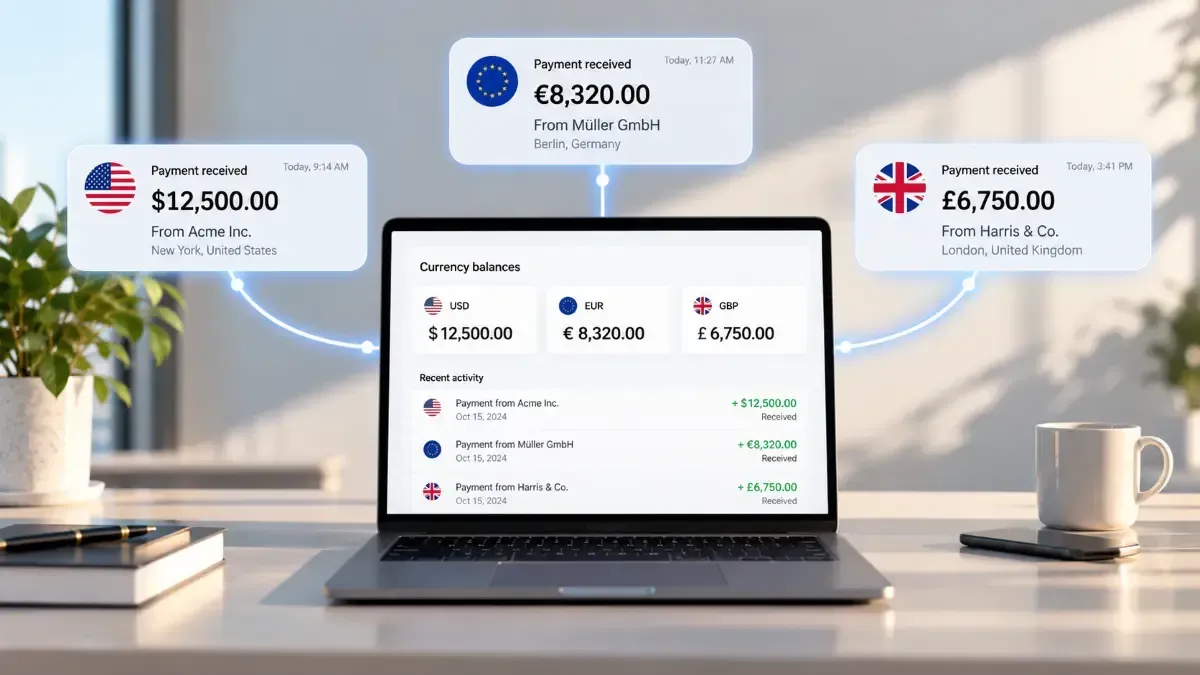
A virtual receiving account allows Canadian businesses to collect payments from international customers using local banking details. Instead of asking overseas clients to send funds directly to a Canadian bank account, businesses can provide receiving details suited to the customer's market and receive payments into their foreign-currency balances.
For Canadian exporters, consultants and businesses with international customers, this can make a meaningful difference to how foreign revenue is managed. With MTFX, businesses can receive USD, EUR and GBP payments, maintain balances in those currencies and choose when to convert funds into Canadian dollars.
But how does the money actually reach your account? And what is the difference between a virtual receiving account, a virtual IBAN and a traditional business bank account?
This guide explains how virtual receiving accounts work, what happens to payments after they arrive and how Canadian finance teams can manage international receivables more effectively.
What is a virtual receiving account for a Canadian business?
A virtual receiving account provides banking details that customers can use to make payments to a business. These details may include a local account number, routing number, IBAN or sort code, depending on the currency and country involved.
For Canadian businesses working with international customers, the main purpose is to make it easier to receive foreign-currency payments without requiring a conventional business bank account in every country where they operate.
For example, consider a Canadian software company that invoices clients in the United States, Germany and the United Kingdom.
Rather than giving every customer the same Canadian bank information, the company can provide relevant local receiving details for USD, EUR and GBP payments. Once received, the funds can be managed through a multi-currency business account.
The benefit is not simply having access to several account numbers. It's having a practical way to collect and manage revenue in the currencies your customers already use.
Is a virtual receiving account the same as a traditional bank account?
Not exactly. Although the terms are sometimes used interchangeably, they serve different purposes. A traditional business bank account is a banking product with features determined by the financial institution and the account agreement.
Virtual receiving details provide payment instructions that help direct incoming funds through the relevant payment infrastructure. The resulting balance can then be managed through a multi-currency platform.
The important distinction is that receiving details identify where a payment should go, while the currency balance shows the funds available to your business after the payment has been processed.
The features and legal arrangements behind virtual receiving details vary by provider, so they should not automatically be treated as identical to a conventional bank deposit account.
How do virtual receiving accounts work?
Virtual receiving accounts connect customer payments to a business's foreign-currency balances. When a customer sends money using the appropriate local banking details, the payment moves through the relevant payment network. After processing, the funds are credited to the business's corresponding currency balance.
With MTFX's international payment collection services, Canadian businesses can receive supported foreign-currency payments and manage the resulting balances through one platform. The process follows four main stages.
Step 1: Your customer receives local payment details
Suppose your Canadian business invoices a US customer for USD 25,000. Instead of supplying Canadian banking information for an international wire, you provide the relevant US account number and routing number.
The customer can use these details to initiate an eligible domestic US payment.
| Field | Value |
|---|---|
Amount Receivable (CAD) 25,000 | |
Bank Exchange Rate 1.3867 / 0.7212 | |
Total received 18,028.76USD |
| Field | Value |
|---|---|
Amount Receivable (CAD) 25,000 | |
MTFX Exchange Rate 1.4109 / 0.7088 | |
Total received 17,719.44USD |
You Save
USD 309.32
with MTFX
17 October 2026
We use mid-market rates. This is for informational purposes only. Log in to view send rates.
Step 2: The customer sends the payment
The customer submits the payment through their financial institution using the details provided. For US dollar collections, MTFX describes receiving payments through domestic ACH or wire transfers. The payment method should match the instructions associated with the receiving details.
The Nacha ACH Network supports electronic transfers between US financial institutions, including business payments and direct deposits.
Step 3: The payment reaches your currency balance
After the payment is processed and credited, the USD 25,000 appears in your business's USD balance. Because the payment was received in USD, the business does not need to convert the amount into Canadian dollars simply to maintain that balance.
The finance team can now see the foreign-currency funds available for its next decision.
Step 4: Your business manages the received funds
Once the payment is available, the business can choose to retain the USD balance or convert some or all of it into CAD. For example, the company might require CAD 15,000 for Canadian operating expenses but prefer to retain the remaining funds in USD for upcoming US dollar obligations.
This gives the finance team more flexibility than a payment arrangement that automatically converts every incoming foreign-currency receipt.
The payment flow at a glance:
Customer's bank → Local receiving details → Payment processing → Foreign-currency balance → Hold or convert funds
The local receiving details and currency balance play different roles, but together they make international collections easier to manage.
What is the difference between virtual receiving details and a multi-currency account?
Virtual receiving details and a multi-currency account are connected, but they are not the same thing.
The receiving details tell a customer how to send money. The multi-currency account is where the business views and manages its balances after funds are received.
Where does a virtual IBAN fit in?
A virtual IBAN is an IBAN-format identifier used by certain payment service providers to direct or allocate incoming payments. Its underlying account structure depends on the provider.
An IBAN, or International Bank Account Number, is commonly used in European payment instructions. However, not every IBAN is necessarily a virtual IBAN.
MTFX provides EUR receiving details that include an IBAN. Canadian businesses should use the specific IBAN and beneficiary information supplied with their account rather than assuming that every IBAN-based arrangement works the same way.
Which receiving details are used for USD, EUR and GBP payments?
The receiving information a business supplies depends on the currency and the customer's payment market.
MTFX offers local receiving details for major currencies, including USD, EUR and GBP. This allows Canadian businesses to provide different payment instructions to customers in these markets.
How do USD receiving details work?
USD receiving details are particularly useful for Canadian companies generating regular revenue from the United States. Consider an Ontario-based engineering consultancy with a US customer paying a monthly invoice of USD 40,000.
By providing the appropriate US receiving details, the consultancy allows its customer to initiate a supported domestic payment rather than relying on Canadian international wire instructions. The received amount can remain in USD, allowing the finance team to decide later whether to convert the funds.
This is especially relevant to businesses that receive US dollar revenue but also have Canadian operating expenses.
How do EUR receiving details work?
European businesses commonly use IBANs when making euro-denominated bank transfers. The Single Euro Payments Area, or SEPA, provides a framework for euro payments across participating markets. The European Payments Council sets out the framework for SEPA credit transfers.
For example, a Canadian manufacturer supplying specialized components to a German distributor may issue an invoice for EUR 60,000. The German distributor can use the provided European IBAN to make an eligible euro payment. After processing, the Canadian manufacturer receives the amount in its EUR balance.
Instead of converting the payment automatically, the business can manage its euro revenue according to its cash flow requirements.
How do GBP receiving details work?
UK bank transfers commonly use an account number and a six-digit sort code.A Canadian technology company billing a British client GBP 30,000 can provide the relevant UK receiving details for the payment.
Once the funds arrive in its GBP balance, the company can retain the pounds or exchange them into another supported currency when required.
For businesses with customers across several countries, having the correct receiving information for each market also helps reduce the administrative work involved in preparing international invoices.
How can Canadian businesses start receiving payments through local account details?
Setting up a virtual receiving arrangement involves more than obtaining an account number. Businesses need the correct currency details, accurate customer instructions and a way to monitor incoming payments.
With MTFX, the process begins with a business account and access to the relevant foreign-currency receiving information.
Step 1: Open and verify your business account
Register a business account and provide the required company information and verification documents. These may include business registration details, identification and information about the company's international payment activities.
Once the account is approved, the business can access the relevant features available to it.
Step 2: Select the currencies you receive
Identify where your customers are located and the currencies they use to pay invoices. A business selling primarily to American customers may need USD receiving details. Another collecting from both American and European clients may require USD and EUR.
MTFX's global collections platform allows businesses to manage supported international receipts and currency balances through a centralized system.
Step 3: Add the correct details to customer invoices
Update your invoice templates with the receiving instructions appropriate to each customer and currency. For a USD invoice, this may include the US account number and routing number. A EUR invoice may instead include an IBAN.
Use the exact beneficiary name and banking information provided with the account.
Step 4: Track received payments and manage balances
Once the customer submits payment, monitor the account for receipt and confirm that the credited amount matches the invoice. Finance teams should reconcile payments using invoice numbers, payer information, credited amounts and any fees or adjustments that apply.
For businesses with several international customers, keeping a consistent global collections workflow can make it easier to match payments to outstanding invoices and manage receivables across currencies.
What should businesses check before sharing virtual receiving details?
Having local receiving details does not mean every payment method or transaction type will be supported.
Before updating invoices or requesting a large customer payment, finance teams should review the instructions associated with their receiving account. Five checks are particularly important:
- Receiving currency: Confirm that the details are intended for the currency being sent.
- Beneficiary information: Use the exact account name and other required information supplied with the receiving instructions.
- Payment method: Check that the customer's bank can send funds using the permitted payment route.
- Payment reference: Include invoice or reference information where required to help with reconciliation.
- Applicable costs: Understand whether sending-bank fees, receiving charges or other payment costs may affect the amount credited.
For example, a Canadian exporter should not assume that receiving details intended for a USD domestic payment can also accept every type of international transfer.
The same applies to businesses receiving payments from marketplaces or payment platforms. The platform's payout requirements must be compatible with the receiving details provided.
Verifying these points before payment helps prevent rejected transfers, incorrect instructions and avoidable delays.
What happens after an international payment reaches your currency balance?
Receiving the payment is only the first part of managing international revenue. The next decision is what to do with the funds.
For many Canadian businesses, that decision depends on when they need CAD, whether they have foreign-currency expenses and how exchange rates affect their cash flow.
Holding funds in the original currency
Suppose a Canadian exporter receives USD 80,000 from a US customer. The company needs CAD to meet domestic expenses, but it also expects a USD 25,000 supplier invoice next month.
Keeping some of the revenue in USD may help the business align its foreign-currency receipts with upcoming foreign-currency obligations, subject to the available payment arrangements.
The business can then avoid converting that portion solely for the purpose of holding it in CAD before making another USD payment. For companies generating regular US sales revenue, separating collection decisions from conversion decisions can improve control over international cash flow.
Converting foreign-currency balances into CAD
Not every business can afford to wait for a more favourable exchange rate. Payroll, taxes, rent and other Canadian operating expenses still need to be funded on time.
If a company receives USD 80,000 but needs CAD immediately, it can convert the required portion rather than waiting for a particular market level. This makes conversion timing a cash flow decision as much as a currency-market decision.
Holding a foreign currency also carries exchange-rate risk: if it weakens against CAD before conversion, the business may receive fewer Canadian dollars.
How do exchange rates and payment fees affect international receivables?
The amount a business invoices in a foreign currency is not necessarily the same as the Canadian dollar value it eventually realizes. That value depends on the exchange rate applied, the amount converted and any applicable fees.
Example: Converting a USD 50,000 customer payment
Imagine a Canadian business receives USD 50,000 from an American customer.
The finance manager compares two hypothetical USD-to-CAD exchange rates.
A difference of just one Canadian cent in the exchange rate changes the converted value of this invoice by CAD 500.
For a business receiving multiple large invoices each month, exchange-rate differences can have a meaningful effect on revenue, margins and budgeting.
These rates are illustrative and exclude transaction fees. They are not live quotes or a prediction of future currency movements.
Look beyond the advertised exchange rate
When assessing the cost of receiving and converting foreign-currency payments, finance teams should consider the complete transaction. The main factors include:
- Sending fees: Charges applied by the customer's financial institution.
- Receiving fees: Any charges associated with accepting the payment.
- Exchange-rate margin: The difference between the reference market rate and the rate actually offered for conversion.
- Other banking charges: Additional deductions that may apply to particular payment routes.
The Bank of Canada publishes indicative daily exchange rates that businesses can use as reference points. These are not necessarily the rates available for an actual transaction.
Comparing the exchange rate alongside the applicable fees provides a clearer picture of how much CAD the business will receive.
How can finance teams plan foreign-currency conversions more effectively?
Businesses that regularly receive international payments benefit from having a conversion plan rather than making every decision separately. A good starting point is to forecast how much CAD the business will need and when those funds must be available.
For example, a company collecting USD 100,000 every month might need to convert USD 60,000 to cover Canadian operating expenses while retaining the remainder for future USD obligations. Its conversion strategy should reflect those payment commitments, not simply expectations about where the exchange rate might move.
Monitor exchange rates against your business requirements
Finance teams can use live exchange rates to monitor movements in USD/CAD, EUR/CAD and GBP/CAD. If a business has flexibility over when it converts a balance, reviewing recent market movements can help it evaluate available rates against its budget.
Another option is to establish a target exchange rate. For example, a business holding USD may want to be notified if USD/CAD reaches a level that meets its planned CAD revenue target.
Using currency rate alerts, finance teams can monitor a preferred market level without checking rates throughout the day. An alert provides a notification, not a guarantee that the eventual transaction rate will match the alert level.
Include currency forecasts in cash flow planning
A business expecting recurring foreign-currency payments may also want a broader view of exchange-rate conditions. The monthly Canadian dollar outlook provides context on economic developments and currency movements that can influence CAD, while bank exchange-rate forecasts offer different perspectives on the potential direction of major currency pairs.
These forecasts can support scenario planning, but they should not replace cash flow requirements or be treated as guaranteed future rates.
For finance teams, the practical goal is to understand what different currency outcomes could mean for the business's Canadian dollar income.
Which Canadian businesses benefit from virtual receiving accounts?
Virtual receiving accounts are particularly relevant to businesses that collect meaningful amounts of revenue from international customers.
The strongest use cases involve regular foreign-currency invoices, multiple customer markets or a need to manage conversion separately from payment receipt.
Canadian exporters receiving USD payments
Consider a Canadian manufacturer selling industrial equipment to distributors in the United States. The company invoices customers in USD and receives several large payments each month.
Local USD receiving details provide a consistent way for American customers to submit their payments. The manufacturer can then manage the received USD balance according to its Canadian operating expenses and future foreign-currency needs.
This can be particularly valuable when payment collections and supplier obligations occur on different dates.
Canadian service providers working with European clients
A Toronto-based consulting company earns EUR 75,000 each quarter from clients in Germany and France. Providing European receiving details allows its clients to pay invoices using appropriate euro payment instructions.
Once received, the company can maintain its EUR balance and decide how much to convert into CAD. For service providers with substantial European revenue, the ability to collect euro payments without immediate conversion can make it easier to separate client collections from foreign exchange decisions.
Businesses receiving international marketplace payouts
Consider a Canadian e-commerce business selling products to customers in the US and UK. The company receives marketplace payouts in USD and GBP, but its Canadian expenses are primarily in CAD.
Rather than converting every payout immediately, a compatible multi-currency receiving arrangement allows the business to manage balances separately. The business still needs to confirm that its marketplace accepts the relevant receiving details. Different platforms can have their own payout rules and account verification requirements.
For businesses managing several marketplaces, international marketplace payment collections can become an important part of their wider accounts receivable process.
How does MTFX help businesses manage international receivables?
MTFX provides Canadian businesses with a way to receive supported foreign-currency payments, manage balances and handle currency conversions through its international payments platform.
Businesses can access local receiving details for major markets, including USD, EUR and GBP, while managing their foreign-currency balances within a multi-currency account.
The platform also brings together currency exchange tools and international payment services, helping finance teams manage cross-border revenue without relying on separate processes for every currency.
For a growing Canadian business, this creates a more connected approach to international receivables. Customer payments, currency balances and conversion decisions can be managed as part of the same financial workflow.
MTFX has supported international currency exchange and payment needs since 1996 and is registered with FINTRAC as a money services business.


Turn international payments into better cash flow decisions
Getting paid by an overseas customer should be the beginning of a well-managed cash flow process, not another round of banking complications.
Virtual receiving accounts help Canadian businesses connect international customer payments to the currencies they actually earn. When combined with a multi-currency account, they provide more control over how those funds are managed and when conversions take place.
For finance teams, the real value comes from understanding the payment route, maintaining accurate records and making currency decisions that reflect the business's operational needs.
Create your MTFX business account today and build a more practical approach to managing international revenue.
FAQs
1. What is a virtual bank account in Canada?
A virtual bank account generally refers to account details provided through a banking or payment platform that allow users to receive or direct funds. For Canadian businesses, virtual receiving details can support international collections using local payment instructions. The underlying structure and available features depend on the provider and are not necessarily identical to those of a conventional bank account.
2. How does a virtual receiving account work?
A virtual receiving account allows a customer to send money using designated account details. The payment moves through the relevant payment network and, after processing, the funds are credited to the business's associated currency balance. Businesses can then manage the funds according to the features available through their provider.
3. Is a virtual receiving account the same as a multi-currency account?
No. Virtual receiving details provide the information needed to direct incoming payments, while a multi-currency account allows a business to manage balances in different currencies. The two can work together, but they serve different functions.
4. Can Canadian businesses receive USD without converting it into CAD?
Yes. Canadian businesses can use suitable foreign-currency accounts or payment platforms to receive and retain USD instead of converting it immediately. MTFX's multi-currency account supports USD balances, giving businesses flexibility over when they exchange received funds into Canadian dollars.
5. Can a Canadian business receive payments using US account details?
Yes. MTFX provides US account numbers and routing details for supported USD collections. American customers can use the appropriate details to initiate eligible domestic payments, including ACH credits or wires, according to the receiving instructions.
6. What is a virtual IBAN, and how is it used?
A virtual IBAN is an IBAN-format identifier that certain payment providers use to route or allocate incoming payments. It can help businesses receive payments using European-style account details. The precise account arrangement depends on the provider, and not every IBAN is a virtual IBAN.
7. Can Canadian businesses receive euro payments from European customers?
Yes. With suitable EUR receiving details, Canadian businesses can collect euro payments from European customers. MTFX provides EUR receiving details that include an IBAN, allowing businesses to receive supported payments and manage the funds in a EUR currency balance.
8. Can virtual receiving details be used for marketplace payouts?
They can be used where the marketplace supports the relevant account details and payment route. Businesses should check the platform's beneficiary, verification and payout requirements before updating their payment settings.
9. Are there fees for receiving or converting foreign-currency payments?
Fees depend on the provider, currency and payment method. Potential costs include sending-bank charges, receiving fees and the exchange-rate margin applied during conversion. Businesses should compare the total amount received or converted rather than focusing on one advertised fee.
10. How long does it take to receive an international business payment?
The timeframe depends on the payment method, currency, sending financial institution and processing requirements. Domestic payment networks and international wires can have different timelines. Businesses should confirm the applicable processing arrangements and allow for additional time when planning important cash flow commitments.
Disclaimer: This article is for general informational purposes only and does not constitute financial, legal or banking advice. Virtual receiving account features, supported currencies, payment methods, processing times and fees may vary depending on the provider and transaction requirements. Exchange rates fluctuate, and any examples are illustrative only. Businesses should confirm applicable account capabilities, receiving instructions and transaction costs before initiating payments.
Streamline your incoming international payments with a virtual account.