How Long Does an International SWIFT Transfer Take?
International wire transfers usually take one to five business days, although many payments arrive within one or two business days. Delivery time depends on the destination, currency, bank cut-off times, intermediary banks, compliance checks, weekends, public holidays and the accuracy of the recipient’s banking details.
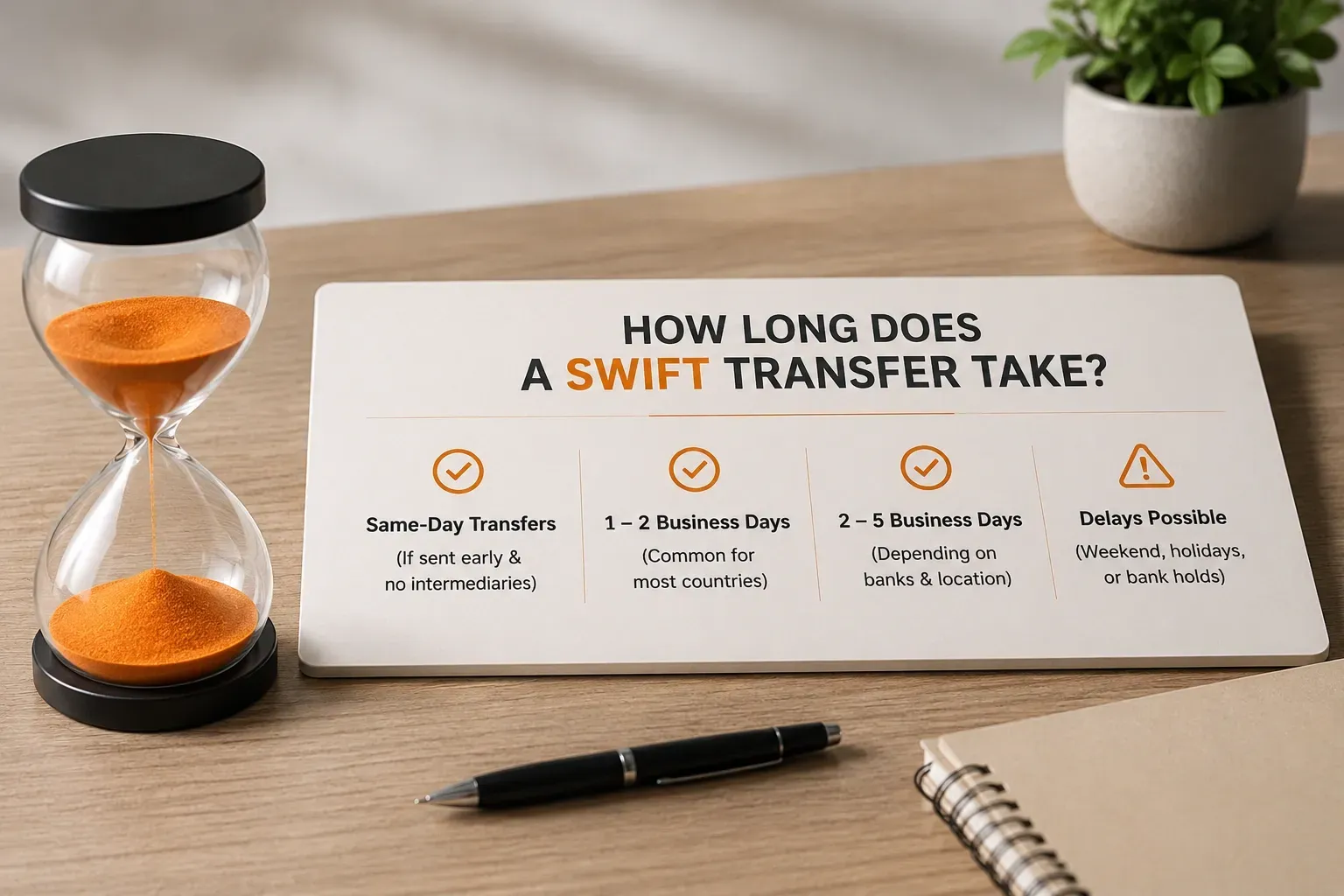
International wire transfers usually take one to five business days to reach the recipient. Payments sent between major financial institutions in commonly traded currencies may arrive within one or two business days, while transfers involving intermediary banks, less common currencies or additional compliance checks can take longer.
The SWIFT network can transmit payment instructions between financial institutions relatively quickly. However, the complete transfer also depends on how long the sending institution takes to release the funds, how the payment is routed and when the recipient’s bank credits the money to the beneficiary’s account.
MTFX has been helping Canadians move money internationally since 1996. Canadian individuals and businesses can use MTFX for secure international money transfers, competitive exchange rates, online payment tracking and specialist support when sending money to recipients around the world.
How long do international wire transfers usually take?
Most international money transfers take between one to five business days. The exact delivery time depends on the payment route, countries involved, currencies exchanged and processing requirements of each financial institution.
A straightforward transfer submitted before the daily cut-off may arrive the same day or the next business day. A transfer that passes through several intermediary banks or requires additional verification may take five business days or longer.
Canadians arranging recurring payments can also review regular international transfer options and schedule payments ahead of important deadlines.
These estimates normally begin after the sending institution has received the funds, verified the payment and released it for processing. Creating a transfer instruction does not always mean the payment has already entered the international banking network.
| Field | Value |
|---|---|
Amount Payable (USD) 50,000 | |
Bank Exchange Rate 1.4144 / 0.7070 | |
Total cost 70,718.64CAD |
| Field | Value |
|---|---|
Amount Payable (USD) 50,000 | |
MTFX Exchange Rate 1.3901 / 0.7194 | |
Total cost 69,505.33CAD |
You Save
CAD 1,213.31
with MTFX
12 September 2026
We use mid-market rates. This is for informational purposes only. Log in to view send rates.
SWIFT can transmit a payment quickly, but final delivery may take longer
SWIFT is a secure messaging network used by financial institutions to exchange payment instructions. It does not directly hold customer money or move funds from one account to another.
According to SWIFT payment-speed data, 75% of payments sent across its network reach the beneficiary bank within 10 minutes, and more than 90% reach the beneficiary bank within one hour. However, reaching the beneficiary bank is not the same as the funds becoming available in the recipient’s account.
How quickly does a payment move through the SWIFT network?
The payment message may move between financial institutions within minutes or hours. The complete transaction can still involve additional steps before and after the message travels through the network.
The sending institution may need to:
- Confirm that the sender has sufficient funds.
- Verify the purpose of the payment.
- Conduct fraud and compliance screening.
- Convert the money into the required currency.
- Select a direct or intermediary banking route.
- Release the transfer before the relevant currency cut-off time.
The receiving institution may then need to:
- Confirm the beneficiary’s identity.
- Match the beneficiary name and account information.
- Review the payment for regulatory or compliance purposes.
- Convert the funds if the account uses a different currency.
- Apply any incoming wire charges.
- Credit the recipient’s account.
What is the last mile of an international payment?
The last mile is the period between the payment reaching the beneficiary bank and the money becoming available in the recipient’s account. SWIFT reports that this stage accounts for more than 80% of the total end-to-end payment time.
A payment may have reached the correct financial institution but remain unavailable because it is:
- Waiting in an internal processing queue.
- Undergoing a compliance check.
- Being matched with the beneficiary’s account.
- Waiting for supporting information.
- Scheduled for crediting during local banking hours.
- Being converted into the recipient account’s currency.
This explains why a sender may receive confirmation that the transfer reached the beneficiary bank while the recipient still cannot see or use the funds.
What happens during an international SWIFT transfer?
An international wire transfer passes through several stages. Understanding these stages makes it easier to identify where a delayed payment may be held.
Not every transfer follows exactly the same route. A payment between institutions with a direct banking relationship may move faster than one requiring several intermediary banks. For a more detailed explanation, review how international wire transfers work from instruction to final delivery.
What factors affect international wire transfer time?
International wire transfer speed depends on more than the distance between the sender and recipient. Banking schedules, routing requirements, currency conversion and the information supplied with the payment can all affect delivery.
The most common factors include:
- The sending institution’s daily cut-off time.
- The time required for the sender to fund the transfer.
- Weekends in the sending or receiving country.
- Public holidays in either country.
- Time-zone differences.
- The sending and receiving currencies.
- The number of intermediary banks involved.
- The recipient bank’s internal processing time.
- Compliance, sanctions and fraud screening.
- The size and purpose of the payment.
- First-time payments to a new beneficiary.
- Incorrect account numbers, IBANs or SWIFT codes.
- Differences between the beneficiary name and account records.
- Missing invoice numbers or payment references.
- Recipient accounts that cannot accept the transferred currency.
Do international wire transfers process on weekends?
Most international wire transfers are processed during business days. A payment submitted on a Saturday, Sunday or public holiday may not begin processing until the next banking day.
A transfer sent late on Friday may therefore remain pending until Monday. If Monday is a public holiday in Canada or the recipient’s country, processing may not resume until Tuesday.
The sender should consider banking days in every country involved in the transaction. A normal working day in Canada may be a bank holiday at the payment destination.
For deadline-sensitive transfers, it is safer to arrange the international transfer several business days before the payment is due.
Can a SWIFT transfer arrive on the same day?
A SWIFT transfer can arrive on the same day, but same-day delivery is not guaranteed.
A transfer is more likely to arrive quickly when:
- It is funded before the applicable cut-off time.
- The sender and recipient use major currencies.
- The institutions have an efficient banking relationship.
- Few or no intermediary banks are required.
- The beneficiary information is complete and accurate.
- The payment does not require additional review.
- The recipient bank processes incoming transfers promptly.
Payments sent between major financial centres may move faster than payments to smaller banks or destinations with limited international payment infrastructure.
Even when the beneficiary bank receives the payment on the same day, the money may not appear in the recipient’s account until the bank completes its internal processing.
Why is my international wire transfer taking so long?
A delayed international wire does not always mean the money has been lost. In many cases, the payment is still being processed by one of the financial institutions involved.
Common reasons for a delay include:
- The transfer was submitted after the daily cut-off.
- The sender had not fully funded the payment.
- A weekend or public holiday interrupted processing.
- The payment is moving through an intermediary bank.
- The recipient bank has not yet credited the account.
- The beneficiary name does not match the account records.
- The account number, IBAN or SWIFT/BIC code is incorrect.
- The payment purpose or reference is missing.
- A bank has requested supporting documents.
- The transfer is undergoing compliance or sanctions screening.
- The recipient’s account cannot accept the payment currency.
- The amount received does not match an invoice because fees were deducted.
- The transfer was rejected and is being returned to the sender.
Before assuming there is a problem, count the number of business days rather than calendar days. A transfer submitted before a long weekend may appear delayed even though only one or two banking days have passed.
How to track a delayed international wire transfer
If the expected delivery date has passed, begin by contacting the institution that sent the payment. The sending institution normally has the information needed to trace the transfer.
Step 1: Confirm that the payment was released
Check that the transfer status shows sent, released or completed rather than pending, scheduled or awaiting funds.
A transfer instruction may appear in an account even though the payment has not yet been submitted to the international banking network.
Step 2: Count the business days
Confirm the date and time the transfer was released. Exclude weekends and public holidays in both the sending and receiving countries.
A Friday transfer may still be within the normal delivery timeframe on the following Tuesday.
Step 3: Verify the beneficiary information
Review the following details:
- The recipient’s full legal name.
- The account number or IBAN.
- The bank name.
- The bank address where required.
- The SWIFT or BIC code.
- The payment currency.
- The payment reference.
- The invoice number or payment purpose.
You can use the MTFX BIC and SWIFT code checker to confirm a bank code before submitting a new transfer.
Step 4: Request proof of payment
Ask the sending bank or payment provider for confirmation showing:
- The transfer date.
- The payment amount.
- The currency.
- The recipient information.
- The beneficiary bank details.
- The transaction reference.
The recipient can provide this information to their bank when asking about the incoming transfer.
Step 5: Ask for the payment reference or MT103
For an eligible SWIFT payment, the sender may be able to request an MT103 or another transaction record containing detailed payment information.
This record can help financial institutions identify:
- Which institution sent the payment.
- Which institution received the instruction.
- Which intermediary banks were involved.
- The amount and currency.
- The payment reference.
- How transaction charges were allocated.
An MT103 does not necessarily prove that the recipient’s account has been credited, but it can provide information needed to trace the payment.
Step 6: Request a payment trace
When the transfer has passed the expected delivery window, ask the sending institution to initiate a payment trace.
The institution can contact the next bank in the payment route and determine whether the transfer is:
- Still being processed.
- Waiting for additional information.
- Held by an intermediary bank.
- Received by the beneficiary bank.
- Rejected.
- Being returned.
Step 7: Have the recipient contact their bank
The recipient should contact the bank’s international payments or wire department rather than relying only on general customer service.
They should provide the payment reference, amount, currency, expected delivery date and sender information.
Step 8: Request a recall where necessary
A recall may be appropriate when the transfer was sent to the wrong account, contains serious errors or cannot be completed.
International wires can be difficult to cancel after the beneficiary has been credited. A recall is therefore a request rather than a guaranteed reversal. Contact the sending institution immediately when a payment has been misdirected.
Save on FX costs with secure global payments from MTFX.
What is an MT103 and how can it help locate a transfer?
An MT103 is a standardized SWIFT message commonly used for international customer payments.
It may contain information such as:
- The sender’s name.
- The beneficiary’s name.
- The sending bank.
- The receiving bank.
- An intermediary bank.
- The transfer amount.
- The currency.
- The transaction reference.
- The payment details.
- The fee instructions.
Financial institutions can use this information to identify the payment route and determine where a transfer may be delayed.
The record is particularly useful when the sender’s account has been debited but the recipient’s bank cannot locate the incoming transfer. However, an MT103 is not the same as confirmation that the recipient has received usable funds.
When should you contact your bank or payment provider?
The appropriate time to contact the sending institution depends on the estimated delivery time and circumstances surrounding the transfer.
Contact the sending institution sooner when the payment is urgent, unusually large or connected to a fixed deadline such as a property closing, tuition payment or overseas bill payment. For high-value transactions, reviewing the process for large international money transfers before the due date can help prevent last-minute delays.
How can Canadians avoid international wire transfer delays?
Many delays can be prevented by preparing the beneficiary information and supporting documents before sending the transfer.
Canadian senders should:
- Submit the payment before the applicable currency cut-off.
- Avoid waiting until late Friday to send an urgent transfer.
- Check public holidays in both countries.
- Confirm the beneficiary’s full legal account name.
- Verify the account number or IBAN.
- Use the correct SWIFT or BIC code.
- Confirm that the beneficiary account accepts the payment currency.
- Fund the payment as early as possible.
- Allow extra time when paying a new recipient.
- Use a provider offering clear payment tracking and specialist support.
It is also important to consider the exchange rate. A transfer may arrive on time but still cost more than expected if a provider applies a wide foreign exchange markup.
MTFX clients can also use currency rate alerts to monitor market movements before arranging a transfer.
SWIFT transfer vs local payment rail: Which is faster?
SWIFT is widely used for international bank transfers, but it is not the only payment route available. Some transfers may use a combination of international funding and a local payment network in the recipient’s country.
A local payment route may reduce the number of intermediary banks involved. However, availability depends on the destination, currency, payment provider and beneficiary account.
The fastest route is not always the cheapest or most suitable. Senders should compare delivery time, current exchange rates, transfer charges, tracking and payment limits. For a more detailed comparison, review the differences between ACH transfers and SWIFT payments.
Which banking details are required for an international transfer?
The exact information depends on the destination and recipient bank, but most international transfers require:
- The recipient’s full legal name.
- The recipient’s residential or business address where required.
- The bank account number or IBAN.
- The bank name and address.
- The SWIFT or BIC code.
- The payment currency.
- The payment amount.
- A payment purpose or reference.
- A routing number or local clearing code where applicable.
Some destinations use an IBAN, while others require a domestic routing number or clearing code. Learn more about IBAN numbers, review the MTFX SWIFT code guide or find out when you may need a routing number for an international transfer.
How MTFX helps Canadians send international payments efficiently
MTFX helps Canadian individuals and businesses send secure international payments with competitive exchange rates, clear payment instructions and specialist support. Transfers through major currency routes may be completed within one or two business days, subject to funding, cut-off times, compliance review and recipient-bank processing.
Canadians who need to move larger amounts can also review MTFX’s large international money transfer services. Top benefits of working with them include;
- International payments to more than 190 countries.
- Support for major global currencies.
- Competitive foreign exchange rates.
- Secure online transfers.
- Clear beneficiary and funding instructions.
- Online transfer tracking.
- Currency tools and rate alerts.
- Specialist assistance for urgent or high-value payments.


Plan your International Funds Transfer with MTFX
International wire transfers usually take one to five business days, but the exact timeline depends on more than the SWIFT network. Funding time, currency conversion, intermediary banks, compliance checks and recipient-bank processing can all affect when the money becomes available.
For deadline-sensitive payments, arrange the transfer early, confirm all beneficiary details and keep supporting documents ready. If a payment has not arrived within the expected window, request proof of payment and ask the sending institution to trace it.
MTFX helps Canadians plan and send international payments with competitive exchange rates, secure transfer processing, online tracking and specialist support throughout the payment process. Sign up with MTFX & get your payments delivered securely across the globe.
FAQs
1. How long does a SWIFT transfer take?
A SWIFT transfer usually takes one to five business days. Many payments between major financial institutions and commonly traded currencies arrive within one or two business days.
2. Can an international wire transfer arrive the same day?
Yes. Same-day delivery may be possible when the transfer is funded before the cut-off, uses an efficient payment route and does not require additional compliance review.
3. Why is my international wire transfer taking longer than five days?
The transfer may be delayed by incorrect bank details, intermediary banks, compliance checks, public holidays, currency conversion or the recipient bank’s internal processing.
4. Do international wire transfers process on weekends?
Most banks process international wires on business days. A transfer submitted during the weekend usually begins processing on the next banking day.
5. How can I track an international wire transfer?
Ask the sending institution for the payment reference, transfer confirmation or MT103. A formal payment trace can be requested after the expected delivery date has passed.
6. What is an MT103?
An MT103 is a standardized SWIFT payment message containing transaction information such as the sender, beneficiary, financial institutions, amount, currency and payment reference.
7. Can intermediary banks delay a SWIFT transfer?
Yes. An intermediary bank may perform its own processing, reconciliation and compliance checks, which can add time to the transfer.
8. Why has the money left my account but not reached the recipient?
The payment may still be moving through intermediary banks or waiting for the recipient’s bank to verify and credit the beneficiary’s account.
9. Can an international wire transfer be cancelled?
A wire may sometimes be recalled before it is credited, but cancellation is not guaranteed. Contact the sending institution immediately if the details are incorrect.
10. What information is needed for a SWIFT transfer?
You normally need the recipient’s legal name, account number or IBAN, bank name, SWIFT or BIC code, payment currency and payment reference.