CNY vs CNH vs RMB: A Guide for Canadian Businesses
The difference between CNY, CNH and RMB is their role: RMB abbreviates renminbi, China’s currency; CNY is its official code and identifies onshore FX pricing; CNH identifies offshore pricing. Yuan is the currency’s unit. CNY and CNH represent the same currency, but exchange rates can differ. CNY also appears in offshore settlement messages.
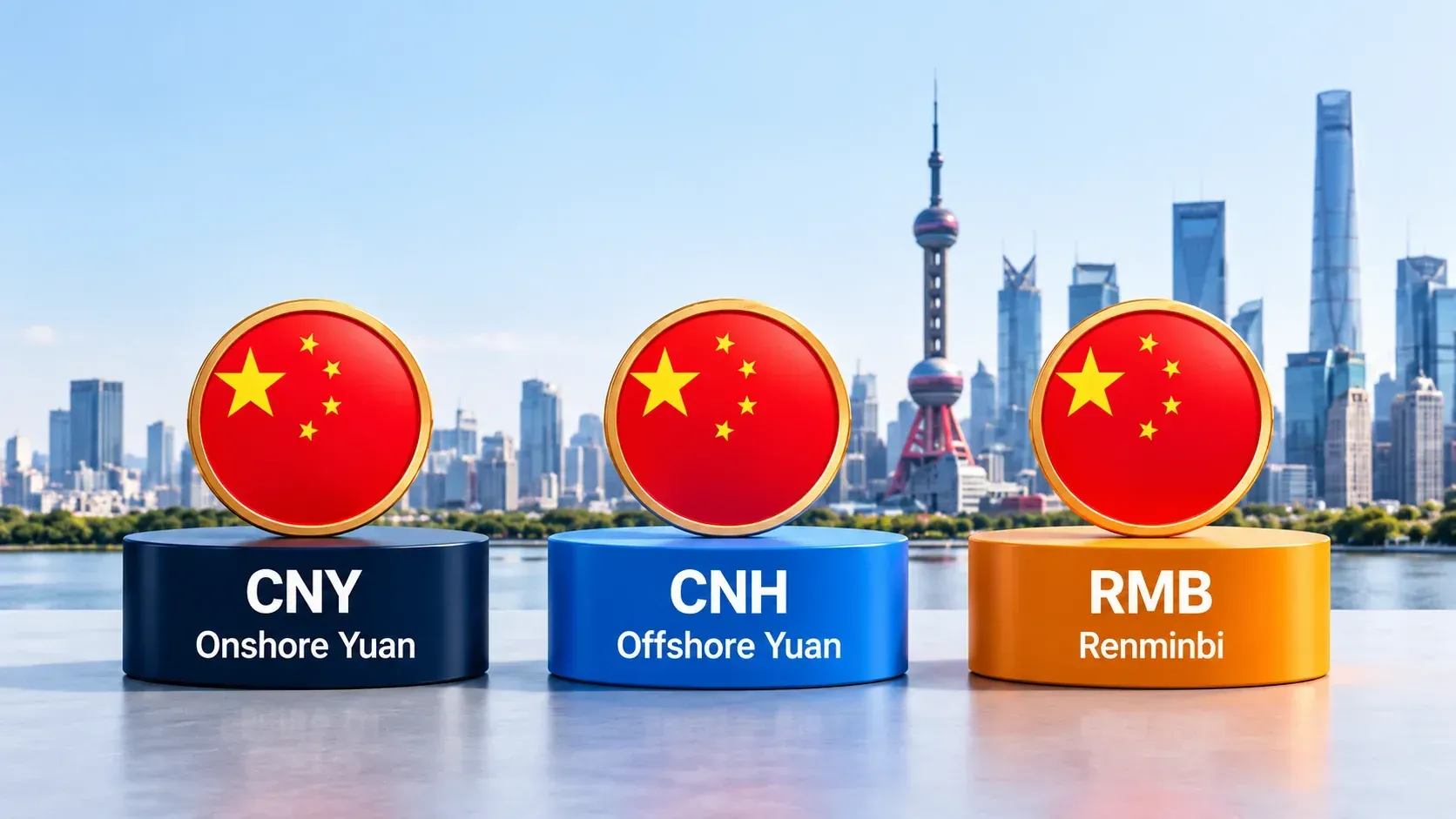
RMB is the common abbreviation for renminbi, China's currency, and yuan is its unit. CNY is the official currency code and identifies onshore yuan pricing in foreign exchange discussions. CNH identifies the offshore yuan market. CNY and CNH represent the same currency, but their exchange rates against Canadian dollars can differ.
That distinction becomes practical when a Chinese supplier invoices you in RMB, your FX quote refers to CNH and the transfer confirmation displays CNY. Those labels can be consistent. The question is how your Canadian dollars will be converted and how the supplier will receive the agreed amount.
For Canadian importers, manufacturers and purchasing teams, understanding the terminology helps turn an unclear payment request into clear instructions. This guide explains the differences and the checks to make before approving a yuan payment. MTFX helps Canadian businesses navigate CAD-to-yuan conversions and supplier payments with specialist FX support.
CNY vs CNH vs RMB: What is the difference?
Think of these terms as answering different questions: what is the currency called, how is the amount expressed and which market provides the exchange-rate quote?
CME Group's explanation of RMB, CNY and CNH confirms that CNY is used as the Swift currency code for both domestic and offshore renminbi. A CNY settlement label alone therefore does not establish which market supplied your conversion rate.
Yuan vs renminbi: The currency name and its unit
Renminbi and yuan describe the currency and its unit respectively. If a supplier asks for RMB 100,000, the amount is 100,000 yuan. You do not need to convert an RMB invoice into a different currency called yuan.
For an accounts payable team, consistent records matter more than the supplier's preferred wording. Keep the original invoice, record the agreed currency in your accounting system and avoid using an ambiguous currency symbol as the only identifier.
The practical issue with an invoice marked RMB is what it leaves unanswered. It does not identify the beneficiary's account currency, explain any bank deductions or confirm how an international payment should be routed. Obtain those details separately.
CNY vs CNH: How onshore and offshore yuan markets work
The onshore and offshore distinction concerns where renminbi is traded and the arrangements governing that activity. It does not mean China has two different kinds of money for buying the same goods.
CNY: Renminbi traded in the onshore market
In FX discussions, CNY generally identifies renminbi traded within mainland China's onshore market. That market operates within China's managed exchange-rate framework, with rules governing access and cross-border transactions.
However, being outside China does not automatically exclude a business from every arrangement involving onshore conversion. Eligible trade transactions can be served through authorised banking channels. The available route depends on the transaction and the institutions handling it.
CNH: Renminbi traded in offshore markets
CNH identifies renminbi traded outside mainland China, including offshore financial centres such as Hong Kong. Its pricing reflects offshore demand and liquidity, and can diverge from onshore pricing.
The BIS analysis of international currency trading explains how controls can fragment FX activity between onshore and offshore markets. For a Canadian buyer, this means the quote should be understood in the context of the actual payment arrangement.
Why CNY and CNH exchange rates can differ
CNY and CNH trade in markets with different participants, liquidity conditions and constraints. Demand can change faster in one market than the other, producing different prices against foreign currencies.
BIS research on the CNY–CNH pricing differential identifies liquidity differences and global risk appetite among the factors affecting that gap. Neither designation guarantees a better rate for every payment.
Does a better headline rate mean a cheaper payment?
Compare quotes for the same invoice amount, funding currency and delivery requirements, taken close together in time. A public market rate and a provider's executable quote serve different purposes.
Ask for three figures: the total CAD debit, the quoted renminbi amount and any charges that could reduce the recipient's credit. Also confirm the quote's expiry and estimated delivery date. A favourable rate loses its appeal if the payment leaves an unexpected invoice shortfall.
| Field | Value |
|---|---|
Amount Payable (CAD) 50,000 | |
Bank Exchange Rate 4.8108 / 0.2079 | |
Total cost 240,541.5CNY |
| Field | Value |
|---|---|
Amount Payable (CAD) 50,000 | |
MTFX Exchange Rate 4.7283 / 0.2115 | |
Total cost 236,414.56CNY |
You Save
CNY 4,126.94
with MTFX
16 October 2026
We use mid-market rates. This is for informational purposes only. Log in to view send rates.
Which currency code should appear on a Chinese supplier invoice?
The invoice should clearly identify the agreed currency and amount. CNY is the official code for renminbi, but suppliers may write RMB or yuan. If the wording is unclear, request written confirmation before converting funds.
- When the invoice says RMB
Confirm the exact amount due in yuan and request the beneficiary's payment instructions. Do not infer an onshore or offshore conversion route from the abbreviation alone.
- When the invoice says CNY
Check that your provider can deliver renminbi to the nominated account. The invoice code does not mean you must personally access the onshore FX market.
- When the invoice says CNH
Ask the supplier to clarify the intended account and payment arrangement. CNH is useful market terminology, but it is not an official ISO 4217 currency code. Swift's offshore CNY guidelines explain this distinction. Follow your provider's field instructions rather than manually replacing codes.
Before approval, check:
- The invoice currency, amount, reference and payment deadline.
- The beneficiary's legal name and its relationship to the invoicing supplier.
- The bank name, account number, account location and receiving currency.
- The bank-issued routing details required for the chosen payment route.
- The agreed treatment of payment charges and any invoice balance.
If bank details change, verify them through an established contact channel before updating the beneficiary. A familiar currency code does not authenticate a payment request.
Example: An RMB invoice and a CNH quote
A Canadian importer receives an invoice for RMB 250,000. The supplier provides instructions for its mainland renminbi account, while the payment provider quotes an offshore conversion. The importer should confirm that the proposed route can settle the invoice and ask how charges affect the credited amount.
If the final payment record displays CNY, the team should reconcile it against the agreed 250,000-yuan obligation and the provider's confirmation. The different labels are a reason to understand the records, rather than evidence that the supplier has been paid in a different currency.
Can a Canadian business use CNH to pay a supplier in mainland China?
Offshore renminbi can be used to fund payments to mainland Chinese beneficiaries through supported arrangements. Acceptance depends on the recipient account, payment purpose and requirements of the institutions involved.
For example, Currencycloud's CNH and CNY payment guidance describes an offshore-funded route where the beneficiary receives CNY. This illustrates how the market and settlement labels can differ; it does not establish that every provider offers the same route.
The HKMA's June 2025 guidance on trade-related CNY conversions also explains banks' due diligence and recordkeeping responsibilities. Supporting documents may be requested to establish the underlying trade.
Ask your provider to confirm eligibility before committing to a route. An offshore quote does not remove mainland receipt requirements, and instructions suitable for one supplier may not suit another.
How to convert Canadian dollars to yuan for a business payment
Start with the obligation you need to settle. If the supplier must receive 250,000 yuan, organise the conversion around that payable amount and the agreed charges. For broader payment preparation, see our guide to paying suppliers in China from Canada.
1. Confirm the invoice currency and amount
Check the invoice against the purchase order or contract. Resolve discrepancies before requesting a conversion. If the contract specifies USD, obtain the supplier's agreement before substituting a yuan payment.
2. Verify the beneficiary's bank instructions
Obtain current instructions through a verified channel. Confirm the receiving account's currency and check any difference between the account holder and the invoicing company.
3. Confirm the supported payment route
Give your provider the destination and transaction details. Ask which conversion and settlement arrangement applies, along with required information, cut-off times and estimated delivery.
4. Review the full CAD cost
Request a quote showing the exchange rate, conversion amount, fees and total Canadian-dollar funding requirement. Confirm how possible intermediary or receiving-bank charges will be handled.
5. Provide the requested documents
Have the invoice and relevant trade records ready. Answer payment-purpose questions accurately and resolve missing information before the deadline becomes urgent.
6. Approve and reconcile the payment
Review the beneficiary, currency and amount before authorisation. Retain the payment confirmation and verify receipt before marking the invoice fully settled. MTFX's international invoice payment services provide a starting point for discussing your business payment needs.
Get competitive FX rates on your international business payments.
What a yuan exchange-rate change could cost your business
Once an invoice is fixed in yuan, its Canadian-dollar cost can still change before payment. Suppose a Canadian manufacturer owes 500,000 yuan in 60 days.
These hypothetical rates illustrate a currency movement over time. They are not live quotes or an assumed CNY–CNH pricing difference. Fees are excluded.
The calculation is the yuan amount divided by the yuan received per Canadian dollar. At the lower rate, each CAD buys less yuan, increasing the invoice cost by CAD 2,040.82.
For recurring orders, record the budget rate alongside payment dates. CAD to CNY rate alerts can support monitoring, but an alert does not reserve a rate. If cost certainty matters, discuss available FX risk management services and their terms with your provider, including how a hedge would match the actual payment exposure.
If an order requires a deposit now and a balance before shipment, treat those as separate payment dates in your budget. Converting the deposit does not fix the CAD cost of the unpaid balance. Record the remaining yuan obligation so purchasing and finance teams can see the exposure still outstanding.


Confirm your yuan payment details with MTFX
A clear payment plan brings together the invoice, verified recipient instructions, an executable quote and a realistic delivery estimate. That gives your team a stronger basis for approval than a currency abbreviation or a public rate alone.
Before your next supplier payment, speak with MTFX about the amount due, destination account and payment date. Confirm the available route, documentation, pricing and funding requirements for your transaction.
For ongoing imports, explore MTFX's business global payment solutions and build those checks into your regular approval process. Also, sign up with MTFX to get your process started smoothly.
FAQs
1. Are CNY and CNH the same currency?
Yes. Both refer to renminbi, but they identify different FX markets. CNY generally denotes onshore pricing and CNH offshore pricing. Their exchange rates against foreign currencies can differ, so compare quotes for the payment route you will actually use.
2. Is RMB the same as CNY?
RMB is the common abbreviation for renminbi, while CNY is its official currency code. They refer to the same currency. An invoice using RMB still needs clear bank instructions and an agreed payment amount.
3. What is the difference between yuan and renminbi?
Renminbi is the currency's name; yuan is its unit. An amount of RMB 50,000 is 50,000 yuan. The terminology does not create an additional conversion between two currencies.
4. Is CNH an official ISO currency code?
No. CNH is an offshore market designation, rather than an ISO 4217 currency code. A provider may use CNH on its trading screen and CNY in settlement records. Confirm the platform's instructions before choosing a payment currency.
5. Why do CNY and CNH exchange rates differ?
The markets have different liquidity conditions, participants and constraints on fund movements. Those differences can produce separate FX prices. The gap is variable; neither market is consistently the cheaper option for every business transaction.
6. Why does my payment confirmation display CNY after a CNH quote?
The quote can describe offshore FX pricing while the confirmation uses the official settlement currency code. This can be consistent. Check the conversion confirmation, recipient amount and payment route with your provider if the records are unclear.
7. Can a Canadian business pay an invoice labelled RMB?
Yes, through a provider supporting the relevant renminbi payment arrangement. First confirm the yuan amount, beneficiary account eligibility and required instructions. The RMB label alone is not enough to authorise the transfer.
8. Can a mainland Chinese supplier receive an offshore renminbi payment?
Supported routes can deliver offshore-funded renminbi to mainland accounts. Acceptance depends on the account, payment purpose and bank or provider requirements. Confirm the supplier's receiving instructions and the route's eligibility before converting funds.
9. Is it cheaper to pay a Chinese supplier in USD or yuan?
Compare the supplier's agreed prices in each currency and the complete CAD cost of paying them. A yuan invoice is not automatically cheaper. Include conversion pricing, transfer charges and the terms the supplier offers for each option.
10. Do I need a Chinese bank account to pay a supplier from Canada?
Not necessarily. A provider supporting your transaction can arrange payment from Canada to the supplier's account. Confirm the funding method, beneficiary requirements and documents needed for your specific payment.