Treasury Dashboard and KPIs for Businesses Managing Multiple Currencies
A treasury dashboard tracks future payments and expected receipts across currencies. Key KPIs include funding shortfalls, forecast variance, overdue invoices and payment exceptions.
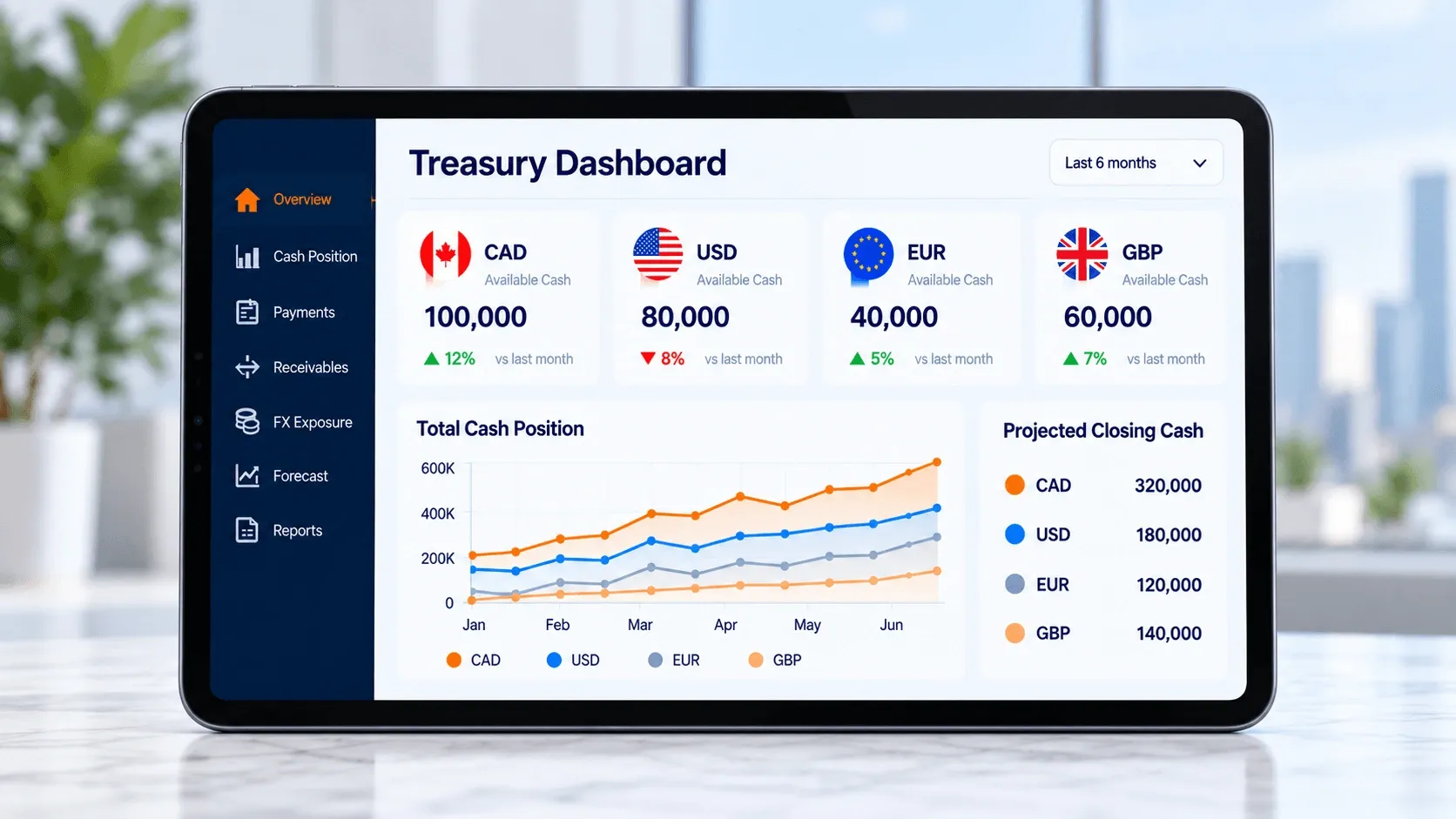
A treasury dashboard should show which payments are approaching and where a currency shortfall could develop. For Canadian businesses managing CAD alongside USD, EUR or GBP, useful reporting combines currency balances, payment status and clear treasury key performance indicators.
A consolidated Canadian-dollar total cannot answer every funding question. You may have enough money across the business but too few US dollars available before a supplier deadline. The report needs to show the amount, currency, timing and action required.
MTFX has helped clients move money globally since 1996. Its treasury solutions for international businesses cover multi-currency accounts, payments and FX management. This guide explains how to define a management dashboard using your business records and provider information, with practical metrics and an illustrative report.
What is a treasury dashboard?
A treasury dashboard is a summary of the cash, liquidity, currency exposure and payment information a business needs for financial decisions. It turns records from accounts, accounting systems and payment providers into a view of current resources and upcoming obligations.
Treasury reporting is the wider process behind it: collecting data, reconciling balances, applying definitions and explaining changes. A liquidity dashboard focuses specifically on the ability to meet obligations as they fall due.
A controlled spreadsheet can serve this purpose for a smaller business. As currencies, entities and payment volumes grow, assess when your business needs a dedicated treasury solution. Either approach depends on consistent inputs and someone responsible for resolving exceptions.
What should a multi-currency treasury dashboard show?
Organize the first page around decisions: what can be used today, what will be needed next and what requires intervention.
- Available cash: Cleared, usable balances by currency, account and legal entity, with restricted funds identified separately.
- Upcoming cash movements: Expected receipts and scheduled outflows over the next seven days, followed by weekly forecasts.
- Currency funding gaps: Projected balances below zero or below the business’s minimum operating buffer.
- Payment and collection exceptions: Approvals outstanding, transfers under investigation and overdue customer invoices.
- Reporting reliability: Data timestamps, missing accounts and unreconciled transactions.
Businesses using multi-currency accounts should retain the original currency balances alongside any CAD equivalent. Show legal entities separately before consolidation: cash belonging to one company may require approvals or other arrangements before another entity can use it.
Which treasury key performance indicators should you track?
Start with metrics that lead to a funding, collection or payment decision. Define the calculation, reporting horizon and responsible person before setting targets.
These frequencies, roles and triggers are suggested starting points; adapt them to your payment volumes, staffing and internal policies.
Measure forecast quality before changing the forecast
Save each forecast version before the period starts. Comparing actual cash flows with a forecast edited afterwards conceals the original planning error.
Suppose forecast USD receipts were $100,000 and actual receipts were $80,000. Receipt variance is −$20,000. Absolute forecast error, using the forecast as the denominator, is $20,000 ÷ $100,000 × 100 = 20%.
Assess receipts and payments separately because their errors can cancel in a net total. If the forecast amount is zero, report the dollar variance instead of dividing by zero. Explain if the difference came from timing, volume or exchange-rate assumptions.
Separate payment progress from payment completion
A payment awaiting approval differs from a submitted transfer awaiting confirmation. Keep approval queues separate from instructed pending payments, and define what each provider status means.
When reporting overseas invoice payments, retain the invoice reference, expected delivery date, current status and next action. An instruction marked as sent should not automatically be treated as confirmation that the supplier received funds.
Track overdue receipts without treating them as cash
Use ageing bands such as 1–30, 31–60 and more than 60 days overdue. Assign an owner and record a realistic collection date for significant invoices.
A global collections arrangement can support receiving international payments, but the forecast still needs a judgement about when each receipt will clear. Keep disputed invoices separate from confirmed customer payment commitments.
Example: a liquidity dashboard for a Canadian business
Consider a Canadian wholesaler holding CAD, USD and EUR. The following seven-day report is an illustrative management report, with amounts shown in each row’s currency.
The USD account needs $30,000 to avoid a negative closing balance, or $50,000 to preserve its $20,000 buffer. Those figures answer different questions and should be labelled clearly.
Using illustrative reporting rates of CAD 1.40 per USD and CAD 1.55 per EUR, opening cash totals CAD 274,000. That healthy-looking total hides the USD funding requirement.
Buying USD 50,000 would cost CAD 70,000 at the illustrative rate, before fees. Funding it entirely from CAD would turn the projected CAD closing balance from $50,000 to −$20,000. The team therefore needs a funding plan that tests both currencies together.
Once your forecast identifies a currency shortfall, check how much Canadian cash is needed to cover it. Compare exchange rates below to estimate the cost of funding an upcoming foreign-currency payment.
| Field | Value |
|---|---|
Amount Payable (USD) 50,000 | |
Bank Exchange Rate 1.4281 / 0.7002 | |
Total cost 71,406.63CAD |
| Field | Value |
|---|---|
Amount Payable (USD) 50,000 | |
MTFX Exchange Rate 1.4036 / 0.7124 | |
Total cost 70,181.52CAD |
You Save
CAD 1,225.11
with MTFX
24 October 2026
We use mid-market rates. This is for informational purposes only. Log in to view send rates.
How should treasury reporting handle exchange rates?
Use original currency amounts for funding decisions and a consistent reporting currency for consolidation. Record the rate source, timestamp and quotation direction so another person can reproduce the calculation.
Keep these three purposes clear:
- Budget rate: The planning assumption used to estimate future CAD costs or receipts.
- Reporting rate: The rate applied to consolidate balances for an internal management view.
- Transaction rate: The agreed rate used for an actual conversion, with charges recorded separately.
The Bank of Canada’s daily exchange rates are indicative averages, expressed as Canadian dollars per unit of foreign currency. They provide a reference, rather than a guaranteed transaction quote. Financial statement translation should follow your applicable accounting policies.
Separate currency translation movements from operational cash movements. A USD balance can rise in CAD value without a customer paying anything. Currency exchange charts provide market context; forecast variance should still explain what changed in the underlying cash flows.
Simplify global payments and reduce FX conversion costs.
Which foreign-currency obligations still need covering?
A currency exposure view brings upcoming foreign-currency payments together with expected receipts and existing FX contracts. Group these amounts by currency and settlement period so your team can identify what still needs covering. Keep the original currency amounts visible before translating them into Canadian dollars.
The net payment requirement is not the same as the funding shortfall: existing usable balances, operating buffers and transaction dates must also be considered. A receipt arriving after a supplier deadline cannot cover that earlier payment.
How to define your treasury dashboard requirements
Write a short reporting specification before choosing software or requesting a demonstration. It gives finance, operations and providers a shared definition of a usable report.
- List the decisions. Identify the questions the report must answer, including currency purchases, supplier funding, collection priorities and payment approvals.
- Set the scope. List entities, accounts and currencies. Define a reporting cutoff, time zone and forecast horizon. One practical starting point is daily detail for seven days and weekly detail for a rolling 13 weeks.
- Map the inputs. Identify balance records, accounts payable, receivables, payment statuses and booked FX transactions. Record the source, owner and expected update time.
- Define each metric. Document calculations, exclusions and status rules. Include FX contract settlement obligations on their relevant dates; a booked future currency purchase is not cash available today.
- Set action thresholds. Agree currency buffers, escalation deadlines and approval responsibilities. Base them on payment commitments and cash-flow volatility rather than a generic benchmark.
- Reconcile a pilot report. Compare it with source records. Test a delayed receipt, a failed transfer and a currency conversion before relying on the report for decisions.
If payment automation forms part of the workflow, confirm which references, statuses and exports are available for your setup. Establish how they will reach the management report and who will investigate missing information.
How often should you review treasury reports?
Match the review schedule to payment activity and the consequences of delay.
- Daily: Check usable balances, urgent payments, funding gaps and stale data before important cutoffs.
- Weekly: Refresh the rolling forecast, review overdue receipts and assign actions for emerging shortfalls.
- Monthly: Review forecast error, payment exceptions, conversion costs and recurring process delays.
A weekly treasury report should explain the largest changes since the previous version. For example, “USD receipts moved back one week after a customer revised its payment date” gives management a cause to address.
Each material exception needs an amount, currency, deadline, owner and next action. Record unresolved items in the next review so an acknowledged problem does not disappear between reporting cycles.
Treasury reporting mistakes that hide cash problems
Reconciliation and clear definitions prevent many misleading dashboard results. Check for these issues before acting on a reported surplus:
- Showing only a consolidated CAD total and missing a currency-specific shortage.
- Counting restricted funds or unconfirmed receipts as available cash.
- Deducting a payment twice when it already reduced the available balance.
- Counting an internal transfer as new cash at group level.
- Netting balances across entities without confirming funds can move between them.
- Reporting a favourable week-end balance without checking earlier payment dates.
- Using data without a timestamp or treating missing records as zero.
How MTFX supports multi-currency treasury decisions
MTFX supports the currency and payment activity behind treasury decisions. Established in 1996 and registered with FINTRAC as a money services business, we offer services Canadian businesses can assess against their reporting requirements.
- Multi-currency accounts for holding, sending and receiving foreign currencies.
- International payments for overseas suppliers and other business obligations.
- Global collections for international customer receipts.
- FX tools, including forward contracts, subject to agreed terms.
- Specialist support for planning currency conversions and payment timing.


Put your treasury dashboard to work
A well-built treasury dashboard helps your team spot currency shortfalls, follow up on overdue receipts and prepare for payments before deadlines become urgent. Keep the figures current, investigate significant changes and assign a clear owner to every action.
MTFX helps you act on those insights through business payment solutions for overseas supplier payments and currency conversions aligned with your cash-flow needs.
Sign up with MTFX to access competitive exchange rates, secure international transfers and specialist support for your business.
FAQs
1. What is the purpose of a treasury dashboard?
It helps businesses monitor cash, anticipate funding needs and manage payments. A useful dashboard connects balances and forecasts to specific actions and deadlines.
2. Which treasury KPIs should a small business start with?
Start with available cash by currency, projected balances, funding shortfalls, overdue receivables and pending payments. Add forecast variance and process metrics as reporting becomes more reliable.
3. What is the difference between cash and liquidity?
Cash is money held in accounts or on hand. Liquidity describes the ability to meet obligations when due, potentially including accessible funding beyond cash balances.
4. How do you calculate a currency funding shortfall?
Subtract the projected balance from the minimum required balance. If the result is positive, it is the funding requirement for that currency and date.
5. Should a treasury dashboard show every currency separately?
Show each currency with material balances or obligations separately. A consolidated reporting-currency total helps management compare positions but can conceal a local funding gap.
6. How is cash forecast variance calculated?
Subtract the original forecast cash flow from actual cash flow for the same period. Assess receipts and payments separately and explain the causes of significant differences.
7. Can Excel be used for treasury reporting?
Yes. A controlled spreadsheet can work when data volumes are manageable, inputs reconcile and access is restricted. Increasing complexity may justify dedicated reporting software.
8. What should a weekly treasury report include?
Include opening cash, expected receipts, scheduled payments, projected balances, currency shortfalls and major changes. Add an owner and deadline for each significant exception.