Supplier Payment Checklist for International Business Payments
A supplier payment checklist helps Canadian finance teams confirm invoice details, supplier bank information, payment currency, exchange rate, transfer fees, approval status, compliance checks, payment timing, and reconciliation records before sending money overseas. It helps reduce errors, avoid hidden FX costs, and keep international suppliers paid on time.
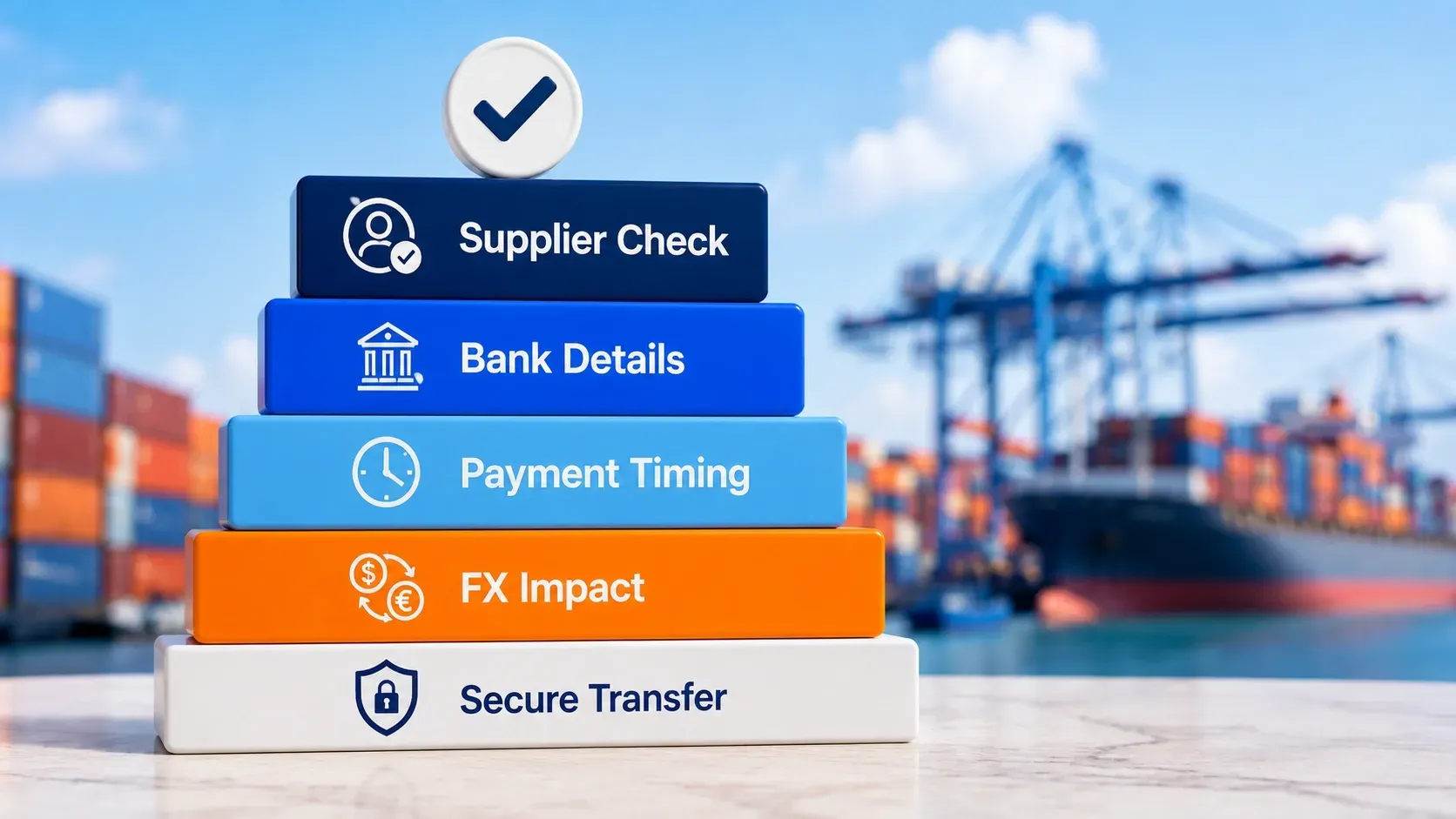
Canadian finance teams can reduce the cost and risk of paying overseas suppliers by using a clear checklist before every international payment. That means verifying the invoice, supplier bank details, payment currency, exchange rate, transfer fees, approval status, payment deadline, and reconciliation records before funds leave the business account.
International supplier payments affect more than accounts payable. A small mistake in a SWIFT code, beneficiary name, invoice currency, or exchange rate can cause payment delays, rejected transfers, unexpected fees, or supplier relationship issues. A repeatable process helps finance teams protect margins, improve cash flow visibility, and keep global vendors paid on time.
MTFX has been helping clients move money globally since 1996. Canadian businesses can use MTFX for secure international business payments, competitive exchange rates, paying international invoices, rate alerts, and specialist FX support when sending payments to overseas suppliers in multiple currencies.
What should businesses check before making international supplier payments?
Before paying an overseas supplier, finance teams should confirm the invoice amount, payment currency, supplier bank details, SWIFT/BIC or IBAN, payment reference, exchange rate, transfer fees, approval status, and expected delivery timeline.
They should also check for fraud red flags, such as sudden bank-detail changes, mismatched beneficiary names, unfamiliar payment instructions, or urgent payment pressure. Once the payment is sent, the team should save confirmation records and reconcile the payment against the supplier invoice.
Before paying overseas suppliers, it’s worth checking how the exchange rate and transfer costs affect the total amount your business pays in Canadian dollars. Comparing rates before sending funds can help finance teams reduce unnecessary FX costs and keep international supplier payments on budget.
| Field | Value |
|---|---|
Amount Payable (USD) 20,000 | |
Bank Exchange Rate 1.4270 / 0.7008 | |
Total cost 28,539.4CAD |
| Field | Value |
|---|---|
Amount Payable (USD) 20,000 | |
MTFX Exchange Rate 1.4025 / 0.7130 | |
Total cost 28,049.75CAD |
You Save
CAD 489.65
with MTFX
19 September 2026
We use mid-market rates. This is for informational purposes only. Log in to view send rates.
Why supplier payments need a stronger checklist
Paying an overseas supplier is not the same as paying a domestic vendor. International payments involve foreign exchange, cross-border banking details, country-specific payment requirements, possible intermediary bank charges, and different settlement timelines.
For Canadian businesses that import goods, pay global manufacturers, work with foreign distributors, or rely on international vendors, supplier payments can directly affect profit margins and cash flow. A stronger checklist helps finance teams avoid unnecessary costs and build a more reliable payment workflow.
A supplier payment checklist also supports better internal controls. When every payment follows the same review process, finance teams can reduce manual errors, improve approval visibility, and create a cleaner audit trail.
Supplier payment checklist for Canadian finance teams
Use this checklist before approving and sending international supplier payments:
- Confirm the supplier’s legal business name.
- Match the invoice number, purchase order, and payment terms.
- Confirm the invoice currency before converting CAD.
- Verify that the beneficiary name matches the supplier record.
- Confirm the supplier’s bank name and branch address.
- Check the account number, IBAN, SWIFT/BIC, routing code, sort code, or local bank code.
- Ask whether an intermediary bank is required.
- Review the exchange rate and total CAD cost.
- Check the transfer fee and possible third-party deductions.
- Confirm the payment deadline and supplier cutoff expectations.
- Get approval from the correct finance or management authority.
- Watch for sudden changes to supplier bank details.
- Save the payment confirmation.
- Reconcile the payment against the invoice and purchase order.
- Track recurring supplier payments for future budgeting.
For businesses sending regular international supplier payments, using a provider that supports global payments and business FX tools can help simplify the process and improve visibility across currencies.
What information do you need to pay an overseas supplier?
Finance teams should collect complete and accurate payment information before sending funds. Missing or incorrect details can delay the transfer or cause the payment to be returned.
If the supplier provides an IBAN or SWIFT code, finance teams should validate the format before sending funds. MTFX offers tools such as the IBAN checker and SWIFT/BIC code checker to help reduce avoidable payment errors.
Bank wire vs international payment provider for supplier payments
Many Canadian businesses still use traditional bank wires for overseas supplier payments. Banks are familiar and widely used, but they may not always offer the most efficient or cost-effective option for recurring business payments.
A specialist international payment provider can offer more competitive exchange rates, better payment visibility, and tools designed for businesses that regularly pay suppliers in foreign currencies.
For finance teams managing recurring vendor invoices, business money transfers through a specialist provider can help reduce manual effort and improve control over exchange rate costs.
Reduce FX costs and streamline international supplier payments with MTFX.
Common supplier payment risks finance teams should avoid
International supplier payments can go wrong when payment details are rushed, exchange rates are not reviewed, or internal approvals are skipped. Even small errors can lead to payment delays, extra fees, supplier disputes, or margin loss.
Common risks include:
- Paying in the wrong currency.
- Using outdated supplier bank details.
- Sending payment to a beneficiary name that does not match the invoice.
- Ignoring FX markup and focusing only on the transfer fee.
- Missing international payment cutoff times.
- Not accounting for intermediary bank charges.
- Sending funds without proper internal approval.
- Failing to verify sudden bank-detail changes.
- Not including the correct invoice or payment reference.
- Paying each invoice separately when batching could save time.
- Not saving proof of payment for reconciliation.
- Waiting until the due date and risking late supplier receipt.
A strong checklist helps finance teams catch these issues before payment is released.
How exchange rates affect supplier payment costs
Exchange rates can have a major impact on the total cost of paying overseas suppliers. If a Canadian business receives an invoice in USD, EUR, GBP, CNY, or another foreign currency, the final CAD cost depends on the exchange rate used at the time of payment.
Many businesses focus only on the visible transfer fee, but the FX markup can be a larger cost. The Bank of Canada daily exchange rates can help finance teams understand benchmark market movement, but businesses should compare the live rate available at the time they send payment.
Finance teams can use live exchange rates and currency rate alerts to monitor market movement before paying supplier invoices.
For larger or recurring supplier payments, finance teams may also need a broader FX risk management strategy to help protect margins when exchange rates move.
How to pay overseas suppliers step by step
A clear payment process helps finance teams reduce errors and keep supplier payments consistent.
- Review the supplier invoice and payment terms.
Check the invoice amount, currency, due date, purchase order, tax details, and payment instructions. - Confirm the supplier’s banking details.
Verify the beneficiary name, bank name, account number, IBAN, SWIFT/BIC, and any intermediary bank details. - Compare the exchange rate and total CAD cost.
Review the rate, FX markup, transfer fee, and any possible receiving or intermediary bank charges. - Get internal approval.
Make sure the payment is approved by the correct person based on your company’s payment limits and approval policy. - Send the payment through a secure provider.
Use a trusted international payment provider that supports business payments, payment tracking, and multi-currency transfers. - Track the transfer.
Monitor the payment status and confirm when the supplier receives the funds. - Save records and reconcile the invoice.
Keep the payment confirmation, exchange rate details, invoice, approval record, and reconciliation notes.
Businesses that manage multiple overseas supplier invoices may benefit from payment automation to reduce manual work and improve AP efficiency.
When should finance teams automate supplier payments?
Finance teams should consider automating supplier payments when they handle recurring invoices, high payment volumes, multiple currencies, or frequent payment approvals across departments.
Manual payment processes can work for occasional transfers, but they become harder to manage as supplier lists grow. Automation can help reduce repetitive data entry, improve approval visibility, and make reconciliation easier.
Automation may be useful when your business:
- Pays the same overseas suppliers every month.
- Handles large volumes of international invoices.
- Needs better visibility across currencies.
- Wants to reduce manual AP work.
- Has recurring vendor, distributor, contractor, or manufacturer payments.
- Needs stronger approval and reconciliation workflows.
- Wants to batch payments instead of sending them one by one.
For growing businesses, accounts payable automation can help create a more scalable supplier payment process.
How to manage supplier payment timing
Timing matters when paying overseas suppliers. International payments may take longer than domestic transfers, and the exact timeline can depend on the destination country, currency, payment rail, receiving bank, and intermediary banks.
Finance teams should avoid waiting until the due date to send international payments. Instead, build in enough time for processing, compliance checks, receiving bank review, and supplier allocation.
A practical timing checklist includes:
- Check the supplier’s due date.
- Review the payment provider’s cutoff time.
- Confirm the expected delivery timeline.
- Consider weekends and public holidays in both countries.
- Allow time for intermediary bank processing.
- Send urgent payments earlier in the day where possible.
- Confirm receipt with the supplier after payment.
Better timing helps protect supplier relationships and reduces the risk of late fees, production delays, or shipment holds.
How to reduce the cost of overseas supplier payments
Finance teams can reduce supplier payment costs by looking beyond the invoice amount. The true cost includes the exchange rate, FX markup, transfer fee, intermediary bank fee, receiving bank deductions, and the time spent managing the payment.
To reduce costs, Canadian businesses should:
- Compare exchange rates before sending payment.
- Avoid relying only on traditional bank wire rates.
- Pay suppliers in the invoice currency where appropriate.
- Use rate alerts for recurring foreign currency payments.
- Batch supplier payments when it makes sense.
- Review payment fees and intermediary charges.
- Use a multi-currency account for frequent global transactions.
- Plan larger payments instead of making rushed conversions.
- Work with a provider that understands business FX needs.
A multi-currency account can be useful for businesses that regularly send, receive, or hold funds in different currencies.
How SWIFT codes support international supplier payments
Many international supplier payments use SWIFT/BIC codes to help identify the receiving bank. SWIFT is a global financial messaging network used by financial institutions to exchange secure payment instructions across borders.
For finance teams, this means SWIFT details should be checked carefully before sending funds. An incorrect or outdated SWIFT/BIC code can lead to returned payments, processing delays, or additional bank charges.
Before approving a supplier payment, confirm that the SWIFT/BIC code, beneficiary name, and account details match the supplier’s invoice and bank confirmation. You can also use the MTFX SWIFT/BIC code checker to review bank code details before sending an international transfer.
How MTFX helps Canadian businesses pay overseas suppliers
MTFX helps Canadian businesses simplify overseas supplier payments with secure international transfers, competitive exchange rates, business payment tools, and specialist FX support. For finance teams managing supplier invoices, vendor payments, and recurring cross-border transactions, MTFX provides a practical alternative to relying only on traditional bank wires.
- Secure international supplier payments in multiple currencies.
- Competitive exchange rates for business transfers.
- Payment support for overseas invoices and vendor payments.
- FX tools such as live rates and rate alerts.
- Multi-currency payment solutions for global operations.
- Support for recurring and high-value business payments.
- Canadian-based service with experience in global money movement since 1996.
Canadian finance teams can use MTFX to streamline paying international invoices while improving visibility over exchange rates, transfer costs, and supplier payment workflows.
Build a smarter supplier payment process with MTFX
A strong supplier payment process helps finance teams protect margins, improve cash flow control, and keep overseas vendors paid on time. The most effective approach is simple: verify every invoice, confirm bank details, compare exchange rates, approve payments properly, and keep clean reconciliation records.
For Canadian businesses that regularly pay overseas suppliers, the right payment workflow can reduce delays, avoid unnecessary FX costs, and support stronger supplier relationships. A checklist gives finance teams a repeatable process they can use before every international payment.
Sign up with MTFX to streamline international supplier payments with competitive exchange rates, secure cross-border transfers, multi-currency payment solutions, and specialist support for paying suppliers, vendors, contractors, and global business partners.


FAQs
1. What is a supplier payment checklist?
A supplier payment checklist is a step-by-step review process finance teams use before paying vendors. It helps confirm invoice details, bank information, payment currency, approval status, exchange rate, fees, and reconciliation records.
2. What details are needed to pay an overseas supplier?
You usually need the supplier’s legal name, invoice number, payment amount, currency, bank name, account number or IBAN, SWIFT/BIC code, bank address, and payment reference.
3. What is the best way to pay overseas suppliers from Canada?
The best way is to use a secure international payment provider that offers competitive exchange rates, transparent fees, payment tracking, and support for business supplier payments.
4. How can finance teams reduce supplier payment costs?
Finance teams can reduce costs by comparing exchange rates, checking FX markup, reviewing transfer fees, batching payments, using rate alerts, and avoiding unnecessary intermediary deductions where possible.
5. Are exchange rates important when paying international suppliers?
Yes. Exchange rates directly affect the total CAD cost of foreign supplier invoices. Even a small rate difference can significantly affect margins on large or recurring payments.
6. What is a SWIFT code in supplier payments?
A SWIFT code, also called a BIC, identifies a bank in an international payment. It helps route funds to the correct financial institution when sending money overseas.
7. Do overseas supplier payments have hidden fees?
They can. Costs may include FX markup, transfer fees, intermediary bank fees, and receiving bank deductions. Finance teams should compare the total cost before sending payment.
8. How can finance teams avoid supplier payment errors?
Finance teams can avoid errors by verifying invoice details, confirming supplier bank information, checking payment currency, reviewing approvals, validating SWIFT or IBAN details, and saving proof of payment.
9. Can supplier payments be automated?
Yes. Recurring supplier payments, high-volume invoices, and multi-currency AP workflows can often be automated to reduce manual work, improve approval visibility, and support faster reconciliation.
10. Why use MTFX for overseas supplier payments?
MTFX helps Canadian businesses send secure international supplier payments with competitive exchange rates, global payment support, rate tools, and specialist FX guidance for business transfers.