Moving to the UK from Canada: Costs, Banking and Money Transfers
Your UK relocation budget should account for upfront expenses, refundable deposits and ongoing bills, with any required proof-of-funds balance tracked separately. Confirm your receiving account and payment routes, then calculate the total CAD needed to cover each GBP commitment.

Moving to the UK from Canada means preparing for relocation expenses, initial housing payments and the bills that fall due before your UK income begins. Start by listing those commitments in GBP, identifying the Canadian funds available to cover them and calculating the CAD cost of getting the required pounds to each recipient.
Whether you are moving for work, joining family or studying abroad, a clear funding plan helps you avoid last-minute payment problems. Arranging how you will send money to the UK from Canada is part of that preparation, alongside opening a bank account and confirming your payment deadlines.
What financial arrangements should you make before moving to the UK from Canada?
Your first arrangements should establish how money will move between your accounts, which expenses you must cover and when those funds need to be available.
Connect your UK bank account to the Canadian bank account
Set up a reliable transfer route between the Canadian account holding your funds and the UK account you will use after arrival. Through MTFX, for example, you can arrange CAD to GBP transfers funded from your Canadian account and designate your UK account as the recipient.
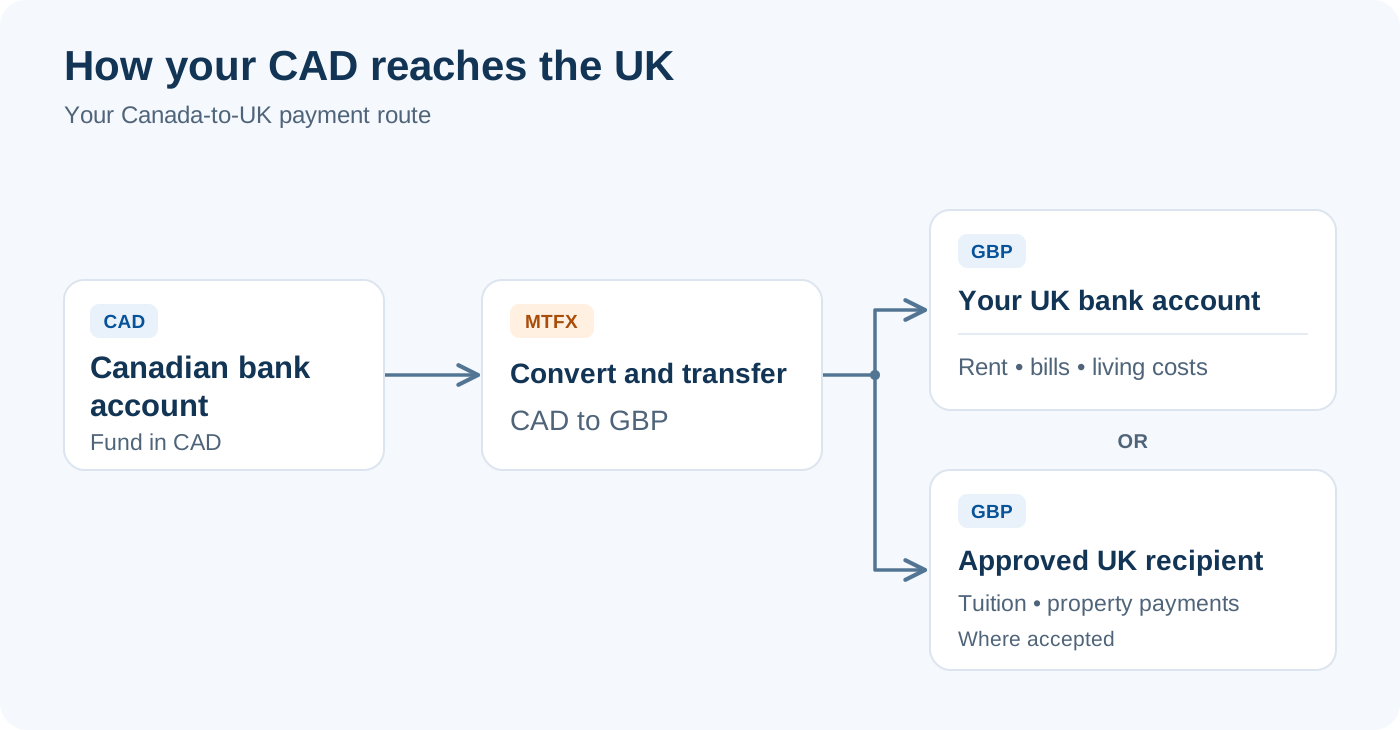
This connection is a transfer arrangement between accounts, rather than a shared balance or automatic link between banks. Once your UK account is open, confirm its receiving instructions, complete the transfer-provider setup and check your Canadian bank's funding limits. Also make sure you can access online banking and receive authentication codes after changing your phone number.
If you are still arranging the UK account, prepare your Canadian funding access first and add the receiving details once the bank confirms them.
Set aside funds for moving and settling in
Your savings need to cover the move itself and your expenses before your first UK salary arrives. List the costs payable before departure, then reserve enough for rent, deposits and everyday spending after arrival. Record each payment’s amount, currency and due date.
Example: You have CAD $20,000 saved for your relocation and pay CAD $3,000 for flights and shipping. That leaves CAD $17,000 for your remaining commitments. Use this balance to plan your GBP funding, allowing for applicable transfer charges and a buffer for unexpected expenses.
Match Canadian funds to UK payment dates
Identify which savings or income will cover each commitment. Keep money for outstanding Canadian rent, mortgage payments, insurance or other bills separate from your UK arrival budget.
Your payment calendar should show:
- Expense and currency: What you owe and whether the invoice is in CAD or GBP.
- Recipient and reference: Who receives the payment and how it will be identified.
- Due date: When the recipient needs cleared funds.
- Funding source: Which account or confirmed income will cover it.
- Status: Whether the payment is planned, sent or received.
Update your Canadian bank with your address and circumstances. If you become a non-resident of Canada, the CRA requires you to notify Canadian financial institutions and Canadian payers.
How much does moving to the UK from Canada cost?
There is no single relocation budget that fits every Canadian. Your funding requirement depends on housing, household size, applicable application charges, travel arrangements and how long you must support yourself before dependable income begins.
Budget for departure and arrival
Divide your budget into three groups:
- Before departure: Applicable visa charges, healthcare surcharge, travel, shipping and temporary accommodation bookings.
- On arrival: Initial rent, tenancy deposit, household setup and living expenses before income arrives.
- Ongoing: Rent, household bills, transport, education and commitments you continue funding from Canada.
Application costs depend on your immigration route. For example, the Youth Mobility Scheme currently lists a £340 application fee and a £2,530 savings requirement. The savings requirement is money you must demonstrate, not a fee paid to the government.
Where payable, the immigration health surcharge is £776 annually for students and Youth Mobility applicants, and £1,035 annually for most other applicants. The amount depends on visa duration and circumstances.
The surcharge must be paid by debit or credit card. Budget for those card-paid costs separately from bank transfers.
Build your arrival budget around your accommodation
Housing can change the calculation substantially. ONS reported average monthly private rent of £1,459 in England and £2,332 in London in August 2026. These figures cover the rental stock across different property sizes; they are context, not quotes for a particular home.
Using the England benchmark, the following illustrates part of an arrival budget at an assumed exchange rate of GBP 1 = CAD 1.90:
The ONS rental figures provide the rent benchmark. The reserve is an illustrative allowance. Add your actual travel, temporary accommodation, shipping, application charges and any other commitments, plus applicable conversion and payment costs.
A CAD to GBP converter can help you estimate your budget. Displayed market rates are indicative; use your quoted customer rate when calculating the amount needed to book a conversion.
| Field | Value |
|---|---|
Amount Payable (GBP) 20,000 | |
Bank Exchange Rate 1.9143 / 0.5224 | |
Total cost 38,285.09CAD |
| Field | Value |
|---|---|
Amount Payable (GBP) 20,000 | |
MTFX Exchange Rate 1.8814 / 0.5315 | |
Total cost 37,628.24CAD |
You Save
CAD 656.85
with MTFX
19 October 2026
We use mid-market rates. This is for informational purposes only. Log in to view send rates.
Plan your spending before your first paycheque
Confirm your first payroll date and whether it covers a full or partial pay period. Starting work early in a month does not necessarily mean receiving a full month's salary immediately.
Add up the expenses due before that payment, subtract funds already available in GBP and confirmed payments your employer will make directly, then allow for identified uncertainties. Include overlapping Canadian bills and deposits that may not be returned before you leave.
What day-to-day expenses should you budget for when you first arrive in the UK?
Your first few weeks can involve more spending than an ordinary month. Alongside rent and deposits, prepare for groceries, local travel, household essentials and the bills that begin when you take responsibility for your home.
Set aside money for utilities and local charges
Check whether your rent includes electricity, gas, water or council tax. If you pay separately, contact the relevant suppliers when you move in, record opening meter readings where applicable and confirm when the first payments are due. Useful benchmarks include:
- Energy: Ofgem's October–December 2026 illustration is £1,723 annualized for a typical dual-fuel household paying by Direct Debit, equivalent to about £143.58 a month. The energy price cap limits rates and standing charges, not your total bill.
- Council tax: England's average Band D charge is £2,392 for 2026–27, equivalent to about £199.33 a month for budgeting. Your actual council tax bill depends on your council, property band, discounts and instalment arrangement.
- Water: Confirm whether it is included in rent or collected through another arrangement before adding a separate allowance.
These are reference figures, not a combined quote for your home. Keep funds available even if the first bill arrives after you have moved in.
Plan for local transport and your first commute
Allow for travel to work, property viewings, shops and appointments while you establish your routine. Your accommodation's location and the number of days you commute will affect whether individual fares or a travel pass suit you.
For example, London's 2026 adult pay-as-you-go cap for travel within Zones 1–2 is £8.90 daily or £44.70 over a Monday-to-Sunday week. Follow the fare-capping rules, including using the same card or device. Other zones, excluded services and other cities have different fares.
Separate groceries from household setup purchases
Your first supermarket trip may include items you will not buy every week: cleaning products, toiletries, bedding, kitchen supplies and food staples. Set aside a one-time setup allowance as well as a weekly grocery budget.
Check what your accommodation already provides before buying larger items. Temporary accommodation may also leave you relying on more expensive meals until you have access to a suitable kitchen.
Prepare for mobile and internet costs
Budget for a UK mobile plan and any broadband activation, equipment or installation charges that apply. Confirm whether internet is included in your accommodation and whether you need a temporary option before a home connection becomes available. Check contract length, the initial payment and later collection dates so these costs fit your arrival funding plan.
Keep your arrival spending money available in GBP
Add these expenses to your living-expense reserve, keeping them separate from money committed to rent, tuition or a property payment. If the reserve already includes them, do not add the same costs again elsewhere.
Fund your UK account before the payments are needed, allowing for Canadian funding and transfer processing. After the first few weeks, use your actual spending and bills to refine the amount you continue transferring from Canada.
Which rental payments should you prepare before arriving in the UK?
Rental funding usually involves separate payments for reserving accommodation, securing the tenancy and paying rent. Their treatment depends on the location and type of agreement.
Distinguish rent from deposits
A holding deposit reserves a property while checks take place. A tenancy deposit provides security against matters such as damage or unpaid rent. Rent pays for your accommodation.
For covered tenancies in England, current government guidance on permitted payments states that rent cannot be accepted before the agreement is signed. After signing, a landlord can request up to one month's rent before the tenancy starts. Do not assume older advice about paying many months upfront still applies.
If a holding deposit is credited towards initial rent or the tenancy deposit, subtract that credit from the later payment.
Check the rules where you will live
Separate guidance is available for Scotland, Wales and Northern Ireland. Confirm which rules cover your accommodation before making a payment.
Verify the recipient and retain the evidence
Check the landlord or agent's identity, property address and payment instructions against the agreement. If bank details change, verify them through an independently obtained contact number before sending funds.
Keep the signed agreement, payment reference, transfer confirmation and deposit-protection information together. These records help you reconcile what you have paid and resolve questions later.
Can you open and fund a UK bank account from Canada?
Some banks offer applications from outside the UK, but eligibility, documentation and available features depend on the bank and account. Confirm approval and receiving instructions before sending money.
Check the account requirements before applying
Ask whether you can apply using your Canadian address, whether you need to attend a branch and what evidence of identity, address or immigration status is accepted. Some pre-arrival application routes exist, but that does not make every account available to every applicant.
Also check account charges, minimum funding conditions and when you can start receiving payments. An application submitted is not the same as an account ready to use.
Confirm the receiving details and everyday facilities
Obtain the bank-confirmed beneficiary name and receiving instructions. UK domestic payments commonly use a sort code and account number, while an international route may require an IBAN and SWIFT/BIC. Follow the instructions for the route your provider will use.
Before relying on the account for your move, check that it supports:
- Incoming GBP payments from your chosen transfer route.
- Salary receipts from your employer.
- Standing orders for regular fixed payments.
- Direct Debits for approved bill collections.
- Online access using your current contact details.
How should you convert CAD to GBP for your relocation payments?
Compare the total CAD required to deliver the GBP you need, then choose a payment arrangement that fits the recipient and deadline. A low advertised transfer fee alone does not establish the lowest overall cost.
Compare banks and online transfer providers
Compare equivalent quotes obtained close together. For a landlord invoice, ask what it costs to deliver the full amount due; for your own account, check how much GBP should arrive after applicable deductions.
Decide where the pounds need to go
Funding your UK account can make sense when several household bills will be paid locally. A tuition invoice or property payment may instead require funds to reach a designated recipient through an approved route.
Choose based on the payment instructions, identification requirements and cost of any additional payment stage. Sending everything through your own account is not automatically necessary, and direct payment is not accepted in every situation.
Understand the effect of exchange rate changes
Example: You need £20,000 for confirmed relocation and education commitments. At GBP 1 = CAD 1.85, the currency cost is CAD $37,000. At CAD 1.90, it becomes $38,000: an extra $1,000 before charges.
A CAD to GBP chart helps you see how the exchange relationship has moved. For expenses with flexible timing, currency rate alerts can notify you when a selected market level is reached. Your payment deadline should still guide the decision.
Compare FX rates and save on CAD to GBP conversions.
Allow time for the complete payment journey
Your Canadian bank must release the funds, your provider must complete the required checks and conversion, and the UK payment must reach the recipient. A university or conveyancer may then need time to allocate it.
UK payout methods have their own timings:
- Bacs: A three-working-day processing cycle.
- Faster Payments: Usually available almost immediately, although delays can occur.
These describe UK payment systems, not a guaranteed end-to-end Canada-to-UK delivery time.
Compare your CAD to GBP quote before committing funds, and confirm the expected delivery date for the payment you are making.
How do you organize your relocation payments from Canada?
Use a consistent process for each commitment so that you can see what remains to be funded and what has actually been paid.
- List the amount and deadline. Start with the signed agreement or current invoice. Record when cleared funds are required, rather than assuming the invoice date is the payment deadline.
- Verify the recipient and payment route. Check beneficiary details, accepted payer arrangements and the reference. Confirm any changed instructions independently.
- Calculate the CAD requirement. Use the customer exchange rate and applicable charges. Keep your household reserve separate from money committed to a particular invoice.
- Book and fund with time to spare. Follow the provider's funding instructions and account for your Canadian bank's limits, cutoffs and processing time.
- Confirm receipt and allocation. Retain the transfer record and check that the recipient has applied the payment to the correct tenancy, student account or property matter.
Which monthly UK expenses may need funding from Canada?
Your ongoing funding requirement is the difference between your UK commitments and the dependable GBP income available to meet them. It may change significantly after the first few months.
Turn your arrival budget into a monthly funding amount
Once you have settled in, replace initial allowances with your actual bills and spending. Record the amount, collection date and funding source for each commitment, then separate:
- Fixed payments: Regular amounts such as rent or a contracted service.
- Variable spending: Costs that change with usage or household needs.
- Less frequent bills: Annual or term-based commitments that require money to be set aside.
- Available UK income: The dependable GBP income that reduces what you need to transfer from Canada.
This gives you an ongoing funding amount based on your circumstances, rather than continuing to transfer the same arrival allowance every month.
Align funding with collections and income
If bills are collected early in the month, have sufficient GBP available beforehand. Moving money on the rent due date leaves little room for funding or processing delays.
When managing regular transfers while living abroad, review the required amount as UK income begins and expenses settle. Canadian pensions, investment proceeds or other income should be budgeted using the amount actually available after applicable deductions.
A monthly Canadian dollar outlook can provide context for upcoming conversions. Use it alongside your payment calendar, rather than treating an expected currency move as money already saved.
How should Canadians plan UK education payments?
Build your budget from the school’s fee schedule or university offer. Separate tuition from accommodation and other expenses, and record each payment’s amount, due date and required reference.
Budget for fees, deposits and living costs
For children attending state-funded schools, confirm admission requirements with the relevant authority. Where applicable, budget for:
- Registration, acceptance and tuition charges.
- Boarding or university accommodation.
- Uniforms, meals, transport and activities.
- Deposits and their refund conditions.
Check whether private-school published fees include VAT. The cost of studying in the UK as a Canadian also includes living expenses beyond tuition.
Avoid counting a credited deposit twice. For example: If £18,000 tuition includes a £3,000 acceptance deposit, paying the deposit leaves £15,000 outstanding.
Follow the institution’s payment instructions
Confirm the institution’s approved payment options and whether it accepts your proposed payer and transfer arrangement. Tuition and accommodation may require separate payments or references.
Include the pupil or student ID and invoice reference where requested. Keep invoices, transfer confirmations and receipts together, and check that each payment has been credited to the correct account.
How can Canadians fund a UK property purchase?
When buying UK property from Canada, start with the GBP amounts and payment dates supplied by your conveyancer. Use these to work out how much CAD you need and when to arrange each transfer.
Calculate the CAD needed for each payment
Get a conversion quote for the deposit, remaining purchase balance and any other confirmed amounts. Check the total CAD cost, applicable transfer charges and the GBP amount that will reach the recipient.
Example: At an illustrative rate of CAD $1.85 per pound, a £50,000 payment requires CAD $92,500 before fees. Your actual CAD requirement depends on the rate available when you book.
Arrange the transfer around the payment deadline
Confirm whether your conveyancer accepts payment directly from your FX provider or requires another arrangement. Before sending, check:
- The recipient’s independently verified bank details.
- The payment reference needed to identify your purchase.
- The date the full GBP amount must arrive as cleared funds.
Allow time for Canadian funding, conversion and delivery. Keep your transfer confirmation and ask your conveyancer to confirm receipt so you know the payment is ready for the purchase.
How can MTFX support your UK relocation payments?
MTFX helps Canadians convert CAD to GBP and arrange transfers for UK commitments, including personal account funding, education and property-related payments where the receiving arrangements are supported.
Match the transfer to your actual commitment
An FX specialist can help you review the amount, funding method and expected transfer timing. Explain whether the money is going to your own account or an approved third-party recipient, and provide the payment reference and deadline.
For larger commitments, discuss the arrangements before the due date approaches. Verification and supporting documents are easier to prepare when you have the relevant invoices and funding records available.
Review the quote before booking
MTFX is a Canadian foreign exchange and payment provider registered with FINTRAC. Before confirming a transfer, review:
- Customer exchange rate for the conversion.
- Total Canadian funding amount.
- Applicable fees and possible deductions.
- Expected GBP payment amount.
- Estimated delivery and recipient details.
Plan your UK relocation payments around the amounts and dates you have confirmed, with support for the conversion and transfer arrangements.
What belongs on your moving to the UK from Canada financial checklist?
Use this checklist to keep preparation, payment and follow-up connected.
Before departure
- Confirm employer-paid expenses and reimbursement dates.
- Prepare Canadian online banking access and authentication.
- Confirm UK account eligibility and receiving instructions.
- Calculate application, relocation and initial housing costs.
- Retain any funds needed for financial-evidence requirements.
- Identify the gap before your first dependable UK income.
Before each payment
- Verify the recipient, instructions and reference.
- Confirm the accepted payment route.
- Review the customer rate and total CAD requirement.
- Allow time for funding, processing and allocation.
- Save the invoice and transfer confirmation.
After arrival
- Check that payments have been received and allocated.
- Confirm deposit records and upcoming bill collections.
- Update address and residency information where required.
- Revise Canadian funding as UK income and expenses become clearer.


Give your UK move a funded starting point
A well-prepared move begins with knowing which expenses are due, who receives the money and how much CAD you need to meet them. Putting those details into one calendar makes it easier to manage the transition from Canadian savings to everyday life in pounds.
Start with confirmed commitments, keep a realistic reserve and arrange your transfer route before an urgent invoice arrives. With your accounts, documents and payment dates in place, you can make currency decisions around your move rather than around the pressure of the next deadline.
Set up your personal MTFX account in minutes and start funding your move to the UK at the best CAD to GBP exchange rates with fast and secure money transfers.
FAQs about moving to the UK from Canada
1. How much money should I prepare before moving to the UK from Canada?
Prepare enough for your applicable departure costs, initial housing payments and expenses before dependable income begins. Add continuing Canadian commitments and an allowance for identified uncertainties. Your own invoices and accommodation arrangements provide a more useful total than a universal relocation estimate.
2. Is proof of funds the same as my relocation budget?
No. Proof of funds is evidence that you meet a particular financial requirement, while your relocation budget covers actual expenses. Required savings are not a government fee. Preserve the balance and evidence for the period required by your application rules.
3. Can I open a UK bank account before leaving Canada?
Some banks accept applications from outside the UK, subject to their eligibility and documentation requirements. Confirm whether you can apply from Canada, which documents are accepted and when the account can receive funds.
4. How much should I prepare for rent and a tenancy deposit?
Use the rent in your agreement and the deposit rules for your location and accommodation type. In England, covered tenancies with annual rent below £50,000 generally have a five-week tenancy-deposit cap. Initial rent and a holding deposit are separate items, with credits accounted for.
5. Should I convert CAD to GBP before moving?
Convert according to confirmed payment needs and when your receiving arrangements are ready. Having GBP available for initial commitments can reduce last-minute pressure. Future expenses can be reviewed separately, based on deadlines, available funds and the customer rates offered.
6. Can I pay a UK landlord directly from Canada?
You may be able to if the landlord accepts the payment route and your provider supports the recipient. Verify the tenancy and bank details, include the required reference and confirm how much GBP needs to arrive.
7. How far ahead should I arrange UK relocation payments?
Work backwards from the date the recipient needs cleared funds. Include Canadian funding time, verification, conversion, payout processing and any allocation period. Obtain an estimate for your specific payment rather than relying solely on a UK domestic payment-system timeframe.
8. Can I fund UK household bills from my Canadian bank account?
You can arrange transfers from Canadian funds to your UK account and pay household bills using the local account's supported facilities. Confirm the provider's service availability for your circumstances and have sufficient GBP available before scheduled collections.
9. Can I pay UK tuition or property expenses through a transfer provider?
Often, but the university or conveyancer must accept the proposed route and payer arrangement. Confirm instructions, references, documentation and deadlines before converting. Some payments must use a designated portal or other specified method.
10. What financial documents should I keep when moving to the UK?
Keep account instructions, tenancy agreements, education invoices, property statements, source-of-funds documents, employer reimbursement terms, conversion records and transfer receipts. Organize them by expense so you can connect each Canadian funding amount to its UK payment and confirmation.
Disclaimer: This article provides general information and does not constitute financial, tax, legal or immigration advice. Costs, regulations, banking requirements and exchange rates can change. Budget examples are illustrative, and actual expenses depend on your circumstances. Confirm current requirements with the relevant authorities, banks and recipients. Transfer availability, customer rates, fees and delivery times depend on the transaction and applicable verification requirements.