How to Import Cars from Japan to Canada: JPY Payments and Final Settlement
Planning to buy a JDM car from Japan? Understand how auction deposits, exporter payments, CAD to JPY exchange rates and shipping costs fit into the import process, from placing your first bid to receiving your car in Canada.
Importing a car from Japan to Canada involves more than finding the right vehicle and arranging shipping. Canadian buyers need to confirm that the car meets import requirements, work with a Japanese exporter or auction agent, pay the required deposits and settle the purchase before shipment.
If you're planning to import cars from Japan to Canada, understanding when payments are due is just as important as knowing the import process. Japanese car auction deposits, exporter invoices, CAD to JPY exchange rates and shipping costs can all affect your budget. This guide explains each stage, with practical examples to help you manage your purchase from the first bid to final settlement.
Can Canadians import cars from Japan?
Yes, Canadians can import cars from Japan, provided the vehicles meet federal import requirements and applicable provincial rules. For many JDM buyers, the most important consideration is the vehicle's age.
Under Canada's federal rules, vehicles that are 15 years old or older, based on their manufacture date, are generally exempt from the Motor Vehicle Safety Act's import requirements. However, they must still satisfy Canada Border Services Agency (CBSA) entry requirements.
According to Transport Canada's older-vehicle import rules, the actual month and year of manufacture determine a vehicle's age, not simply its model year.
Can you register a right-hand-drive Japanese car in Canada?
A Japanese vehicle that qualifies for federal importation is not automatically eligible for registration in every province.
For example, Quebec generally prohibits right-hand-drive vehicles built less than 25 years ago from being operated on public roads, subject to certain exceptions. The province outlines these restrictions in its right-hand-drive vehicle regulations.
Before buying a Japanese import car, confirm its manufacture date, registration eligibility, insurance availability and inspection requirements in your province.
How do you import a car from Japan to Canada?
To import a car from Japan to Canada, you'll need to find an eligible vehicle, arrange the purchase through an exporter or auction agent, complete the required payments and organize shipping and Canadian customs clearance.
Here's how the process generally works.
1. Check the vehicle's import eligibility
Start by confirming that the vehicle meets Canadian import requirements. Check its manufacture date, chassis number, condition and any modifications that could affect admissibility or provincial registration.
2. Choose a Japanese exporter or auction agent
You can buy a vehicle from an exporter with available inventory or use an auction agent to bid at a Japan car auction.
An auction agent generally helps you access auction listings, review inspection reports, place bids and arrange export documentation. Ask for a written breakdown of fees and services before committing.
3. Select your vehicle and pay the auction deposit
If you're purchasing through an auction, your agent may require a deposit before accepting your bidding instructions.
The deposit amount and refund conditions depend on the provider. Confirm whether it will be credited toward the vehicle purchase and what happens if you don't win.
4. Win the auction and settle the invoice
Once your bid succeeds, the agent or exporter will normally issue an invoice showing the purchase price, applicable fees and remaining payment.
Review the amount, settlement currency and deadline before arranging the transfer.
| Field | Value |
|---|---|
Amount Payable (CAD) 35,000 | |
Bank Exchange Rate 113.43 / 0.0088 | |
Total cost 3,969,982.8JPY |
| Field | Value |
|---|---|
Amount Payable (CAD) 35,000 | |
MTFX Exchange Rate 111.48 / 0.0090 | |
Total cost 3,901,870.35JPY |
You Save
JPY 68,112.45
with MTFX
14 October 2026
We use mid-market rates. This is for informational purposes only. Log in to view send rates.
5. Arrange shipping from Japan
After the required payment conditions are satisfied, the exporter can organize the vehicle's transportation to a Japanese port and arrange ocean shipping.
You'll generally need documents such as the commercial invoice, export certificate and bill of lading for the import and clearance process.
6. Clear customs and register the vehicle in Canada
When the car arrives, you'll need to complete customs clearance, pay applicable import charges and meet provincial inspection and registration requirements.
The CBSA may also inspect the vehicle's condition and cleanliness. Imported used vehicles must be free of soil and other prohibited contamination.
How do Japanese car auction deposits work?
A Japanese car auction deposit is an upfront payment that some auction agents require before they will bid on a vehicle for you. It helps establish your purchasing commitment and may also determine how much you're allowed to bid.
Unlike buying a car from a Canadian dealership, you might need to transfer funds before knowing whether you've successfully purchased the vehicle.
How much is a Japanese car auction deposit?
There is no single deposit amount that applies to every Japanese auction agent. Some require a fixed amount, while others base the deposit on your maximum bid.
Example: Suppose an auction agent asks for a ¥100,000 deposit before you can bid. If you win a vehicle for ¥1,800,000 and the agent credits your deposit toward the purchase, you've already paid ¥100,000 of the amount owed.
Your remaining balance will depend on the invoice, including any auction commissions, exporter charges and other agreed costs.
Are Japanese car auction deposits refundable?
Some auction agents refund deposits when a buyer does not win or allow the funds to be used for another auction. Others have conditions covering cancellations, unsuccessful bids and administrative charges.
Before paying, confirm:
- Whether your deposit is refundable if you don't win.
- Whether it can be applied to another vehicle.
- Whether any fees are deducted from a refund.
- What happens if you win but decide not to complete the purchase.
Pay particular attention to the last point. Winning an auction can create a binding purchase commitment, and cancelling afterward may result in financial penalties.
When do you have to pay after winning a Japanese car auction?
After winning a Japanese car auction, you'll generally need to pay the outstanding vehicle balance within the deadline set by your exporter or auction agent. Some require payment within a few days, while others follow a different schedule.
The deadline should be clearly stated in your invoice or purchase agreement. Don't assume you'll have until the car is ready to ship.
What is the typical JDM import payment schedule?
Although arrangements vary, a JDM import payment schedule often follows these stages:
A useful distinction is that the auction balance and final exporter settlement may be the same payment if all Japan-side charges are included in one invoice. They should not automatically be treated as two separate bills.
What happens if your payment arrives late?
Late payment can lead to additional fees, postponed shipping or cancellation, depending on the seller's terms.
For example, if your invoice is due on Friday but you initiate an international payment late Thursday, the exporter might not receive the funds before the deadline.
Bank processing times, holidays, funding methods and intermediary banking arrangements can all affect delivery. Confirm whether the deadline refers to when you initiate the transfer or when the recipient must receive the money.
How much does it cost to import a car from Japan to Canada?
The total cost of importing a Japanese car to Canada includes the purchase price, auction and exporter fees, shipping, customs charges and expenses related to registration.
The winning auction bid is only one part of the budget.
What is the difference between FOB and CIF pricing?
When comparing Japanese vehicle prices, you may come across the terms FOB and CIF.
- FOB (Free on Board) generally means the seller's agreed delivery obligations extend to loading the vehicle onto the vessel at the named Japanese port. Ocean freight and marine insurance are usually arranged separately by the buyer.
- CIF (Cost, Insurance and Freight) generally includes the agreed ocean freight and marine insurance to the named destination port.
For example, a ¥1,500,000 FOB quotation and a ¥1,750,000 CIF quotation do not necessarily represent different prices for the car itself. The higher quotation may include transport and insurance that you'd otherwise need to arrange separately.
Neither quotation automatically includes Canadian customs duties, destination clearance, registration or delivery to your home. Check the named port, shipping terms and itemized charges before comparing prices.
What taxes and duties apply when importing a Japanese car?
Canadian import charges depend on the vehicle's classification, country of origin, customs value and any applicable tariff preference.
A vehicle shipped from Japan does not automatically qualify for duty-free entry. Preferential tariff treatment may be available if the vehicle meets the relevant rules of origin and the required evidence is provided.
The CBSA's vehicle import requirements explain applicable duties, GST and other potential charges. Imported vehicles with air conditioning are generally subject to a $100 excise tax, and some vehicles may face additional excise taxes.
Provincial sales taxes, inspections and registration costs can add to the final amount. Before bidding, prepare a landed-cost estimate that includes these charges rather than budgeting only for the exporter invoice.
How can you pay a Japanese car exporter from Canada?
You can generally pay a Japanese car exporter from Canada through an international bank transfer or an international money transfer provider that supports the required currency, recipient and transaction type.
Many Japanese exporters accept payments through bank transfers, although individual providers may offer additional options. Always follow verified invoice instructions.
What details do you need to pay a Japanese exporter?
Before sending money, ask the exporter for a complete invoice and the required banking information, including:
- Recipient's legal or registered business name.
- Bank name and branch details.
- Recipient's account number.
- SWIFT/BIC code, where required.
- Recipient address and any additional bank information.
- Invoice or vehicle reference to identify your payment.
Confirm that the account belongs to the correct business or authorized payment recipient. If the payment instructions change unexpectedly, verify the new details using an independently confirmed contact method.
How do you send CAD to JPY for a Japanese car purchase?
The process is straightforward once you've confirmed the exporter invoice.
- Verify the amount and currency. Check whether the exporter requires Japanese yen, US dollars or another agreed currency.
- Compare exchange rates. Review how much CAD you'll need to deliver the full invoiced amount, including fees.
- Arrange the transfer. Enter the verified recipient details and confirm the payment through your chosen provider.
- Allow enough processing time. Consider the exporter's deadline, banking days and any verification requirements.
- Confirm receipt. Retain your payment confirmation and ask the exporter to confirm that the payment has been credited.
When your exporter requires JPY, you can send money to Japan from Canada using an eligible CAD to JPY international transfer rather than arranging the conversion separately through your bank.
If your exporter invoices in USD, however, compare the costs of settling that USD invoice before changing currencies. The correct payment currency is the one agreed with the seller.
What is the best way to pay a Japanese car exporter?
The right payment method depends on the amount, exchange rate, fees, payment deadline and banking requirements.
For a vehicle purchase involving several thousand dollars, comparing the total amount payable can make a meaningful difference.
Rather than comparing advertised rates alone, look at the total Canadian-dollar cost of delivering the required JPY amount. A provider with a lower transfer fee may still cost more if its exchange rate is less favourable.
You can compare CAD to JPY exchange rates before choosing how to settle your exporter invoice.
How do CAD to JPY exchange rates affect your car purchase?
CAD to JPY exchange rate movements can change how much you pay for the same Japanese vehicle.
When CAD to JPY rises, one Canadian dollar buys more Japanese yen, reducing the amount of CAD needed for a fixed JPY invoice. When the rate falls, that invoice becomes more expensive in Canadian dollars.
How much can an exchange rate change affect your payment?
Suppose your Japanese car exporter sends an invoice for ¥2,000,000.
Here's what that payment would cost at two hypothetical CAD to JPY exchange rates.
Difference: approximately CAD $866.
The vehicle's price in yen has not changed. Only the exchange rate has moved. Yet the Canadian buyer would need almost $866 less at the higher CAD to JPY rate.
These are illustrative calculations that exclude exchange rate margins and transfer fees. Your actual cost will depend on the customer rate available when you book the payment.
Understanding how Canadian dollars are converted to Japanese yen is especially useful when a deposit is paid on one date and the outstanding invoice is settled later.
How can you plan your JPY payments?
Planning your JPY payments in advance can help you manage exchange rate fluctuations and avoid unnecessary costs. If your auction payment deadline is approaching, prioritize settling your invoice on time rather than waiting for a better rate. These tools can help you plan your payments more effectively.
Estimate your CAD to JPY conversion costs
Use a CAD to JPY currency converter to estimate how much you'll need in Canadian dollars to cover your Japanese car invoice. Keep in mind that the actual transfer rate may differ from the displayed rate.
Review historical exchange rate movements
Checking historical CAD to JPY exchange rates can help you understand how the currency pair has moved over time and prepare for potential fluctuations before making a large payment.
Compare FX rates and save more on your large JPY transfer.
Keep track of daily currency movements
The daily CAD/JPY outlook provides updates on recent market movements and the factors influencing exchange rates, helping you stay informed as your payment deadline approaches.
Understand the longer-term currency outlook
The monthly Canadian dollar forecast offers a broader view of currency trends and expectations. These forecasts can support your planning, although actual exchange rates may move differently.
Set up exchange rate alerts
If you're still looking for a vehicle, exchange rate alerts can notify you when CAD to JPY reaches your preferred level. This helps you monitor opportunities without constantly checking rates, although alerts don't lock in an exchange rate..
What happens during final settlement before your car ships?
Final settlement is the stage when you clear the remaining amount owed to the Japanese exporter under your purchase agreement.
Depending on the arrangement, this may include the vehicle balance, auction fees, export services, Japan-side transportation and shipping charges. Some exporters combine these amounts into a single invoice, while others issue separate bills.
What should your final exporter invoice include?
Your invoice should clearly identify the vehicle and the charges you are being asked to pay.
It should show the vehicle or chassis number, purchase price, relevant fees, deposit credits, remaining balance, settlement currency and payment deadline.
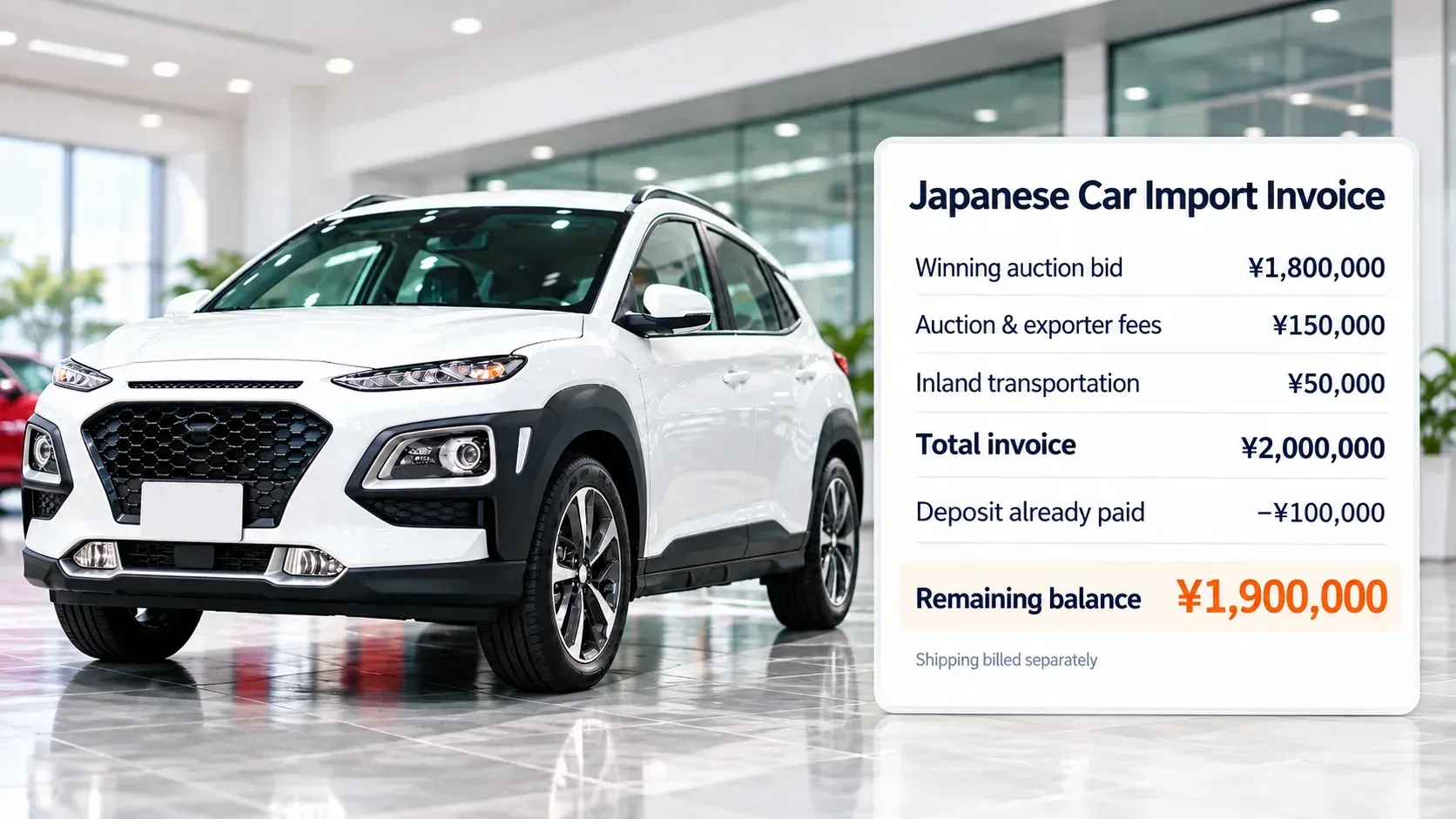
Example: Calculating the final balance after an auction deposit
Suppose you've purchased a Japanese vehicle with the following agreed charges:
In this example, you've already paid ¥100,000, so the remaining exporter payment is ¥1,900,000.
You should not pay the full ¥2,000,000 again if the deposit has been credited. Confirm that the deduction appears on the final invoice.
Shipping is assumed to be billed separately in this example. If it is already included in the exporter invoice, it should not be added again when calculating your budget.
Are there more payments after the exporter is paid?
Yes. Settling the exporter invoice doesn't necessarily mean you've paid the full cost of getting the vehicle onto Canadian roads.
You may still need to cover ocean freight if separately invoiced, destination port charges, customs duties, taxes, brokerage, inspections, transportation within Canada and registration.
Keep some room in your budget for these expenses so the car's arrival doesn't create unexpected financial pressure.
How can you avoid payment mistakes when importing a car from Japan?
Buying a car overseas often means transferring a substantial amount of money to a company you've never dealt with in person. A few checks before payment can help you avoid costly problems.
- Verify the exporter before sending money. Check its company details, contact information and business history. The Japan Used Motor Vehicle Exporters Association member directory can help you check whether a company claiming membership appears in the association's records.
- Check the invoice carefully. Make sure the recipient name, account details, currency, vehicle information and outstanding amount match your agreement.
- Confirm the treatment of your deposit. If the deposit should be deducted from the purchase price, make sure the credit appears before transferring the balance.
- Plan around banking deadlines. Don't assume a transfer initiated today will reach Japan the same day. Processing times can vary, particularly around weekends and holidays.
- Be cautious about payment instruction changes. Unexpected requests to send money to a different bank account deserve independent verification. The exporters' association also warns buyers about fraudulent payment instructions.
- Keep your records organized. Save your auction confirmation, invoice, deposit receipt, transfer confirmation, shipping documents and customs paperwork.
These checks are useful whether you're importing a Japanese sports car, a compact vehicle or a classic JDM model.


From the auction floor to your driveway: Make every payment count
Importing a car from Japan can be an exciting way to purchase a vehicle that's difficult to find in Canada. But between winning the auction and receiving the keys, several financial decisions can affect what you ultimately pay.
Start by checking the vehicle's eligibility and understanding the full purchase agreement. Know how your auction deposit works, when the exporter expects payment and which costs are still outstanding after settlement.
Just as importantly, plan your currency conversion before the payment deadline arrives. Even a modest CAD to JPY movement can make a noticeable difference when you're transferring thousands of dollars.
Ready to pay for your Japanese car import? Choose MTFX
MTFX has helped Canadians manage international money transfers since 1996. With competitive CAD to JPY exchange rates and secure online transfers, you can arrange an eligible exporter payment with greater visibility into the cost.
Check your rate and send money to Japan when you're ready to settle your invoice. Also, register with MTFX to send your payments to Japan.
FAQs
1. Can I import a car from Japan to Canada if it is less than 15 years old?
Most used Japanese-market vehicles under 15 years old cannot be permanently imported through the usual age-exempt route. Certain exceptions may exist for qualifying vehicles, but eligibility must be established before purchase. Check federal requirements and provincial registration rules before making a commitment.
2. How much deposit do I need for a Japan car auction?
The required Japanese car auction deposit depends on the auction agent. Some ask for a fixed deposit, while others calculate it using your maximum bid. Confirm the amount, refund terms and whether it will be deducted from the final purchase invoice.
3. Can I get my Japanese car auction deposit back if I don't win?
You may be able to receive a refund if you don't win, depending on your auction agent's agreement. Some agents also allow unused deposits to be applied to future bids. Ask about refund conditions and any applicable fees before transferring the money.
4. How long do I have to pay after winning a Japanese car auction?
Your payment deadline depends on the exporter or auction agent. Some require settlement within a few business days, while others use different terms. The invoice or purchase agreement should specify when payment must be received and any consequences of missing the deadline.
5. Can I pay a Japanese car exporter in JPY from Canada?
Yes, you can arrange eligible international transfers from Canada with the recipient receiving Japanese yen. Confirm the exporter's invoice currency and bank details before sending. If the invoice is issued in another currency, such as USD, follow the agreed settlement instructions.
6. What bank details do I need to send money to a Japanese car exporter?
You'll generally need the recipient's registered name, bank name, branch details, account number and SWIFT/BIC code where required. The exporter or payment provider may also request an address, invoice reference or other banking information to process and identify the payment.
7. Does the Japan car auction price include shipping to Canada?
Not necessarily. The winning bid usually identifies the auction purchase price, while shipping arrangements depend on the quotation and contract. Check whether inland transportation, ocean freight, insurance and other export charges are included before calculating the full import cost.
8. What documents do I need to clear a Japanese car through Canadian customs?
Documents commonly include the commercial invoice, Japanese export certificate, bill of lading and evidence establishing vehicle identity and age. Additional documentation may be required depending on the vehicle and import arrangement. A customs broker can help confirm the requirements for your shipment.
9. How can I reduce currency conversion costs when buying a Japanese car?
Compare the total CAD cost of delivering the required payment rather than looking only at transfer fees. Review the provider's exchange rate margin, additional charges and payment timing. Planning your conversion before the invoice deadline can also help you avoid rushed decisions.
Disclaimer: This article is for general informational purposes only and does not constitute legal, tax, customs or financial advice. Vehicle import eligibility, auction terms, duties, taxes, exchange rates and transfer fees may vary. Always verify current requirements with Transport Canada, CBSA, your provincial registration authority and your Japanese exporter before making a purchase or payment. Any financial examples are illustrative and do not represent guaranteed exchange rates or actual transaction costs.